How To Elope at Dead Horse Point State Park (Your Complete Utah Guide)
There’s a moment that happens at Dead Horse Point I’ve watched play out with nearly every couple I’ve photographed there. You pull up, step out of the car, walk toward the rim, and go quiet. Not nervous quiet. Just taking it in quiet.
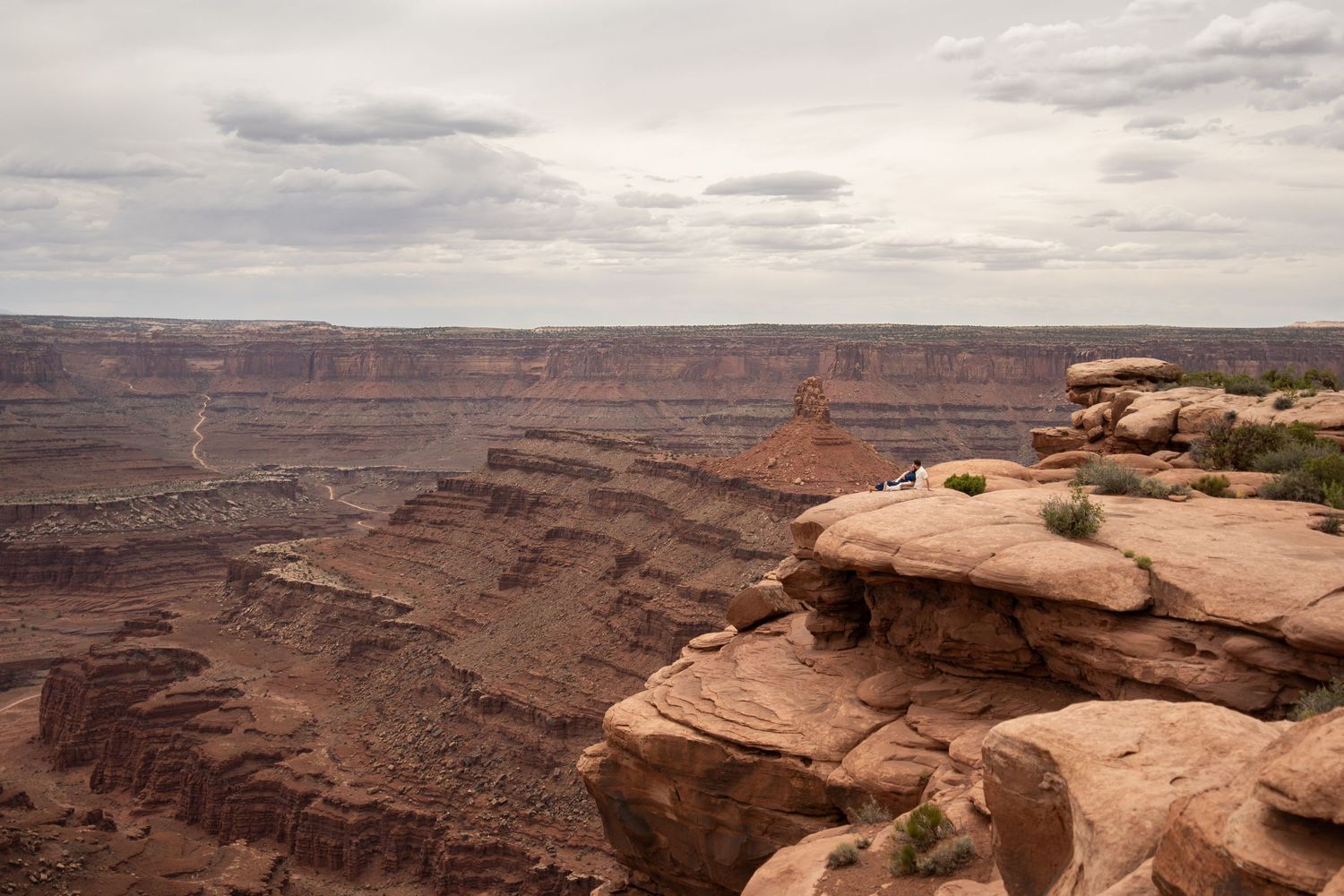
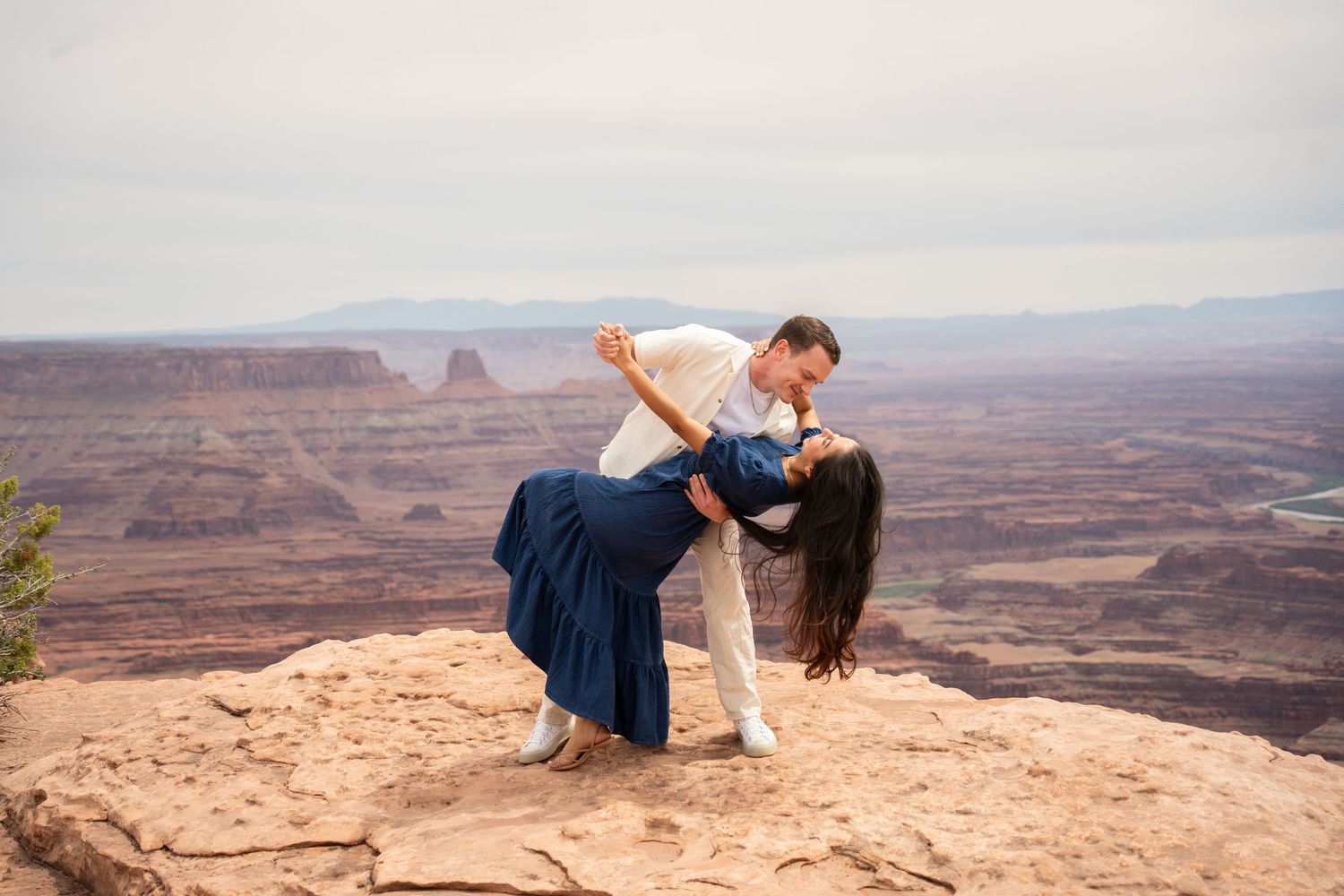
2,000 feet below you, the Colorado River snakes through one of the most recognizable bends in the American West, Canyonlands spreading out beyond it in every direction. Standing there with your favorite person, about to promise them forever, it feels every bit as big as it looks in the photos.
This guide walks through everything that goes into eloping here: the permit and what it costs, all five ceremony sites and who each one fits best, month-by-month timing, the marriage license paperwork, and the small logistics (drones, dogs, decor, dogs again because people always ask twice) that trip couples up when they’re planning from somewhere else.
TL;DR
A Special Use Permit is required for any elopement, any group size; a typical two-person ceremony runs about $180 in park fees.
Five ceremony sites range from the 5-person Point Bench to the 100-person, ADA-accessible Shade Shelter.
Apply 1 to 18 months ahead; spring and fall dates fill fastest, and Memorial Day Weekend isn't approved for ceremonies at all.
Utah marriage licenses stay valid for 32 days, with no waiting period, issued anywhere in the state.
Utah law requires two witnesses plus a licensed officiant for the ceremony itself.
Elopement packages start at $3,100, and travel anywhere within Utah, Dead Horse Point included, is already built into every package.
Why Dead Horse Point Is One of the Best Places to Elope Near Moab, Utah
Dead Horse Point State Park sits on a mesa in southeastern Utah, about 32 miles from Moab, a 40-minute drive that already feels like an adventure before you've said a word to each other about vows. It's a smaller portion of the greater Canyonlands landscape, but it offers what I'd call the most expansive view of the canyon country this part of Utah is known for: layer after layer of geological time, with the Colorado River threading through it 2,000 feet below.
The mesa itself is shaped like a peninsula, which is a bigger deal for your ceremony timing than it sounds. Because it juts out with open sky on both sides, the best sunset viewpoints line the West Rim Trail and the main overlook, while the strongest sunrise spots sit just west of that same overlook. Most parks force you to pick one lighting window and build the whole day around it. Here, both work, so your ceremony time can follow your travel schedule instead of the other way around.
It also sits at 5,900 feet, nearly 1,900 feet higher than Moab's valley floor, which means the air runs noticeably cooler up here. On a June afternoon when Moab town is pushing 95°F, the mesa often reads several degrees milder, and that gap is a big part of why couples choose Dead Horse Point over a lower-elevation spot for a summer ceremony.
Less crowded than Canyonlands, more intimate than Arches
Dead Horse Point doesn't get nearly the foot traffic of its famous neighbors, which means more privacy for your ceremony and a feeling of having the landscape largely to yourselves, especially if you time it right. It's also a certified dark sky park: a sunset ceremony followed by stargazing and night portraits is one of my favorite ways to spend an elopement day here.
The park doesn't ask anything of you beyond showing up and being present. No seating chart, no centerpieces, no fifty-person guest list to manage. Just the two of you, your witnesses, and the widest view in southeastern Utah.
Tell Me Your Date and Your Vision
Give me your travel window and how many people are coming, big family gathering or just the two of you, and I'll help you match a ceremony site and season to what you're picturing.
The Story Behind the Name (Because Couples Always Ask)
Dead Horse Point gets its name from its history as a natural corral: cowboys would drive wild mustangs onto the narrow mesa, using the sheer cliff edges as barriers to keep them contained. Local legend holds that one group abandoned a herd here and couldn't get back in time, and the horses died of thirst, surrounded by the Colorado River 2,000 feet below. A haunting name for one of the most beautiful places in Utah, worth mentioning to your guests when you arrive, and a story that tends to make the view hit even harder once you know it.
Do You Need a Permit to Elope at Dead Horse Point?
Yes, and this is the single most important logistical detail to know: all weddings and elopements here require a Special Use Permit, no matter how small your group, even if it's just the two of you and an officiant. It's a manageable process, and as your photographer, I coordinate the permitting details with you. Here's what it involves.
What a Dead Horse Point elopement permit costs
For a typical elopement (just the two of you, an officiant, and your photographer), you're looking at a $60 permit fee plus $100 an hour for your ceremony site and $20 per vehicle at the gate. Add a longer site window or a bigger group and the site fee scales with your hours, but the permit fee itself stays flat regardless of headcount.
That $180-ish figure covers only the park's own charges. Your photographer, officiant, marriage license, and anything extra (florals, hair and makeup, a picnic spread) sit on top of it, which is why most couples end up budgeting $2,000 to $5,000 or more for the complete day, not just the permit line item.
How far in advance do you need to apply?
The park accepts Special Use Permit applications anywhere from 1 month to 18 months before your date. Spring and fall dates fill fastest, so don't wait if you want golden October light or wildflower season; apply as soon as your date is set. One firm exception worth knowing up front: the park doesn't approve wedding or elopement applications for Memorial Day Weekend at all, since visitation is already at its peak that weekend without a ceremony added to the mix.
Applications go through the park's Weddings/Elopements Special Use Permit application, a short online form. For availability questions or anything permit-related, the park's Assistant Park Manager, Elizabeth Cappa, handles them directly at ecappa@utah.gov or 435-259-2614. As of 2025, photographers shooting commercially here also need their own separate permit, either a single-session application or a renewable five-session punch card backed by a certificate of insurance, which I already carry and handle on my end so you never have to think about it.
Getting your Utah marriage license
Utah marriage licenses are issued statewide, so you can get yours anywhere in Utah, even in Salt Lake City before the drive south, and use it at Dead Horse Point in Grand County. Once it's in your hands, it's valid for 32 days with no waiting period, so don't buy it too far ahead of your ceremony date or you'll need a new one. Utah also requires two witnesses in addition to your licensed officiant, a detail that catches "just the two of us" couples off guard until they realize it just means bringing along two people who care about you both.
What day-use entry costs
Separate from your wedding permit, everyone driving into the park pays the standard day-use fee: $20 per private vehicle (covers up to 8 people), $15 for Utah seniors 65 and older, $10 for motorcycles, $5 per person for commercial vehicles, or $10 per group of up to 4 walk-ins or cyclists. If you're the type to come back to Utah's state parks again, an annual pass runs $125 for Utah residents under 65 or $65 for residents 65 and older, though that pass is separate from your wedding permit and doesn't replace it.
Wedding permit fee: $60 flat, plus $100/hour for your ceremony site.
Day-use gate fee: $20/vehicle (up to 8 people), on top of the permit.
Application window: 1 to 18 months ahead; not approved for Memorial Day Weekend.
Marriage license: Issued statewide, valid 32 days, no waiting period.
Every Dead Horse Point Fee in One Place
Between the wedding permit and the park's own day-use rates, here's every number laid out together so nothing surprises you when you sit down to budget.
Fee
Amount
Applies to
Special Use Permit application
$60
Every wedding or elopement
Ceremony site time
$100/hour
Every wedding or elopement
Day-use vehicle entry
$20 (up to 8 people)
Every vehicle at the gate
Motorcycle entry
$10
Motorcycle arrivals
Utah senior (65+) vehicle rate
$15
Utah resident seniors
Walk-in / bike-in (per group of 4)
$10
No-vehicle arrivals
Photographer's own commercial permit
Separate SUP required
Hired photographers (I handle this)
RV campsite (peak season)
$60/night
Optional overnight stay in the park
Hike-in tent site (peak season)
$45/night
Optional overnight stay in the park
Yurt (standard rate)
$150/night
Optional overnight stay in the park
Peak-season camping and yurt rates apply March through June and September through October; off-peak rates (plus a discounted $100/night yurt rate in July, December, and January-February) apply the rest of the year. Fees and rules change, so verify current pricing with the park before you travel.
Dead Horse Point Elopement Ceremony Sites: Where to Say Your Vows
What I love most about Dead Horse Point is the choice: five designated ceremony sites, each with its own personality, terrain, and headcount limit. Here's my take on each one, in depth.
Cliff Side: most dramatic, best for intimate groups
Cliff Side sits on the park's southwest side, tucked apart from the other four sites, and it's my favorite for a true elopement feel: more isolated than the other locations, with a raw, exposed energy that makes everything feel cinematic. The uneven surface means it's not the most accessible option, and it maxes out at 20 people, but for a couple eloping with just a handful of guests, it's unmatched. The exposure means wind, so plan for that with hair, florals, and veils, and know that a longer veil or a loose bouquet wrap can turn into its own small production in a stiff breeze. Morning tends to run calmer here than afternoon, when thermal winds off the canyon pick up, so if wind is a serious concern for your dress or veil, an earlier ceremony time is the safer call.
I'd steer families with mobility concerns or very young kids elsewhere; the payoff here is drama, not ease of access. But if the two of you (plus a small circle) want the rawest version of this landscape, this is the site I point couples toward first.
Capacity: Up to 20 people.
Terrain: Uneven, exposed rock; not the most accessible site.
Best for: Just the two of you, or an intimate group who wants isolation and drama.
Watch for: Wind. Plan hair, veils, and florals accordingly.
West Bench: easy access, incredible view, up to 50 guests
West Bench sits centrally on the park's south end and is the most popular ceremony site in the park: easy access (great for older guests or anyone with mobility considerations), a breathtaking view, and room for up to 50 people. The trade-off is that it's also the favorite viewpoint for regular park visitors, so you'll share the space with passersby, most of whom end up quietly touched by the moment rather than intrusive. A few strangers pausing to watch two people say their vows tends to add to the moment more than it takes away, in my experience, but it's worth knowing going in if total privacy matters to you.
If your guest list runs 30 to 50 people, West Bench is the strongest fit in the park: nowhere else combines that capacity with this little walking.
La Sal Site: scenic with a view of the mountains
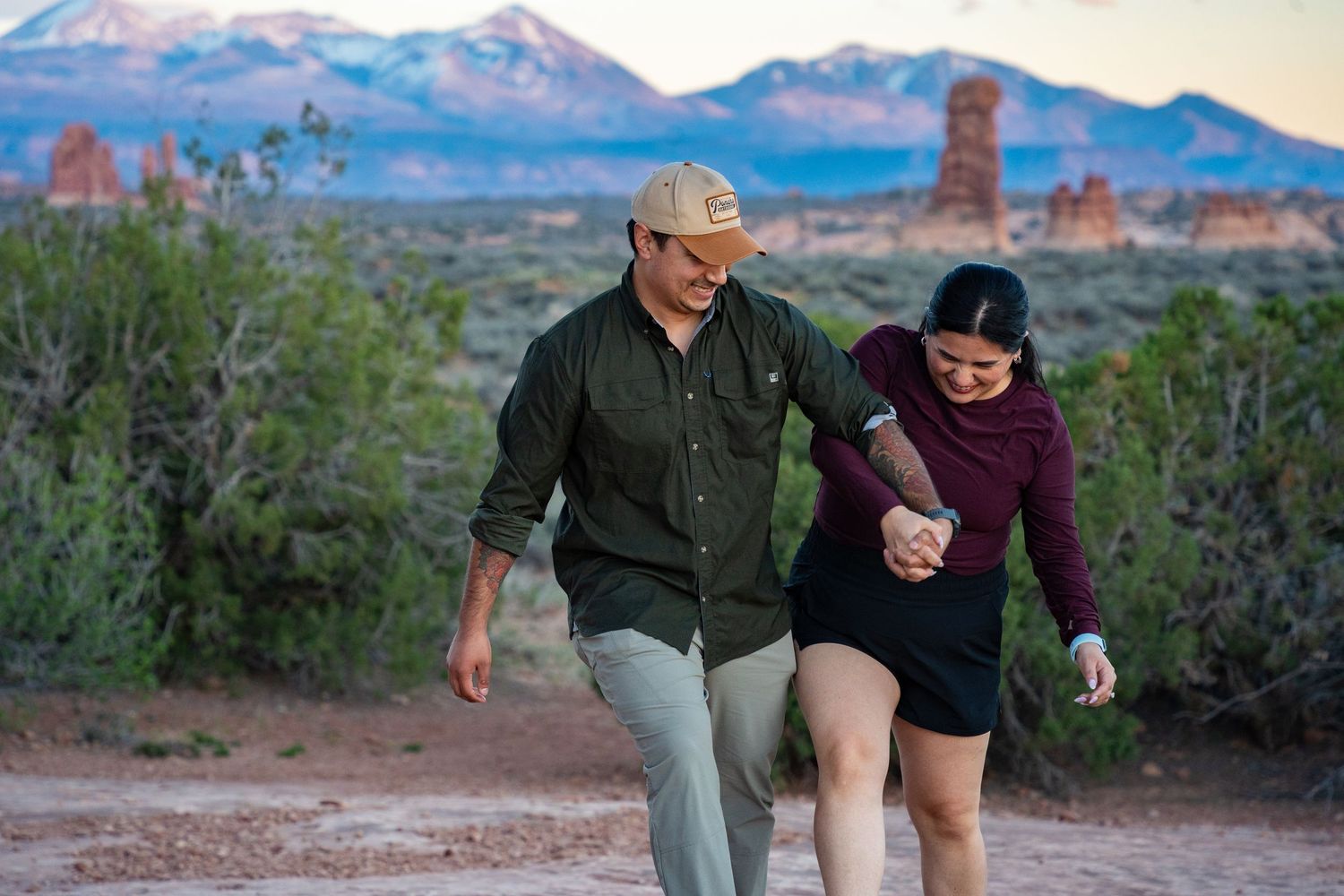
La Sal accommodates up to 25 people on an uneven, sloping surface, with the La Sal Mountains visible to the east on a clear day: red rock canyon in the foreground, snow-capped peaks behind you. It's a distinctly different look from the other four sites, and one I recommend to couples who want their photos to read as unmistakably Utah rather than generic desert.
West Bench capacity: Up to 50 people; easiest access of all five sites.
West Bench tradeoff: Shared with regular park visitors passing through.
La Sal capacity: Up to 25 people, uneven and sloping terrain.
La Sal view: Mountains and canyon in the same frame on a clear day.
Point Bench: intimate and easy to reach, tiny group only
Point Bench is built around a literal stone bench overlooking the canyon, and it has easy access and great views, but it caps out at 5 people: you, your partner, an officiant, and two witnesses. Given Utah's two-witness requirement, that's not a small-print limitation, it's the headcount most true two-person elopements need anyway. No audience, just the canyon and the five of you.
Shade Shelter: ADA accessible, largest capacity, chairs allowed
The Shade Shelter is the only fully ADA-accessible site, the only one where chairs are permitted, and it holds up to 100 people under a covered structure. It's only bookable January-February, July-August, and November-December: not available March-June or September-October, the park's two busiest shoulder seasons. If a family member needs a wheelchair-accessible ceremony space or you want the security of shade during a summer booking, this is the one site built for that, but plan your date around its limited booking window rather than assuming it's open year-round.
Point Bench capacity: Up to 5 people, the most private option.
Shade Shelter capacity: Up to 100 people, ADA-accessible, chairs allowed.
Shade Shelter closed: March-June and September-October.
Important Park Rules Before You Go
Live and cut flowers are allowed (avoid Pampas Grass and other invasive species), but tossing seeds, confetti, or rice isn't. Dogs are welcome under standard park rules as long as they're leashed and cleaned up after. Amplified music and open flames aren't allowed at ceremony sites. Drones are banned March through October; November through February requires the drone operator's own separate Special Use Permit, on top of your wedding permit, and that requirement applies to any operator, guest or hired professional, not just a stranger flying one for fun. Most sites have uneven terrain, so the Shade Shelter is your best bet if anyone needs ADA access. Decor rules follow leave-no-trace principles across the board: nothing attaches to the rock with nails, tacks, or adhesive, and anything you bring in leaves with you at the end of the day.
One rule that surprises couples: alcohol is allowed at a privately hosted wedding, but only under specific conditions. You (the host) have to provide it at no charge to guests, it needs to be purchased in Utah, only your invited guest list gets served, no one under 21 is served, and you'll need liability insurance if alcohol is being served at all. Champagne specifically is not permitted inside the park, full stop, so if a champagne pop is part of how you pictured celebrating, save it for the drive back to Moab or your dinner reservation instead.
Best Time of Year to Elope at Dead Horse Point, Month by Month
You can elope here any time of year, with ceremonies allowed daily from 6am to 10pm. Dead Horse Point sits a few thousand feet higher than Moab's valley floor, so it runs a touch cooler than the numbers you'll see quoted for the town itself, but the overall seasonal pattern tracks closely with the rest of southeastern Utah.
January: Cold and quiet, with an occasional dusting of snow on the red rock that photographs beautifully against the canyon color. Trails and viewpoints are close to empty. The Shade Shelter is bookable this month if you want a larger, covered gathering; dress for full winter regardless of which site you choose.
February: Similar to January, still cold, still quiet, with days slowly stretching longer. Another month the Shade Shelter is open, so it's a strong pick if you're planning a bigger family ceremony without summer's heat.
March: Temperatures start climbing and the park wakes up. The Shade Shelter closes for the season starting this month, so if you want that specific site, lock in January or February instead. Spring booking demand starts ramping up here too.
April: One of the two truly ideal months for comfort: mild days, cool mornings, and some of the best light of the year. It's also one of the most in-demand months for a permit, so apply well ahead if this is your window.
May: Warm and increasingly busy, with heat becoming a bigger factor by the back half of the month. Morning ceremonies start to make more sense than afternoon ones as the month goes on.
June: Heat is the defining factor from here through August. A sunrise ceremony is worth it: you'll get there while it's cool, catch spectacular morning light, and be off the mesa before the worst of the afternoon sets in.
July: Regularly exceeds 95°F in the middle of the day, with serious risk of sunburn and heat exhaustion if you're not planning around it. The Shade Shelter reopens this month, useful if your ceremony needs to happen midday regardless of temperature. Afternoon monsoon storms are common too, dramatic to watch from a distance, not something you want to be caught in mid-ceremony.
August: Still firmly summer heat, same sunrise-or-bust logic as June and July applies. The Shade Shelter stays available this month as well.
September: Heat starts to ease and crowds thin slightly after Labor Day, though the Shade Shelter closes again starting this month. A solid in-between window if you want to skip both peak summer heat and peak fall demand.
October: My personal favorite: mild, less windy than spring, thinner crowds than the busiest months, and light with a warmth that makes everything glow. It's just as popular with other couples for these same reasons, so book early if October is your target.
November: Cooling down fast, quieter trails, and the Shade Shelter reopens for the season if you want that covered, ADA-accessible option again.
December: Cold and hushed, with the park close to empty most days outside the holiday week. The Shade Shelter remains bookable. Good news if seclusion matters more to you than mild weather, though come dressed for true winter conditions at elevation.
Found Your Season? Let's Lock In the Site
Once you know roughly when you're coming, the next call is matching your guest list and vision to one of the five ceremony sites, then getting your permit application moving before your ideal window fills.
How to Plan Your Dead Horse Point Elopement: My 3-Step Process
Planning an elopement here from out of state doesn't have to mean months of back-and-forth with a park office you've never dealt with before. Here's how it works once you reach out.
Step 1
Tell Me Your Date and Guest Count
Once you know roughly when you want to elope and how many people are coming, that's the only piece I need from you to start. I'll match your headcount to the right ceremony site (Point Bench for the two of you, West Bench if family's flying in, Shade Shelter if it's winter or summer and you want coverage) and flag if your ideal month is one that fills fast.
Step 2
I Handle the Permit Coordination
I walk you through the Special Use Permit application, confirm your site and time window, and make sure my own commercial photography permit is squared away so there's no gap on the day. You'll still need to get your Utah marriage license yourself, but I'll tell you when to pick it up so the 32-day window lines up with your ceremony date.
Step 3
We Build a Timeline Around the Light and Heat
Sunrise, midday, or sunset, your ceremony time gets built around what the season calls for, not a generic default. If you're adding a hike, rafting, or a full adventure day around the ceremony, we work that into the timeline too, so nothing feels rushed on the day itself.
What to Expect on Your Dead Horse Point Elopement Day
Here's the rough shape of an elopement day here, start to finish, so nothing catches you off guard.
MORNING OF
Getting Ready and the Drive In
Most couples get ready near Moab, then make the roughly 40-minute drive up Highway 313 (or the longer, more scenic route via Potash Road and Long Canyon Road, which passes Jug Handle Arch along the way). I'm usually already at the site scouting light and confirming the permit paperwork before you arrive.
ARRIVAL
Getting-Ready or First-Look Photos
If you're doing a first look, this is when it happens, timed so we still have your full ceremony window ahead of us. If not, we go straight into a few quiet portraits before your witnesses and officiant arrive.
THE CEREMONY
Vows, 2,000 Feet Above the River
Your officiant leads the ceremony at your chosen site, inside your permitted time window. I shoot the ceremony candidly, vows, ring exchange, the first kiss, without directing you into poses that make it feel staged.
AFTER
Portraits and Whatever's Next
Once the ceremony wraps, we shoot portraits while the light and your energy are both still good. If you've built rafting, a picnic, or stargazing into the day, this is where the elopement itself hands off to the rest of your adventure.
Making Your Dead Horse Point Elopement a Full Adventure Day
Your elopement doesn't have to be just a ceremony. Instead of driving straight up Highway 313, consider coming in via Potash Road: it winds along the Colorado River before climbing Long Canyon Road to meet Highway 313. It takes longer, but the river views and canyon walls (watch for Jug Handle Arch on the turn) make the drive itself part of the experience.
The Colorado River runs right below Dead Horse Point, and some of the best rafting in Utah is accessible from Moab, so combining a morning ceremony on the mesa with an afternoon on the river makes for a day that can't be replicated anywhere else. A helicopter tour of Canyonlands and Dead Horse Point is also surprisingly accessible from the nearby Moab airport, a memorable way to see the same landscape from the air. And since Dead Horse is a dark sky park, staying into the evening for stargazing and night portraits after a sunset ceremony is one of my favorite ways to close out the day.
Getting to Dead Horse Point, Where to Stay & What to Budget
Getting There
Dead Horse Point doesn't have its own airport, so nearly every out-of-state couple routes through Moab or Salt Lake City first. Salt Lake City International Airport is the major hub, about a 4.5-hour drive from the park. Canyonlands Field Airport (CNY), about 18 miles north of Moab, has had smaller-carrier direct flights from Salt Lake City and Denver at various points, worth checking directly since regional schedules change often. However you arrive, plan on at least one overnight in the Moab area before your ceremony so you're rested, not road-weary, for the moment itself.
Where to Stay
Inside the park, Dead Horse Point has camping at the Kayenta Campground (21 sites) and Wingate Campground (31 sites, including hike-in and RV spots), plus Wingate and Moenkopi Yurts for a step up from a tent without leaving the park. Near the park, Moab Under Canvas is an upscale glamping property that puts you close to the entrance without the drive from town. Moab itself, about 40 minutes away, has the widest range of hotels and Airbnbs if you want restaurants and a fuller town experience the night before or after.
Budget Considerations
Beyond your photographer, plan for: the $60 wedding permit fee plus $100/hour of ceremony site time; the $20/vehicle day-use gate fee; your officiant and marriage license; lodging, which swings by season (expect spring and fall rates well above a quiet December night); and gas for the drive in, especially from Salt Lake City. Most couples land somewhere between $2,000 and $5,000 all-in once photography, officiant, license, lodging, and any extras like florals or a celebration meal are added up, well beyond the roughly $180 the park itself charges for a basic two-person ceremony.
Spring and Fall Dates Go First
The park's permit window opens 18 months out, and the best months fill early. If October light or April's mild mornings are what you're picturing, the smartest move is reaching out now, not after your ideal weekend is already booked.
Sturdy shoes matter more than a delicate pair you love. Most of this mesa is uneven rock, and a flat sandal or heel will make the terrain miserable and the photos worse. A supportive sneaker, a block heel, or a light hiking shoe works across nearly every ceremony site here; save anything delicate for a celebration dinner afterward.
Water matters more than people expect, even for a short ceremony. Desert air pulls moisture out of you faster than it feels like at the time, especially above 80°F. Bring more than you think you need for everyone in your party, not just the two of you.
Sun protection is non-negotiable outside the coldest months: most ceremony sites offer little to no shade (the Shade Shelter is the one deliberate exception). A hat, sunscreen, and sunglasses cost you nothing in the photos and save you a bad sunburn on your wedding day.
If you're timing the ceremony around sunrise or sunset, bring a light layer regardless of season. Temperatures swing hard once the sun's off the rock, even on a warm day.
For a winter ceremony, add proper layers: a warm coat, gloves, and traction if you're headed anywhere with shaded, icy sections, plus a vehicle with clearance if snow's in the forecast. Camera batteries handle cold just fine on my end; it's usually the couple's fingers that struggle first, so hand warmers are worth the extra ounce in your bag.
One more note specific to a ceremony: bring your marriage license with you (don't leave it at the cabin or hotel), and decide ahead of time who's holding the rings during the ceremony itself. A small pocket or a witness's bag beats fumbling for it mid-vows.
Which Dead Horse Point Ceremony Site Fits You?
Five sites is a lot to weigh from your couch. Here's the short version: match your priority in the left column to the site that delivers it.
If you want…
Best site
Capacity
Access
Total privacy, just the two of you plus witnesses
Point Bench
Up to 5
Easy
Maximum drama, an intimate group
Cliff Side
Up to 20
Uneven, exposed
Mountains and canyon in the same frame
La Sal
Up to 25
Uneven, sloping
Family flying in, easiest walk to the rim
West Bench
Up to 50
Easy
Chairs, ADA access, the biggest group
Shade Shelter
Up to 100
Fully accessible
Why Book Someone Who Already Knows This Mesa
Permitting handled, not explained. I coordinate your Special Use Permit application and keep my own commercial photography permit current, so you're not learning a state park's paperwork from scratch.
Every site scouted in every season. I know which sites catch first light, which hold up in wind, and which one to steer a family with mobility needs toward before you ask.
A timeline built around the actual heat and light of your season. Summer sunrise, winter's shorter days, the wind at Cliff Side in spring, all of it gets planned around rather than discovered on your ceremony day.
License timing you don't have to track yourself. I'll tell you when to pick up your Utah marriage license so the 32-day window lines up with your date, not before, not after.
One quote, no surprises. Travel to Dead Horse Point is factored into your number upfront, on a planning call before you book anything.
Dead Horse Point Elopement Photos
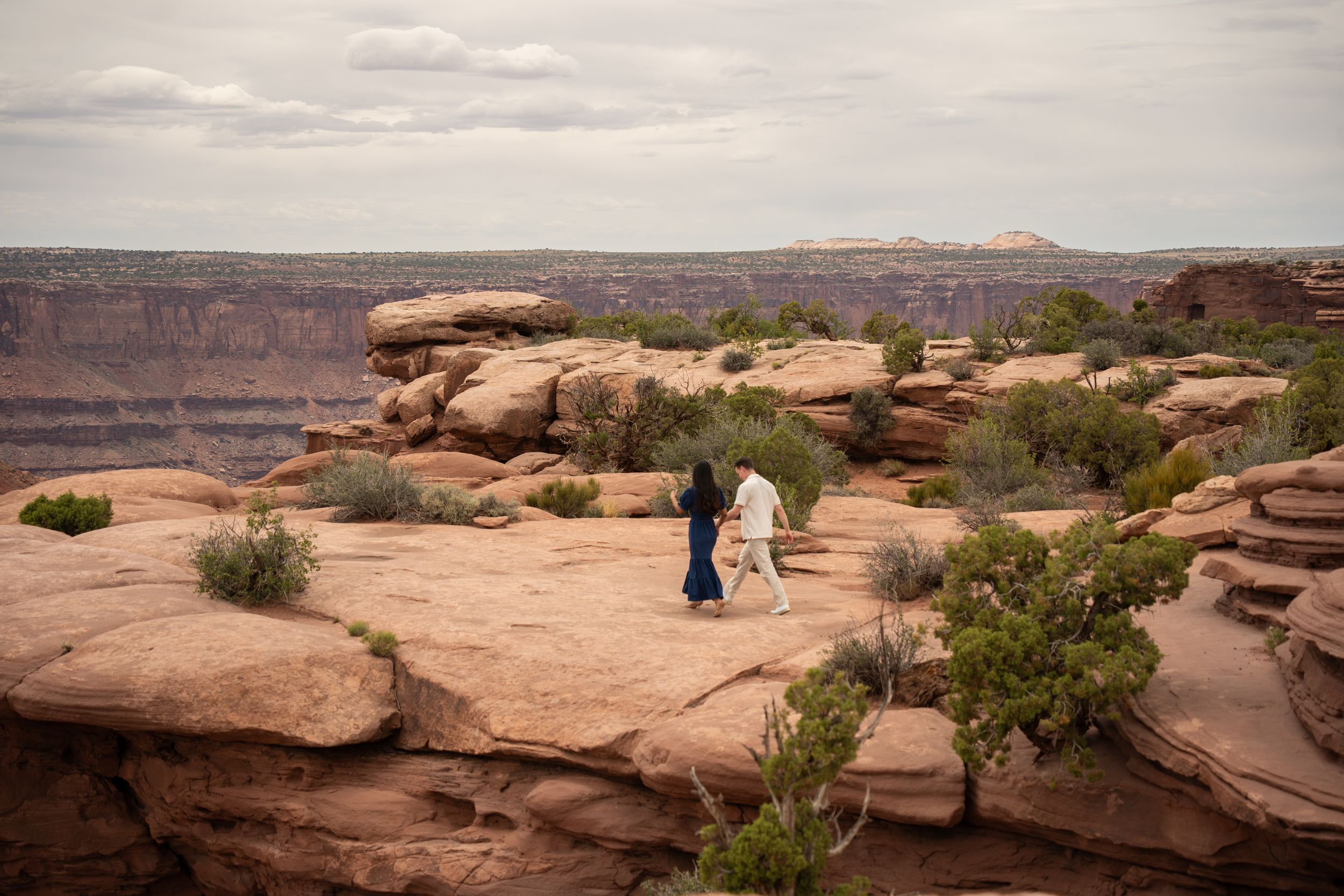
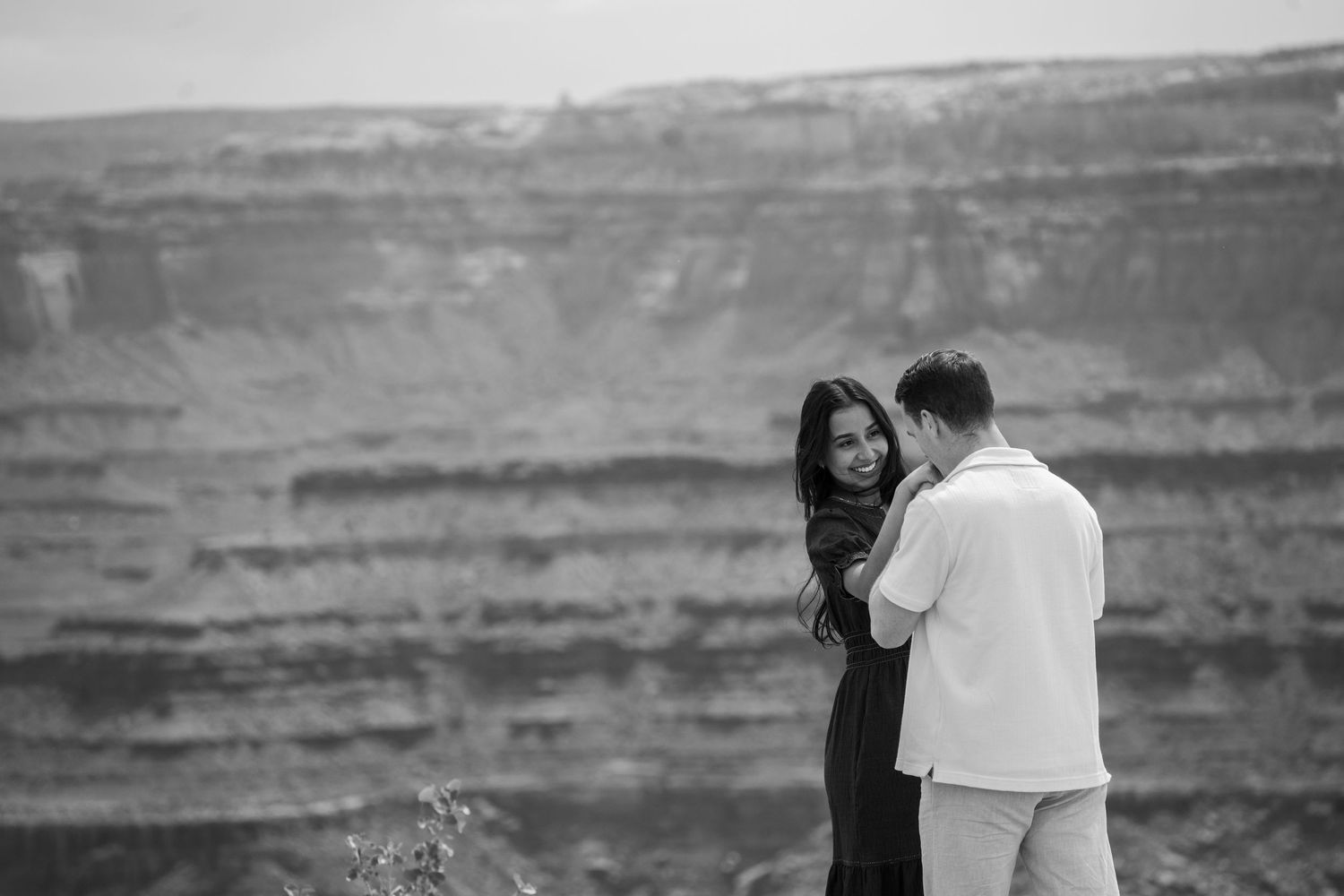
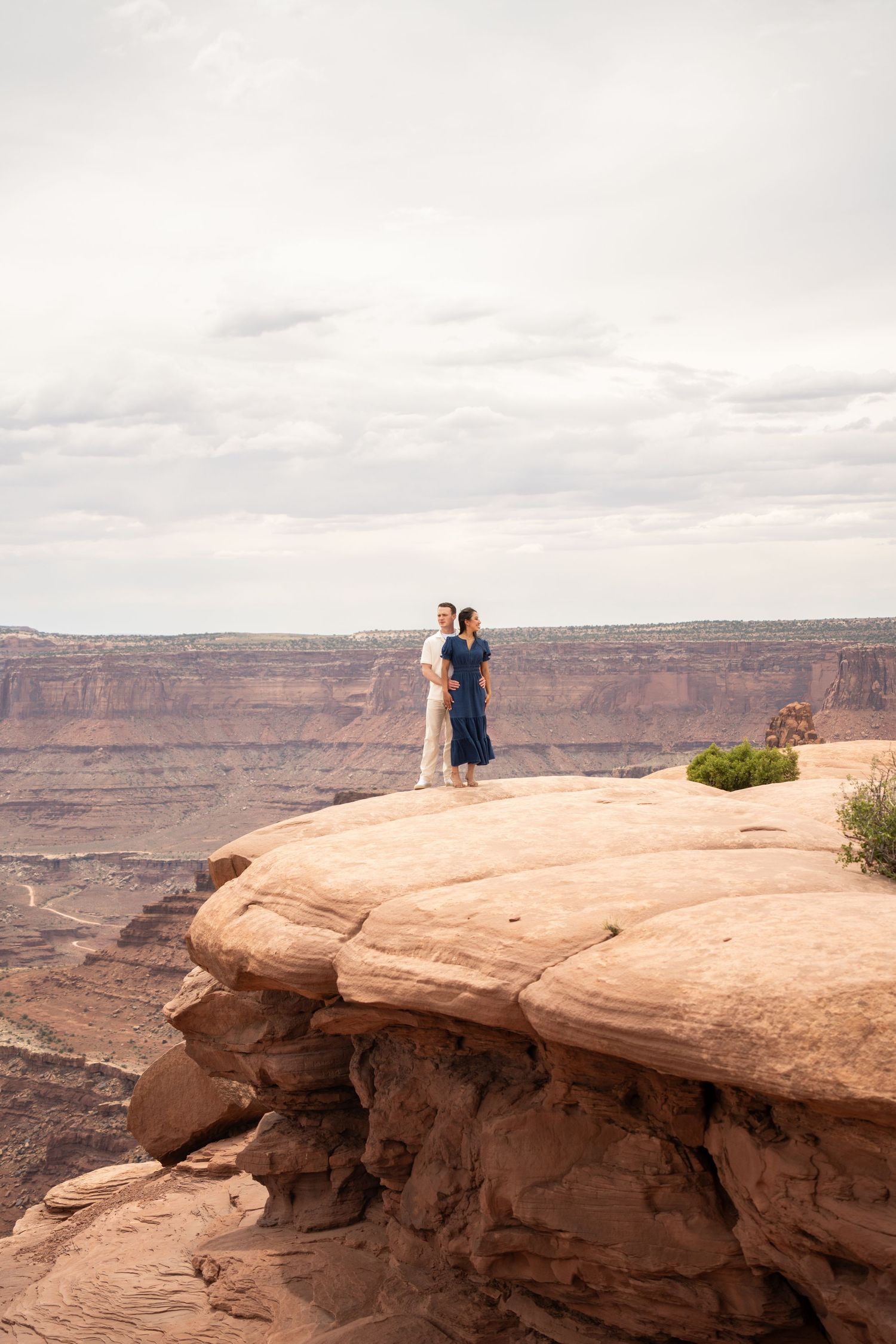
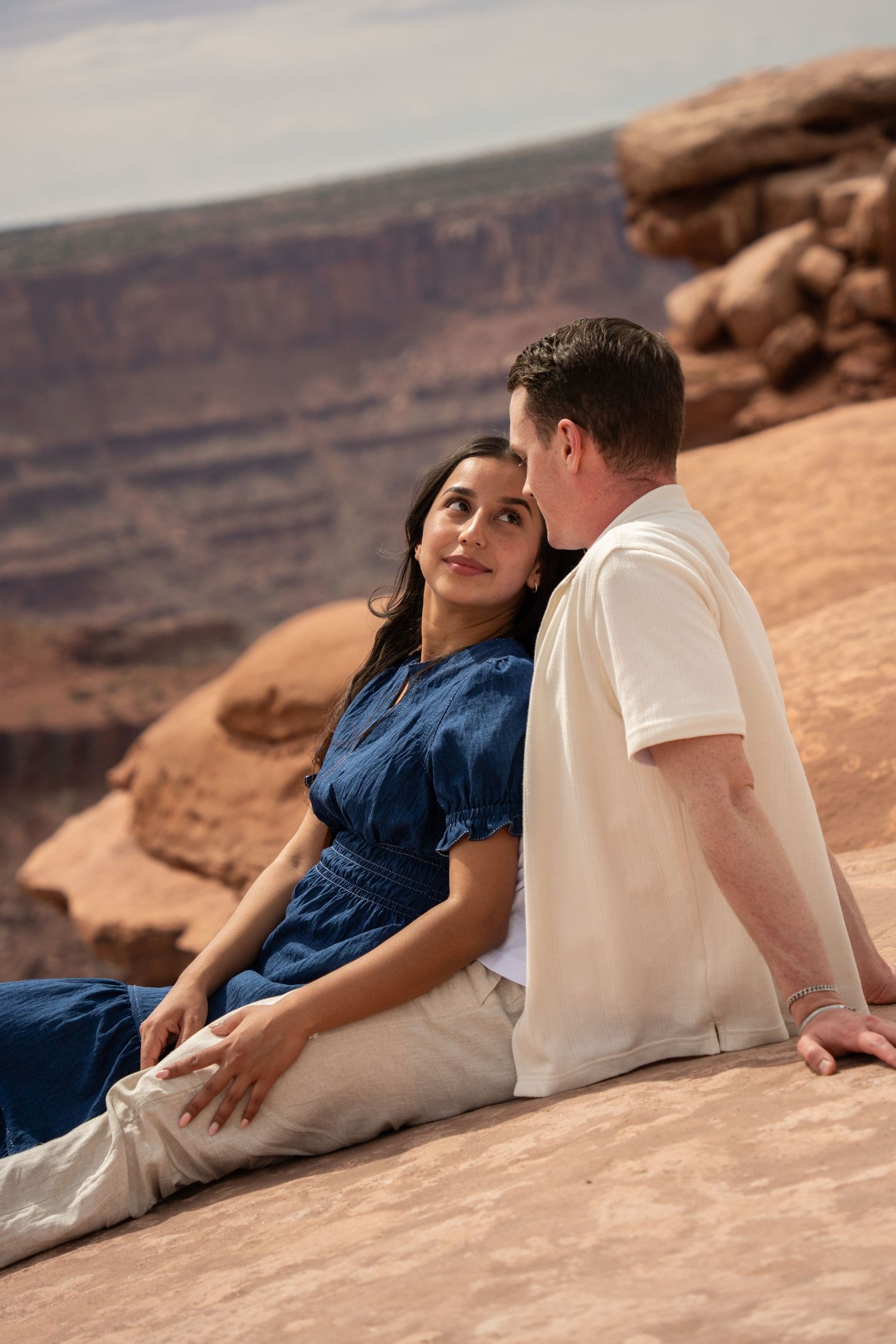
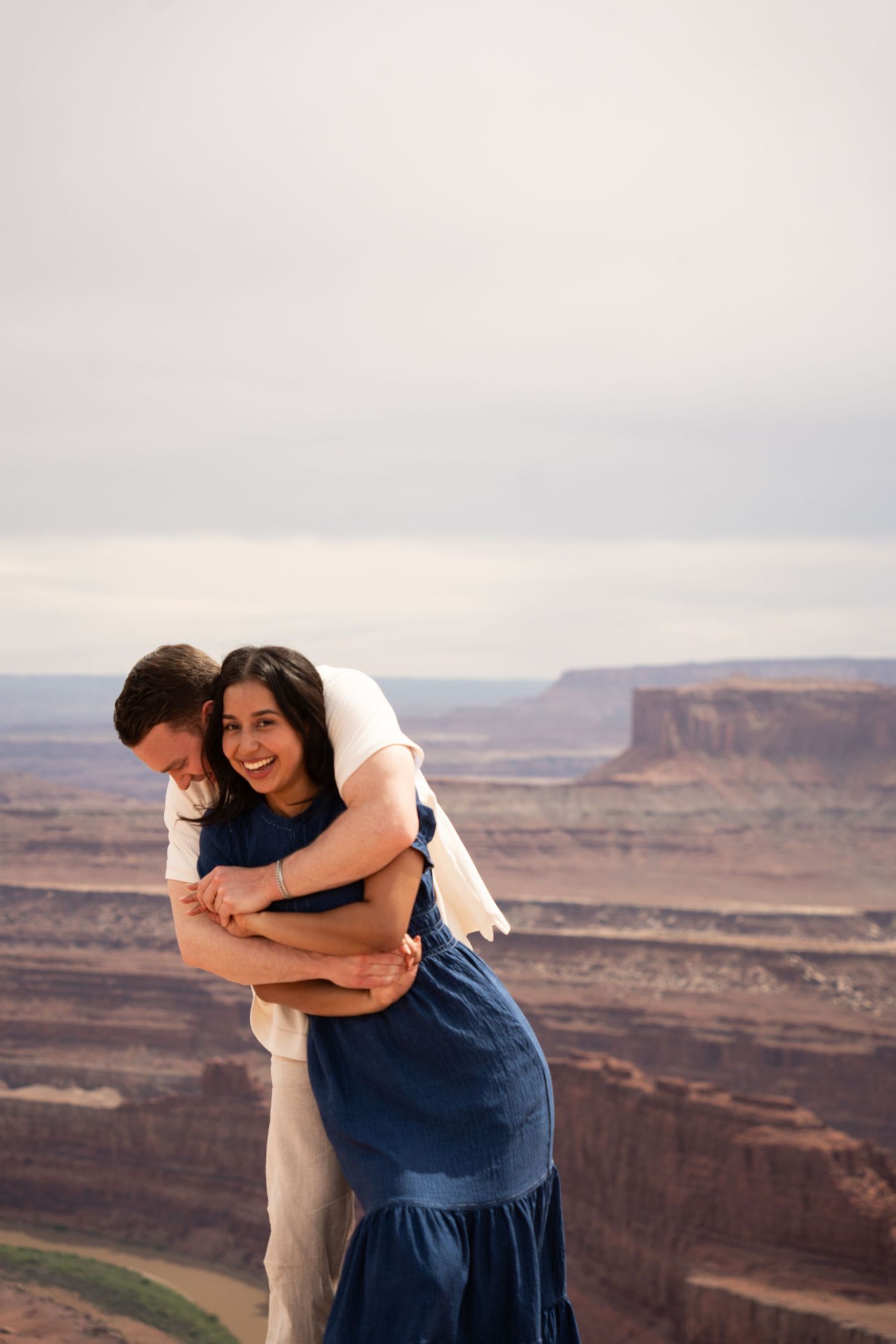
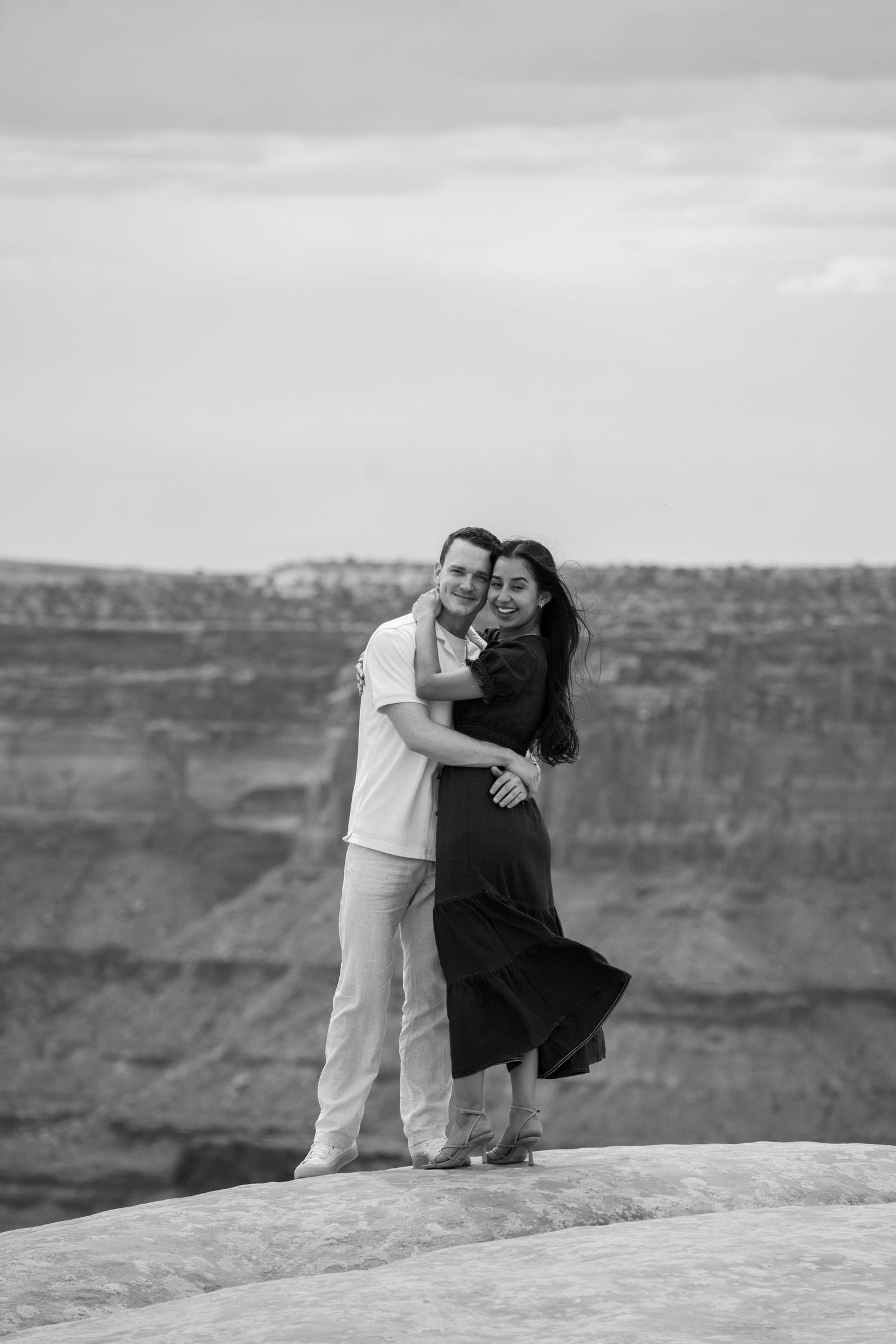
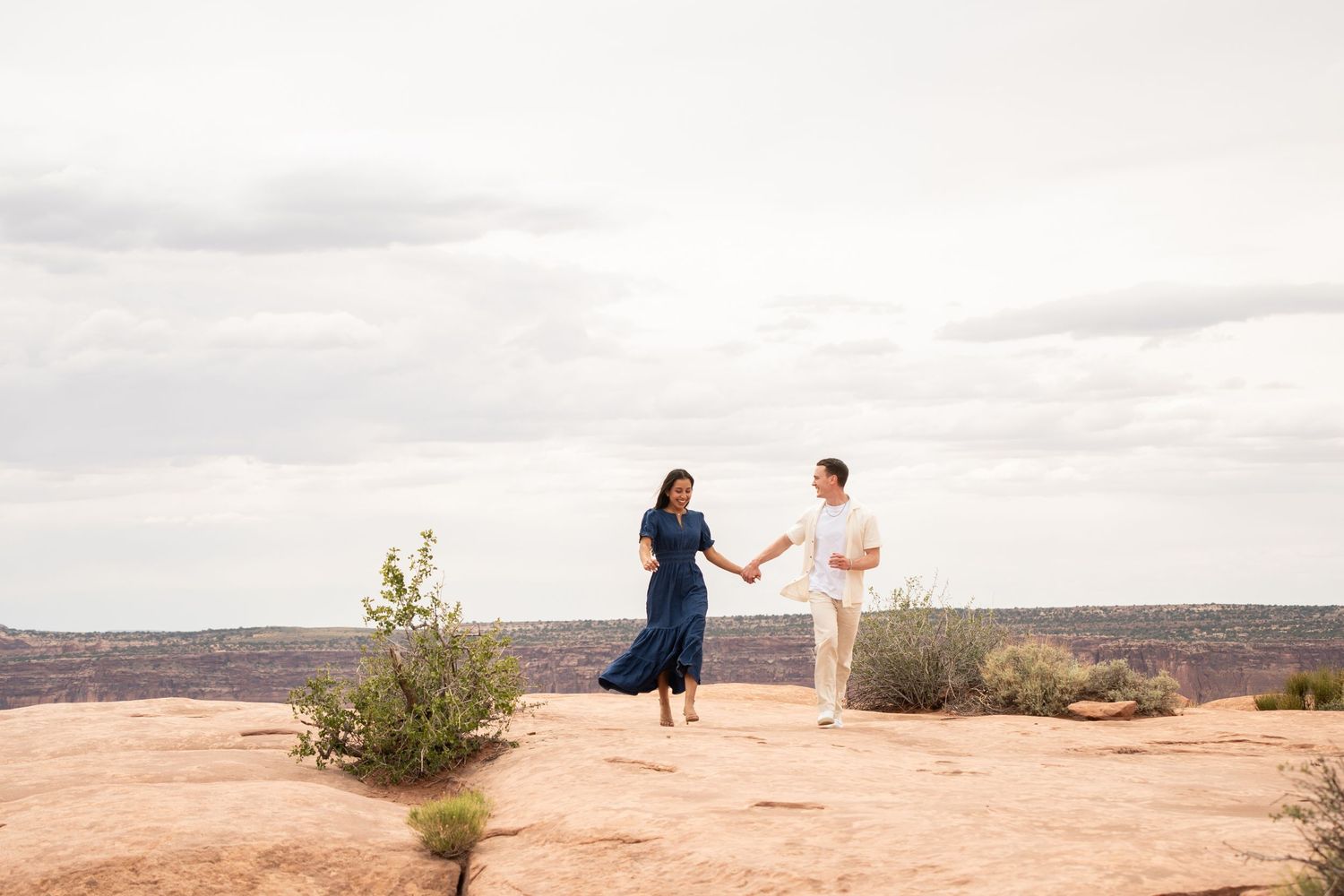
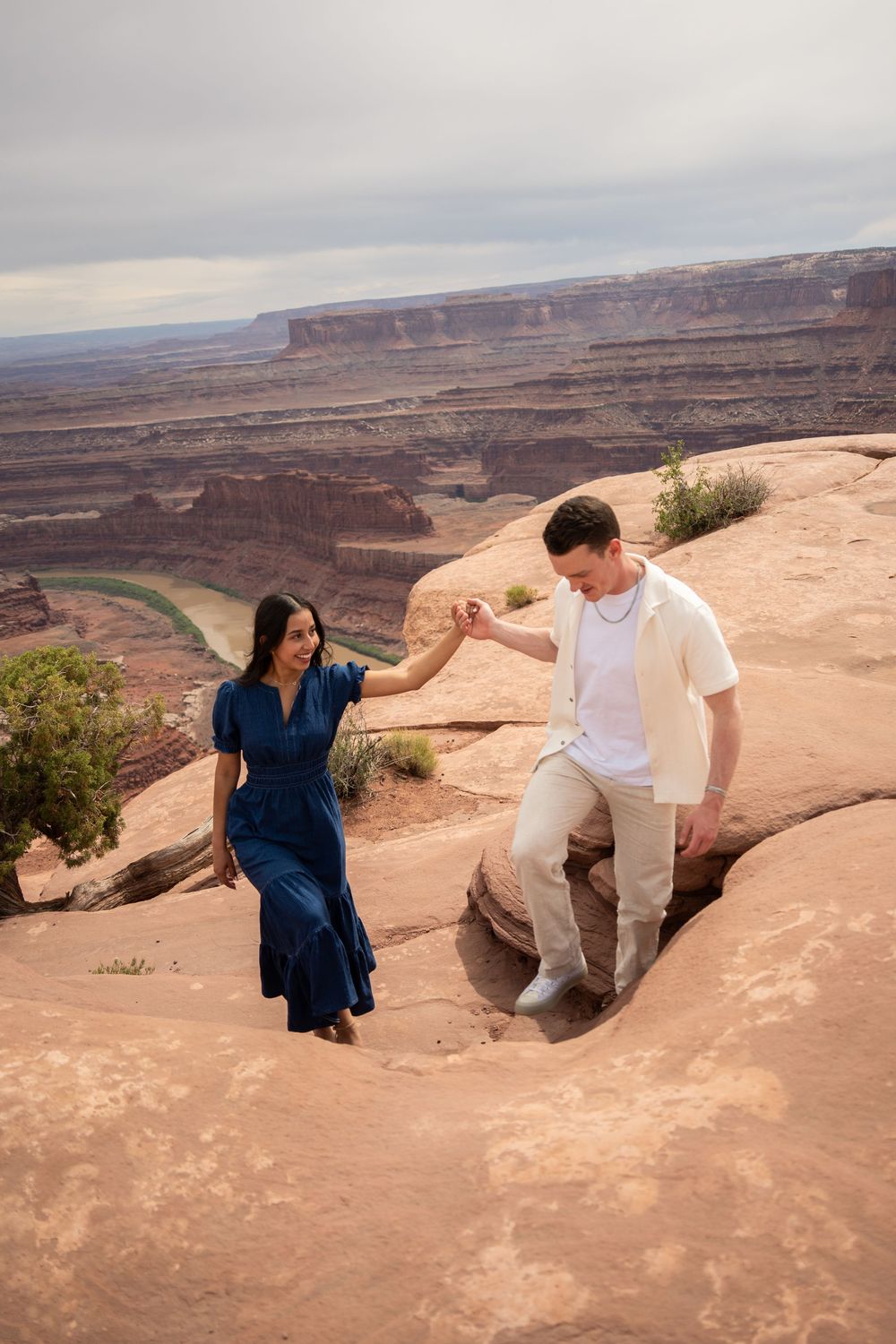
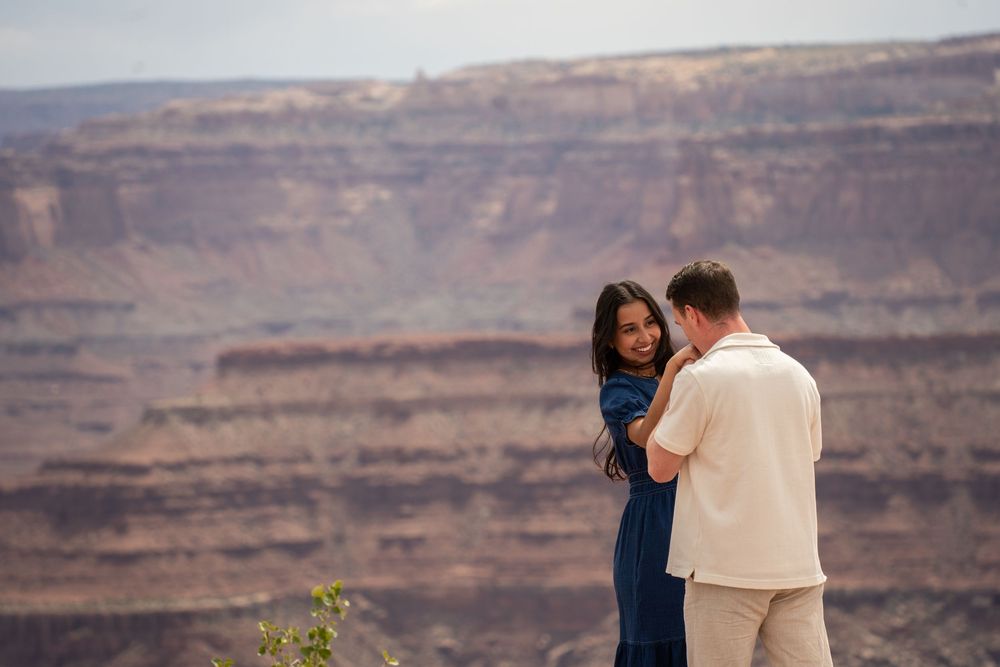
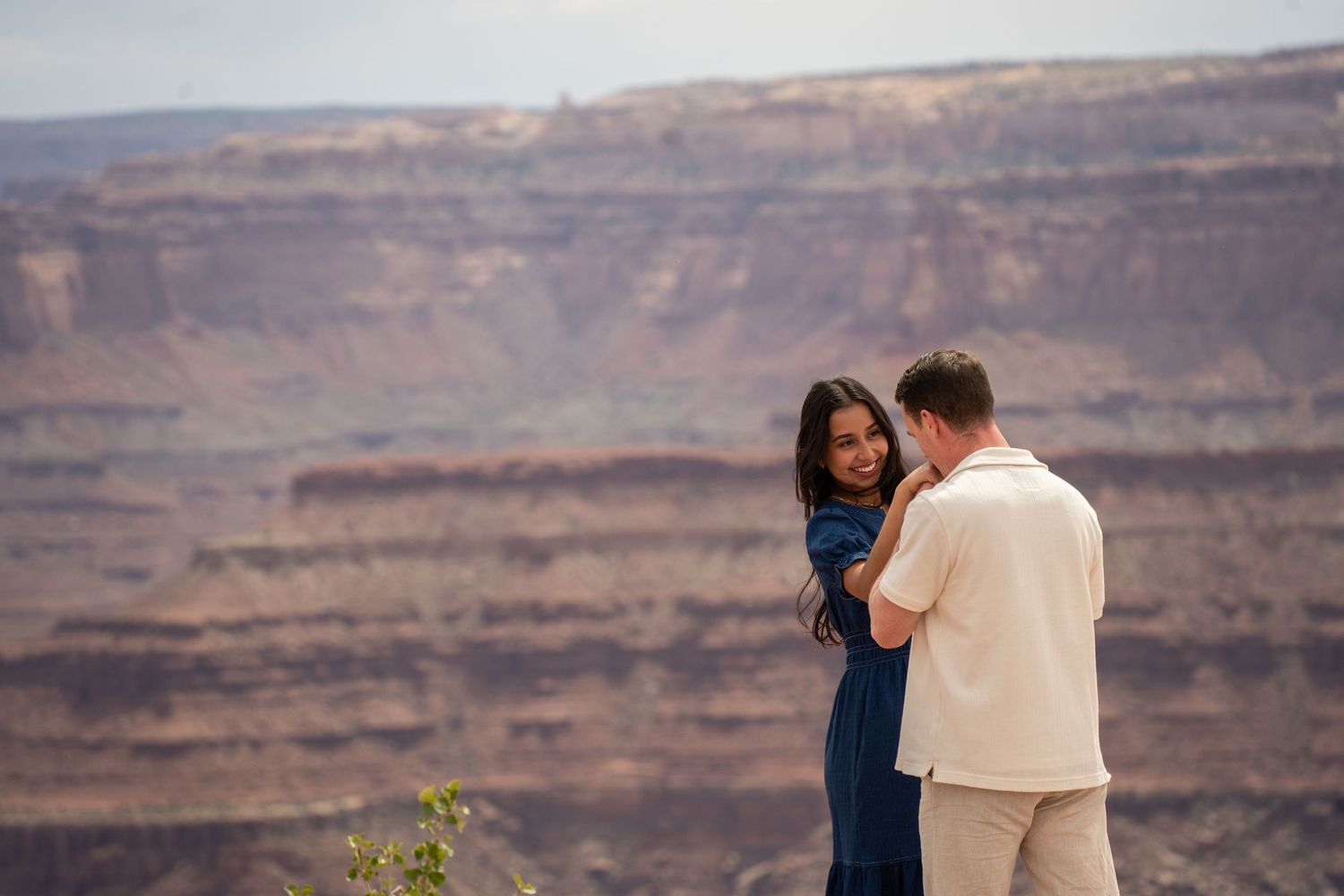
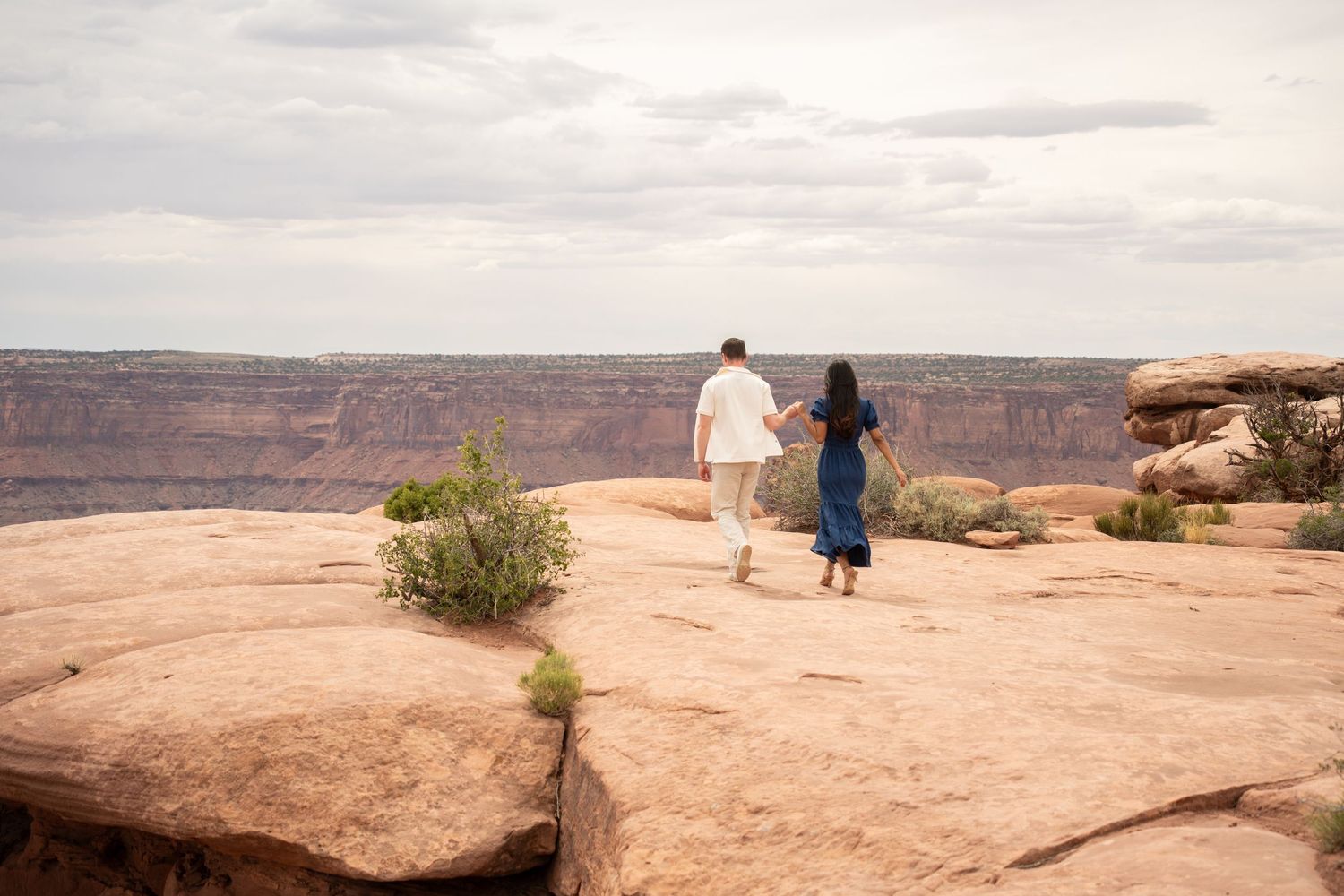
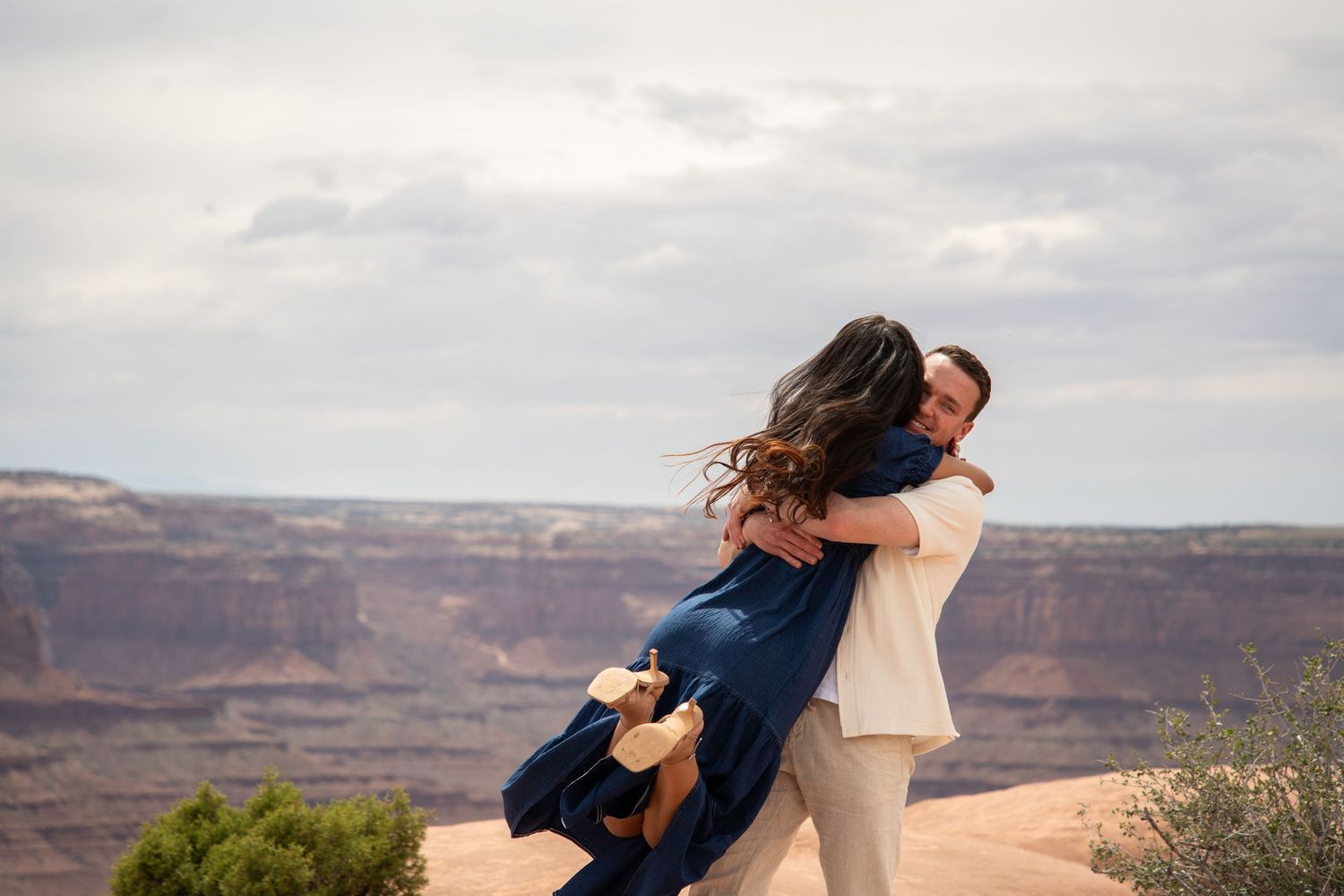
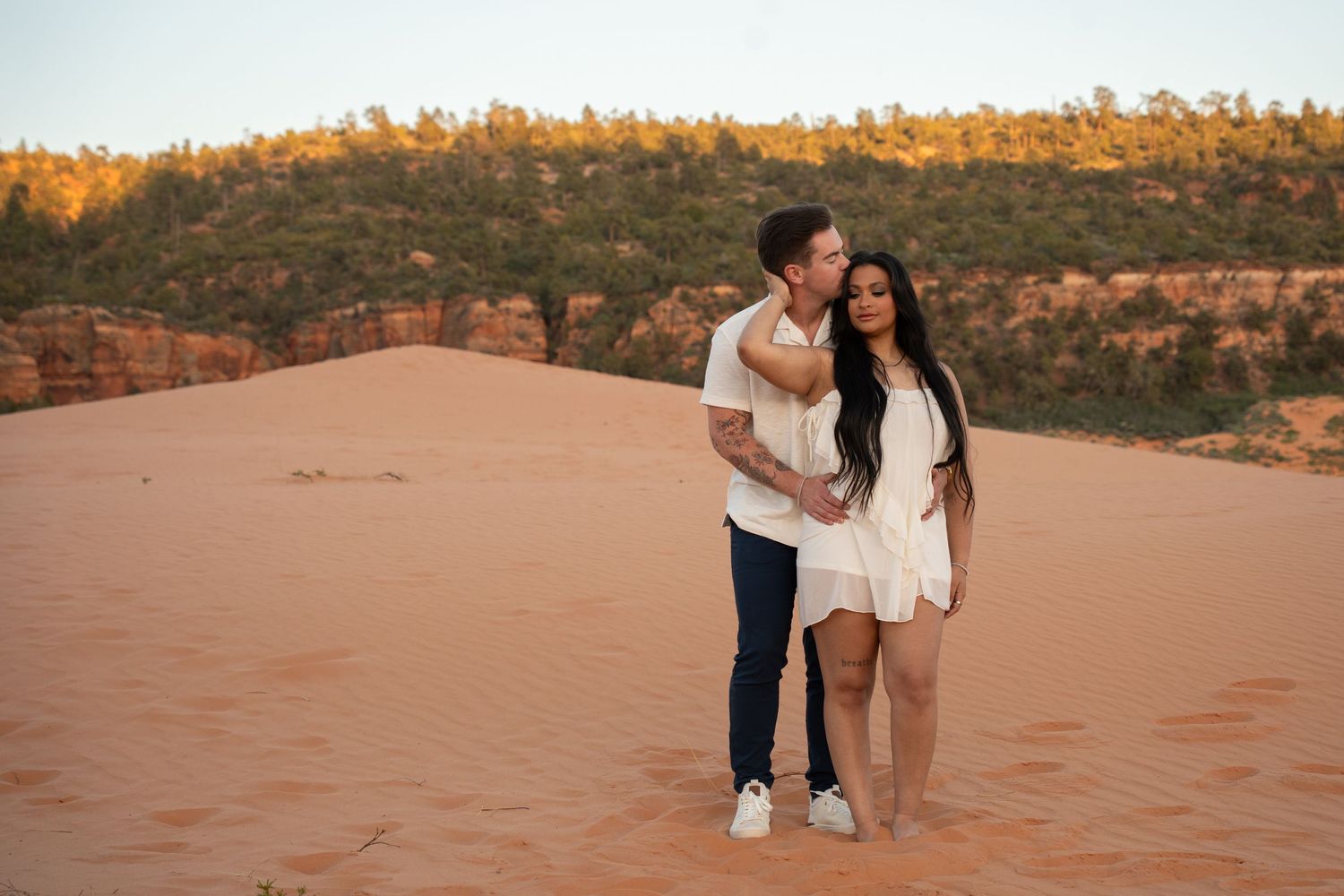
Elopements I've photographed at Dead Horse Point, including Luke and Karen's ceremony overlooking Canyonlands.
Why Elope in Utah Without a Big Wedding?
When you choose to elope, you're not choosing less. You're choosing more presence and more uninterrupted time with each other on one of the most significant days of your life. A traditional wedding asks you to host 150 people while also somehow savoring the moment; an elopement asks you to show up and be fully present instead. Dead Horse Point doesn't care about your centerpieces or your seating chart. It just cares that you're there, together, at the edge of something vast, and in my experience, that's when couples say what they mean, plainly and without performance.
Ready to Start Planning?
If Dead Horse Point is calling your name, I'd love to help you build a day that's completely, unapologetically yours.
I've spent the last several summers exploring Moab, Dead Horse Point, and the surrounding canyon country: which sites catch the best morning light, how the wind moves at Cliff Side in spring, where to position you so the Colorado River appears in the frame below. I coordinate the permitting for you and build a day timeline that works with the light and the heat, not against it. My style is candid and adventure-forward, not stiff posing at the edge of a cliff.
Every elopement package includes a full wedding planning guide, hundreds of candid photos delivered on your one-month anniversary, all photos on a USB drive two months out, and complimentary bridal photos so you're already comfortable in front of my camera by elopement day. Elopement photography starts at $3,100, and travel anywhere within Utah, Dead Horse Point included, is already built into every package at no extra charge.
Frequently Asked Questions About Eloping at Dead Horse Point
Can you elope at Dead Horse Point with just two people?
Yes, and it's one of the most beautiful ways to do it. A permit is still required for any size group, but the process is the same, and Point Bench accommodates as few as 5 people. Worth knowing: Utah law requires two witnesses in addition to your officiant, so a truly "just the two of us" elopement is legally more like a five-person one, which is the exact headcount Point Bench is built for.
How much does it cost to elope at Dead Horse Point?
A bare-bones elopement (permit, one hour of site time, and park entry for one vehicle) runs about $180 total in park fees: a $60 permit fee, $100/hour of site time, and $20 at the gate. Add in your photographer, officiant, marriage license, and any extras (florals, hair and makeup, a picnic) and most couples budget $2,000 to $5,000 or more for the full elopement experience, well beyond the park's own fees.
Is Dead Horse Point the same as Canyonlands?
They're neighbors, not the same park. Dead Horse Point sits on a mesa adjacent to Canyonlands National Park, and both offer incredible canyon views, but Dead Horse is a state park, not a national park, which is part of why permitting is more manageable and crowds are smaller. One practical note: an America the Beautiful federal lands pass won't cover Dead Horse Point's entry fee, since that pass is for federal land and Utah state parks collect their own fees separately. See my Canyonlands elopement page if you're weighing the two against each other.
Do I need an officiant to elope in Utah?
Yes. Utah law requires a licensed officiant to perform your marriage ceremony. I can connect you with wonderful officiants in the Moab area who are experienced with elopements and feel natural rather than formal.
Can I use Pampas Grass or dried florals?
The park discourages Pampas Grass and similar invasive species, but dried florals, silk flowers, and a fresh-cut bouquet are all fine. The same leave-no-trace thinking extends to decor generally: nothing that attaches to the rock with nails, tacks, or adhesive, and anything you bring in needs to leave with you.
What should I wear to my Dead Horse Point elopement?
Whatever makes you feel like yourself, though the terrain is uneven rock, so I'd steer away from stilettos and toward a block heel, sandal, or flat. Layers are smart in spring and winter, and sunscreen is non-negotiable.
How far in advance do we need to apply for a Dead Horse Point wedding permit, and is there a time of year the park won't allow it?
The park accepts Special Use Permit applications anywhere from 1 month to 18 months before your date, and spring and fall book up fastest, so apply as soon as you've settled on a date if you want one of those seasons. One firm exception: the park doesn't approve ceremony applications for Memorial Day Weekend, since visitation is already at its peak that weekend without adding a wedding party into the mix.
Can dogs come to a Dead Horse Point elopement ceremony?
Yes, dogs are welcome under the park's standard rules, which means leashed and cleaned up after like any other visit. If your dog is part of the ceremony itself, plan for the same uneven, exposed terrain that applies to your own footwear, and bring water for them too. The desert dries everyone out faster than it feels like in the moment, dogs included.
Are drones allowed for elopement photos or video at Dead Horse Point?
Not from March through October. Drones are banned park-wide during that stretch. From November through February, drone flight is possible but the operator needs their own separate Special Use Permit, on top of your wedding permit. If aerial footage is a priority for a spring or summer ceremony, that's a limitation worth planning around rather than assuming it'll work out on the day.
Which Dead Horse Point ceremony site fits a bigger family, 30 to 40 people?
West Bench is the strongest fit at that headcount: it holds up to 50 people, has the easiest access of the rim sites, and works well for older guests or anyone with mobility considerations. The tradeoff is that it's also the park's most popular general viewpoint, so you'll share the space with passersby during your ceremony, most of whom end up quietly moved by the moment rather than intrusive.
Can we combine our elopement with camping or rafting nearby?
Absolutely, and a lot of couples build their whole trip around it. The park itself has Kayenta and Wingate campgrounds plus yurts for glamping, so you can stay the night before or after your ceremony without leaving. The Colorado River runs right below the mesa, and Moab, about 40 minutes away, is one of the best rafting basecamps in the state, so a morning ceremony followed by an afternoon on the river is a doable, memorable pairing.
What happens to our permit if the weather turns bad on our date?
Your Special Use Permit is tied to a specific date, site, and time window, so a rained-out or snowed-out ceremony isn't automatically rescheduled for you. In practice, I build a weather contingency into the planning conversation well before your date: a shorter ceremony window that still fits inside your permitted time, a backup site less exposed to wind, or, worst case, working with the park on a new date if conditions are unsafe. I'd rather have that plan ready before you fly out than improvise it the morning of.
Written by
Jade Jarvis
Utah-based wedding, elopement, and proposal photographer since 2025. I've scouted these locations myself, so the advice here comes from firsthand experience, not guesswork.