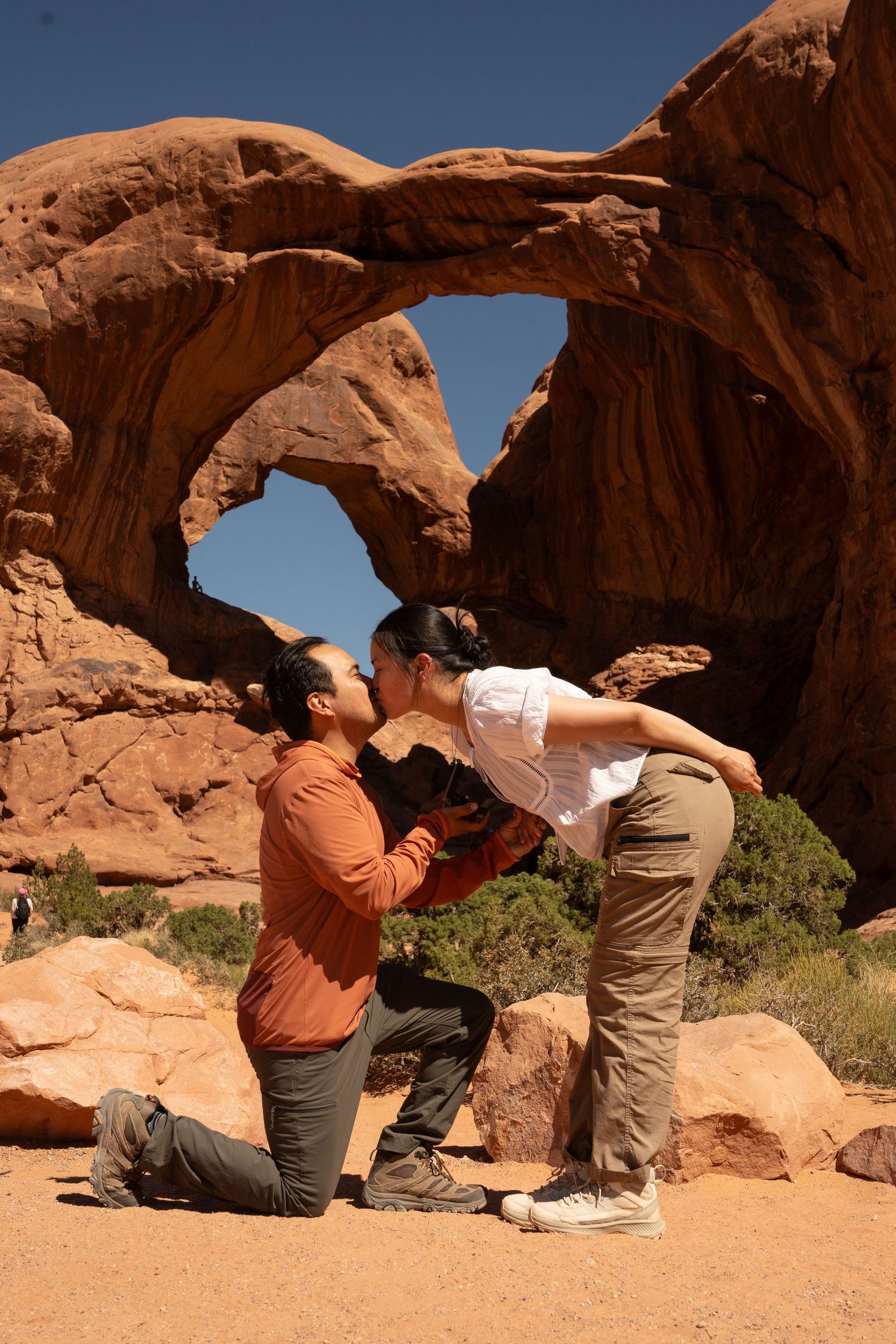
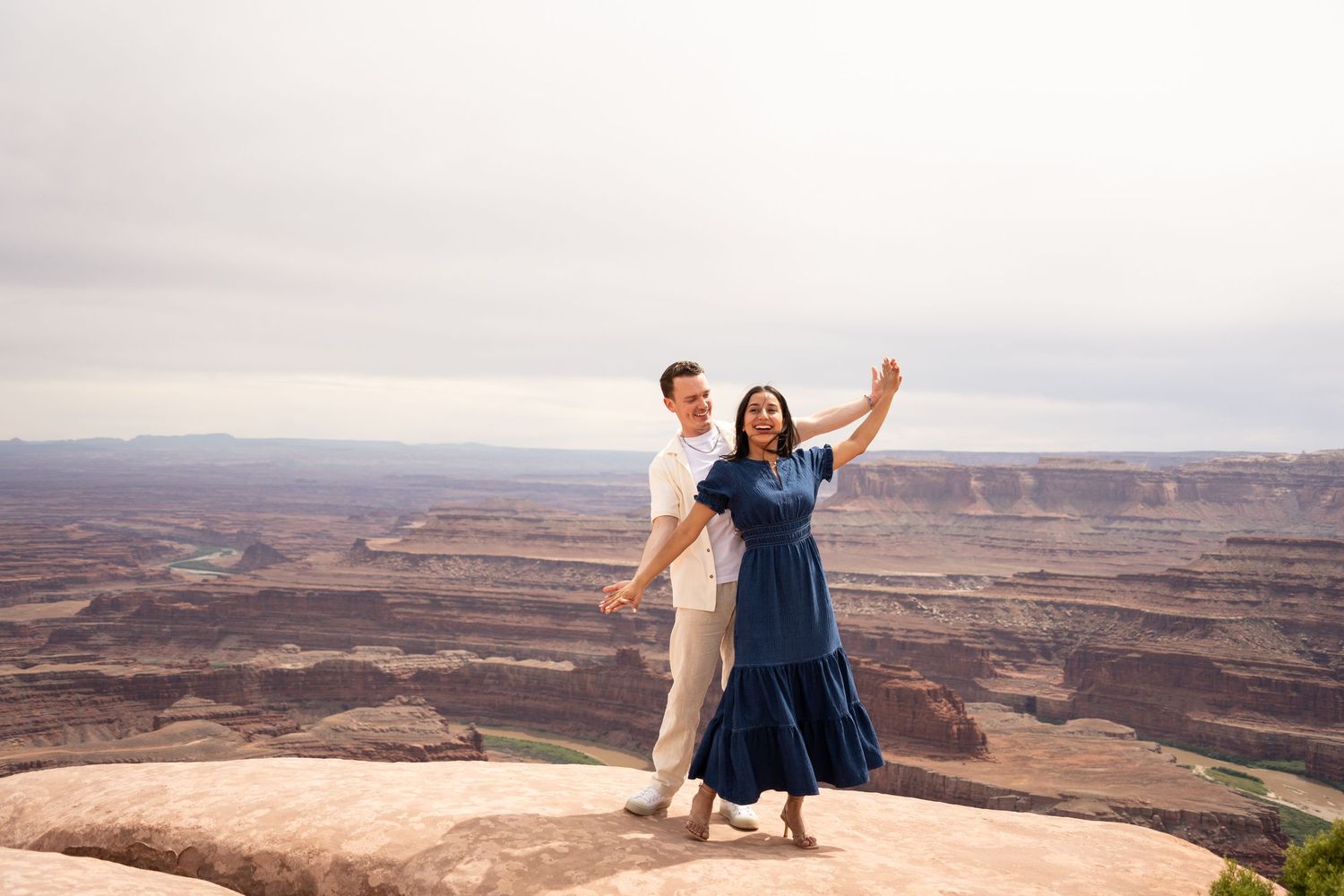
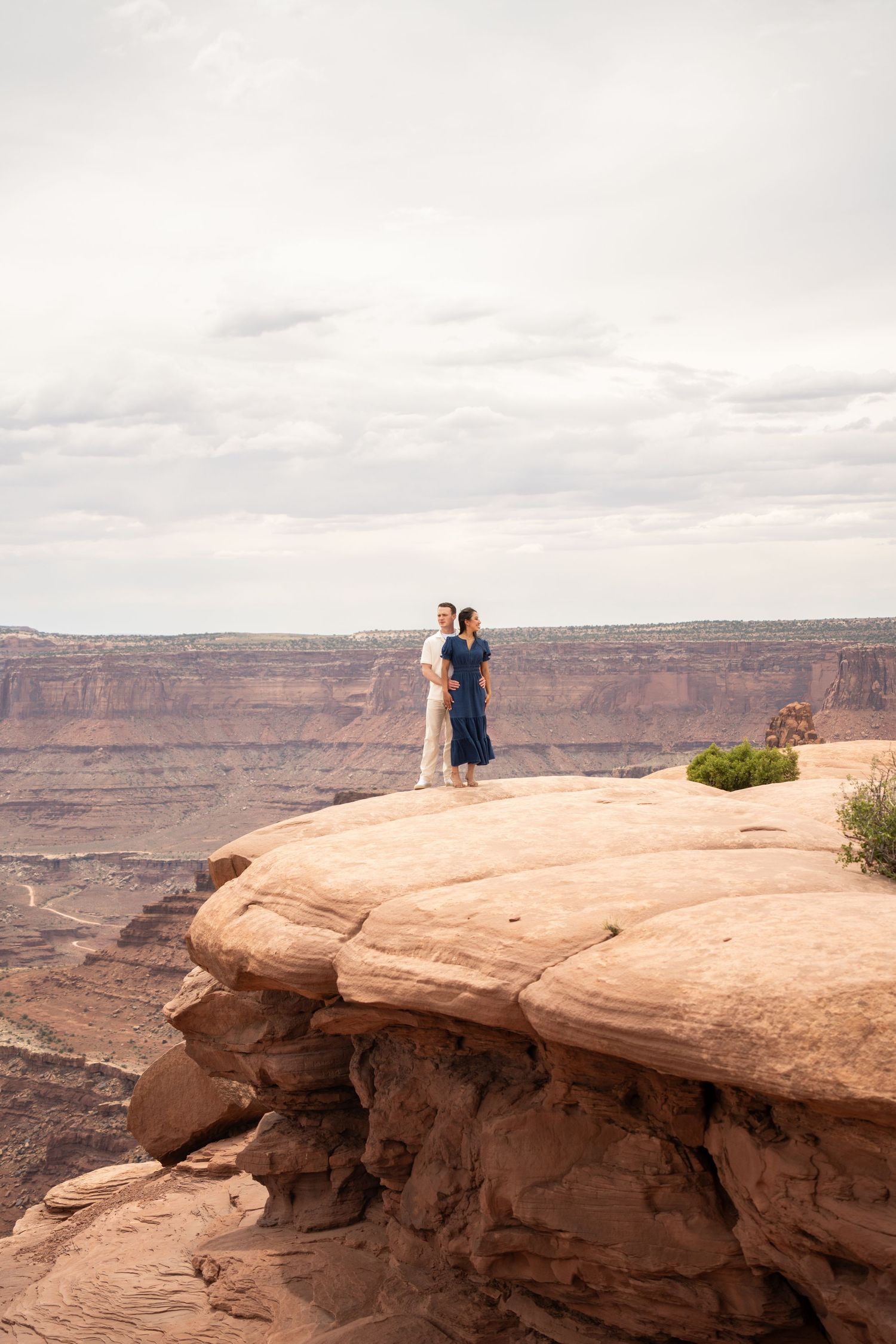
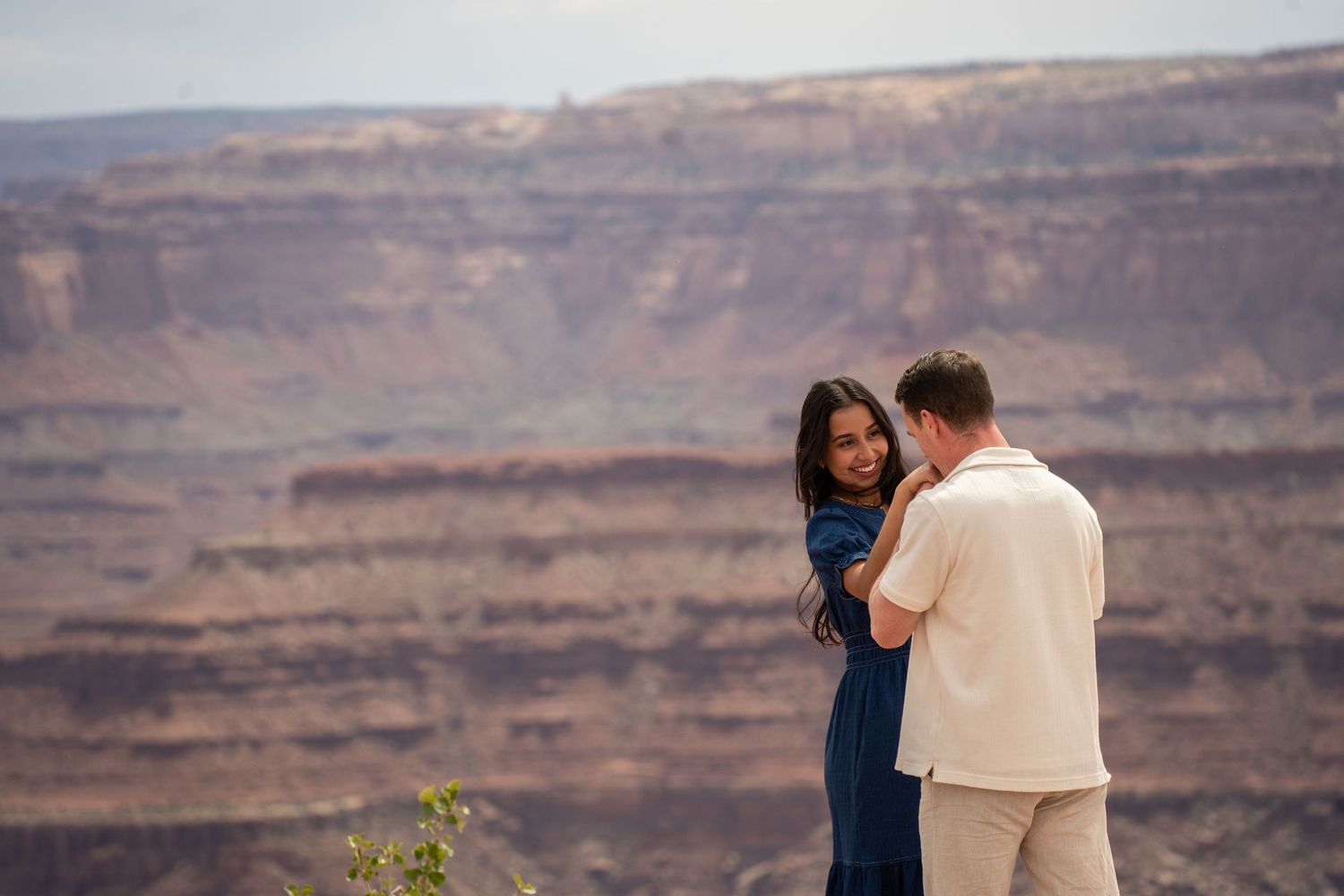
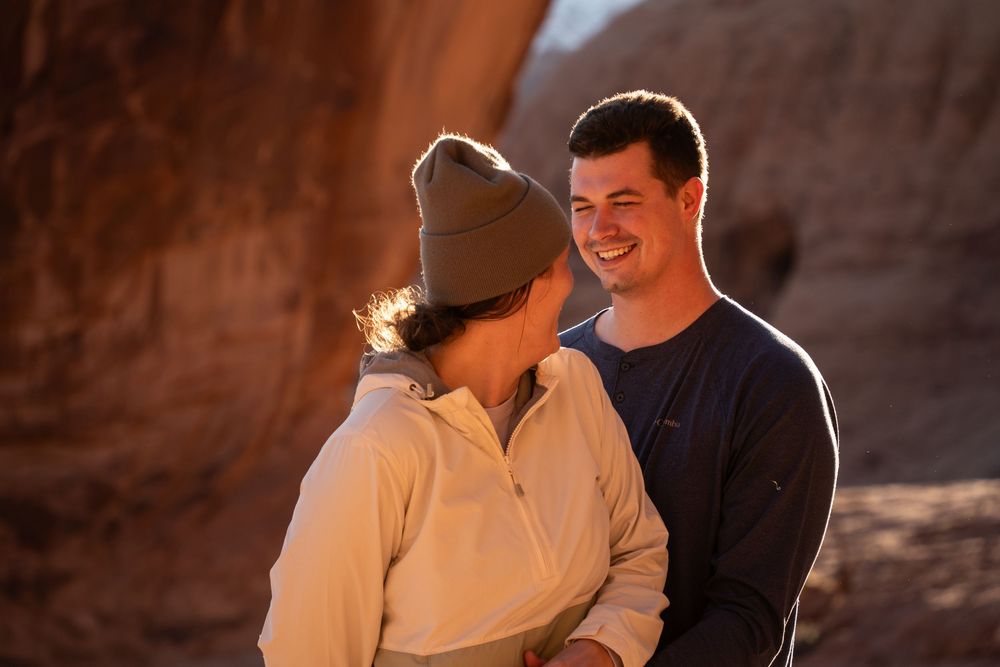
Picture your vows against red sandstone glowing orange, the Colorado River cutting through canyon walls below, and no one around but the two of you, your officiant, and me. That’s not a stretch in Moab. That’s a Tuesday morning at Corona Arch if you build your day around it.
Moab isn’t one elopement spot. It’s a whole basecamp of them: Arches, Canyonlands, Dead Horse Point, and a stretch of BLM desert in between, all inside about a 30-minute drive of downtown. Which one fits your ceremony comes down to how much hiking you want, how many people are standing with you, and which permit path you’d rather deal with.
Here’s the part that catches most out-of-state couples off guard: the biggest planning decision isn’t the trail, it’s the land, and unlike a proposal, an actual ceremony changes the paperwork completely. Corona Arch sits on Bureau of Land Management ground, so a small elopement there skips the National Park Service’s permit process, though the Moab Field Office does require a Special Recreation Permit once your group grows past a small handful of people. Arches and Canyonlands are national parks, so a ceremony there needs a $185 NPS Special Use Permit no matter your headcount. Dead Horse Point splits the difference: a $20 day-use fee plus a Utah State Parks Special Use Permit, since it’s neither BLM nor NPS land.
Every ceremony photo on this page is from a couple I’ve photographed getting married at that exact spot, not a stock stand-in. Where I’m borrowing a photo from a proposal instead of a wedding, I’ll say so plainly, spot by spot.
TL;DR
8 spots covered here: Corona Arch, the Windows/Double Arch, Delicate Arch, Dead Horse Point & Canyonlands, Fisher Towers, Potash Road, the La Sal Mountains, and Moab Rim.
A small elopement on BLM land (Corona Arch, Fisher Towers, Potash Road, Moab Rim): no NPS-style permit, though a bigger group needs a BLM Special Recreation Permit.
Arches & Canyonlands National Parks: a $185 NPS Special Use Permit for any ceremony, plus the $30/vehicle entrance fee, no permit needed if you’re only taking photos with no vows exchanged.
Dead Horse Point State Park: $20/vehicle day-use fee plus a Special Use Permit, required for any wedding or ceremony there.
Utah marriage licenses come from any county clerk, including Grand County in Moab: no waiting period, valid 32 days, $30–$50 fee, an officiant and 2 witnesses required.
Moab elopements start at $3,100 with the Half Day package.
Why Elope in Moab
Moab gives you scale that a backyard or a ballroom can’t touch, and it gives you options a single venue never could.
Most couples eloping in Utah picture one park, one arch, one look, then have to hope it matches what they imagined from photos taken by strangers. Moab hands you a menu instead. Arches for the classic sandstone-window ceremony everyone recognizes. Canyonlands and Dead Horse Point for vows said above a canyon the Colorado River carved over millions of years. Corona Arch, Fisher Towers, and Potash Road for red rock that comes with a simpler permit path than a national park. The La Sal Mountains for alpine meadows fifteen minutes from a desert floor that hits 100°F in July.
That range means the ceremony gets built around the two of you instead of the other way around. A couple who wants an actual hike built into their wedding morning gets Fisher Towers or Corona Arch. A couple who wants maximum drama with a short walk gets the Windows region or Dead Horse Point. A couple who wants total privacy with zero red tape gets a Potash Road pull-off at sunrise, when the whole canyon belongs to just the two of you.
It photographs like nowhere else in the state, too. Sandstone that shifts from rust to gold to deep orange through the day, natural stone arches that frame a ceremony better than any arbor I could build, and a sky big enough to make two people saying “I do” feel like nothing else matters for miles.
And because so much of the land around Moab sits outside a national park boundary, on BLM ground like Corona Arch, Fisher Towers, and most of Potash Road, a small elopement there skips the federal permit process entirely. That’s a meaningful advantage if you’re planning a wedding from out of state on a tight trip window and don’t want a permit office’s turnaround time dictating your date. It’s one most couples don’t realize until they start comparing Moab to a spot like Zion, where the NPS wedding-permit process adds meaningful lead time no matter which trail you choose.
Tell Me Your Dates and Your Vision
Give me your travel window and how many people are standing with you, big ceremony or just the two of you, and I’ll tell you which spot and which permit path fits before you spend another weekend untangling BLM and NPS websites.
The Challenge With Planning a Moab Elopement From Out of State
Here’s what stresses couples out about planning a wedding in a place they’ve never stood in: you’re trying to lock in a legal ceremony, a location, and a permit, sight unseen, based on other people’s photos taken in different light and a different season, with no way to check any of it yourself before you land.
Add up what that costs you. Hours cross-referencing BLM and NPS pages trying to figure out which rules apply to your specific headcount. More hours reading forum posts from other couples who eloped somewhere else entirely. A worry that you’ll apply for the wrong permit, or skip one you needed, and find out on your wedding day instead of three weeks before it. That’s easily a full weekend of research for the one day you don’t get to redo.
I’ve hiked every trail on this page more than once, scouted them at different times of day and different seasons, and photographed elopements at more than one of them. When you tell me your travel dates, your headcount, and what you’re picturing, hiking ceremony or an easy overlook, I can tell you in one conversation which spot fits and which permit, if any, it needs.
I know which agency to call for which trail, how long each permit realistically takes, and which spots let you skip that conversation altogether. I know the difference between a permit for photography and a permit for an actual ceremony, a distinction that trips up more couples than almost anything else on this page.
You don’t need to become a permit expert before your wedding day. You need one conversation with someone who already is.
Best Moab Elopement Spots: 8 Options
Eight spots, eight completely different ceremonies. Here’s the full depth on each one: distance, difficulty, the permit path for a ceremony specifically, best time of day, and the plain tradeoffs, not just a highlight reel.
Corona Arch: The One I Shoot Most
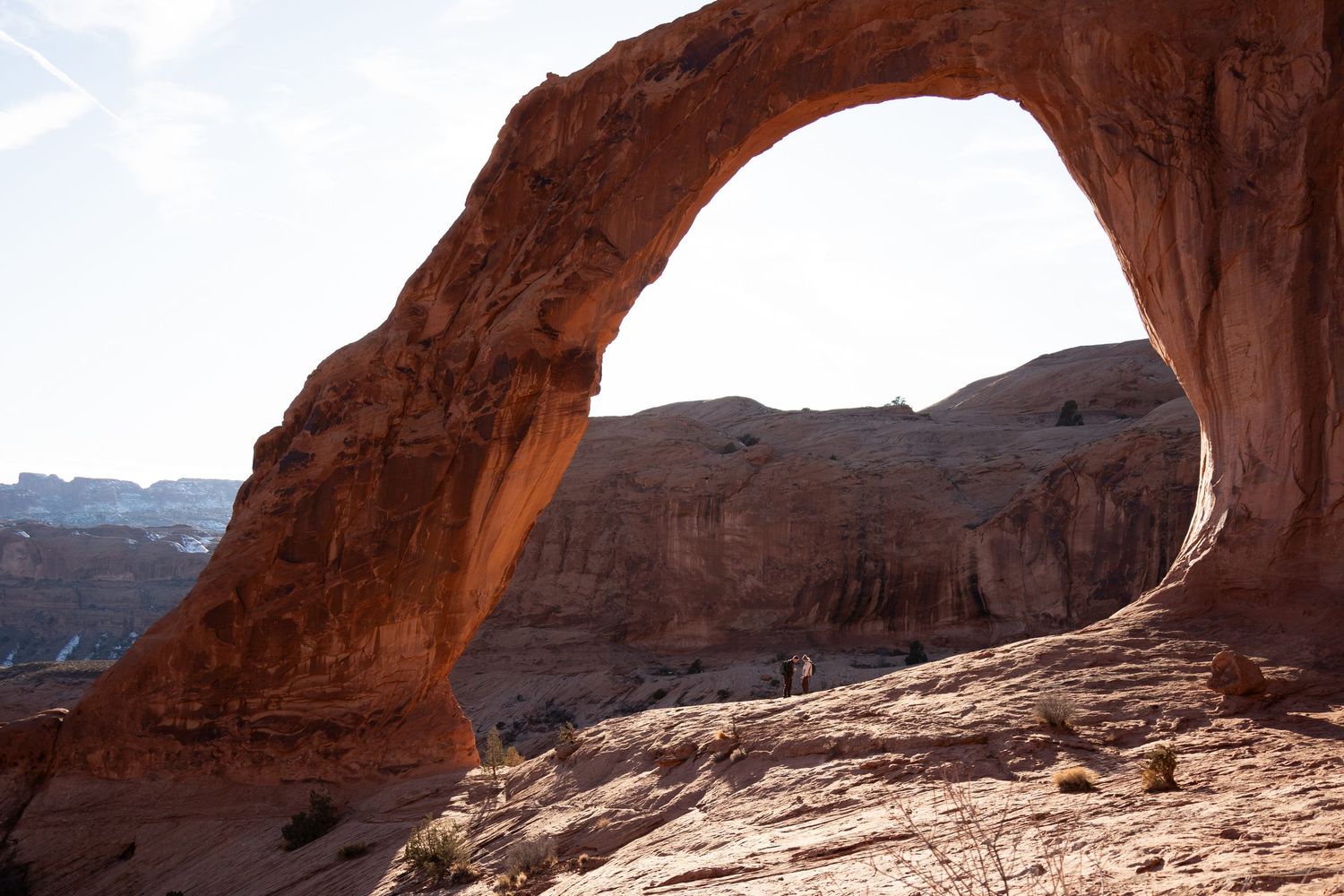
If I had to send every couple to one spot in Moab, it’s Corona Arch. It’s the spot in nearly every “best of Moab” photo you’ve seen, and it earns that reputation as a wedding backdrop too.
Corona Arch sits on Bureau of Land Management and city land off Potash Road (UT-279), about 10 miles south of Moab. The BLM took ownership of it from the state in 2014 and named it a National Recreation Trail in 2018, which means: no national park boundary, no park entrance fee, and for a small ceremony, no NPS-style Special Use Permit standing between you and your vows. The BLM Moab Field Office does require its own Special Recreation Permit once a group grows past a small handful of people, so tell me your headcount early if you’re bringing more than an officiant and a witness or two.
The hike itself is a moderately strenuous 3-mile round trip. It’s not a stroll, but it’s not technical either: a couple of sections use a steel cable and a short ladder to help you up slickrock, and neither requires climbing experience. Budget 90 minutes to 2 hours round trip if you want time to stand at the arch and say your vows, not just pass through it.
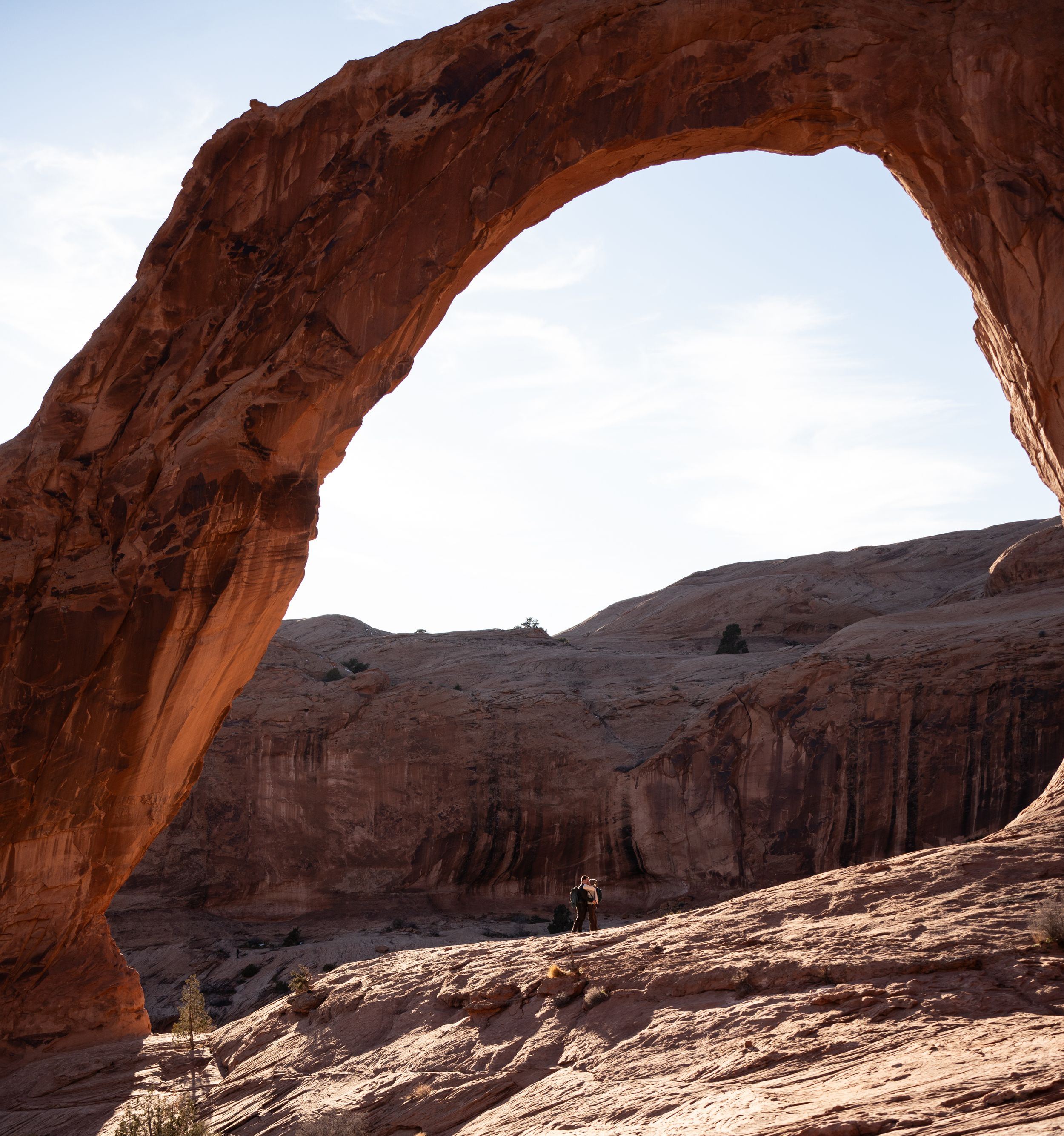
The arch itself is the payoff: a freestanding sandstone span roughly 105 feet wide and 140 feet tall, big enough to frame both of you with canyon walls stacking up behind you as you exchange rings. Morning light hits it clean and even; late afternoon into golden hour turns the whole formation orange-gold, which is why I book most Corona Arch ceremonies for the last two hours before sunset.
One detail that surprises almost everyone: BLM land generally allows recreational drone flying under standard FAA rules, unlike every national park, which bans it outright. If aerial footage of your ceremony is part of your vision, Corona Arch is one of the more flexible spots in the state to get it.
The tradeoff: it’s popular enough (about 80,000 visitors a year) that you’re rarely fully alone there. A weekday sunrise ceremony gets you a noticeably quieter trail than the same slot on a Saturday. If total privacy matters more to you than the iconic look, Fisher Towers or a Potash Road pull-off further down this page might fit better.
Distance: ~3 miles round trip, moderately strenuous, cable and ladder-assisted sections.
Land & permit: BLM/city land off Potash Road (UT-279); no NPS-style permit for a small ceremony, BLM Special Recreation Permit required past a small group size.
Best time: Last two hours before sunset for warm light; weekday sunrise for the fewest people.
Drone-friendly: Yes, under standard FAA rules, unlike inside any national park.
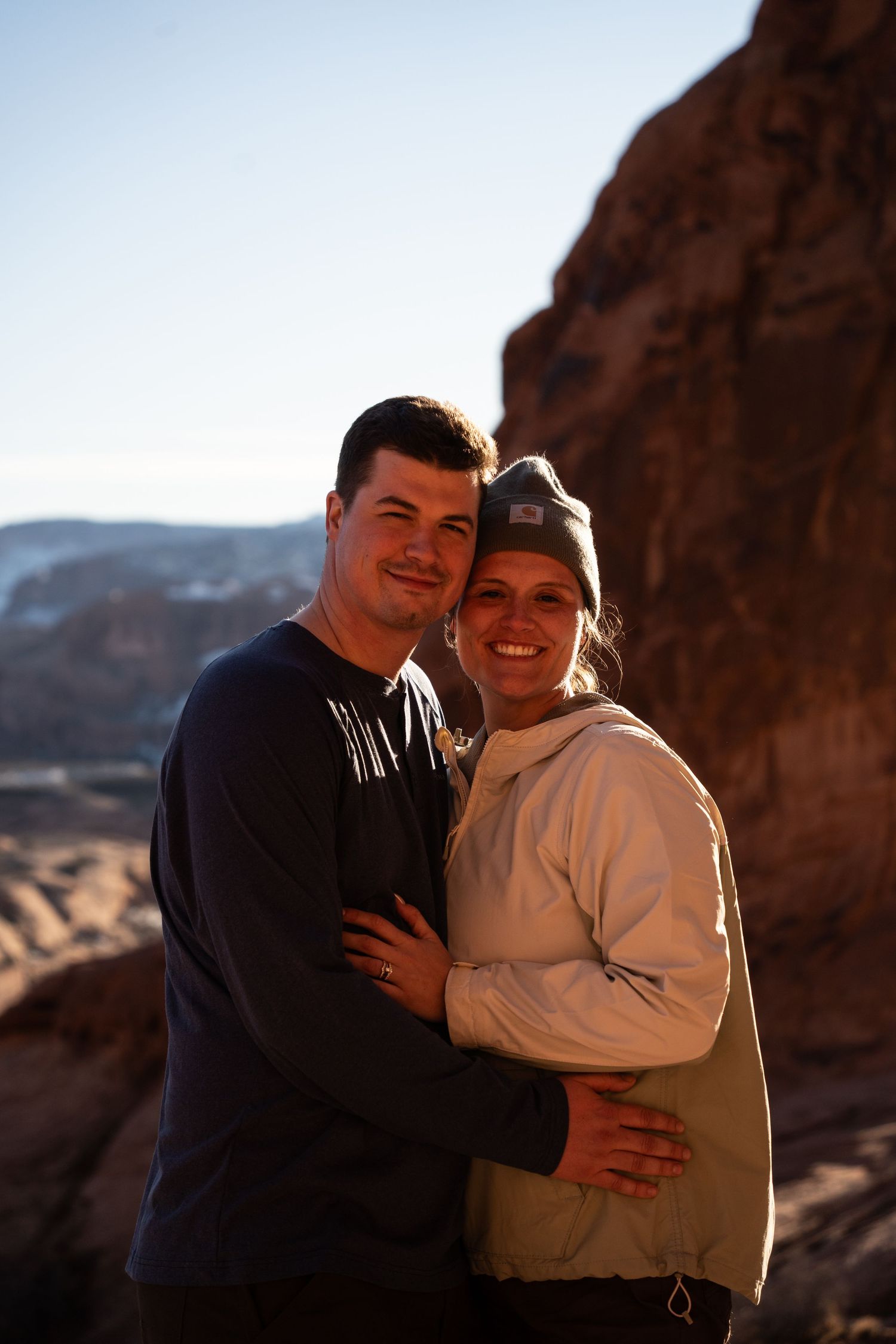
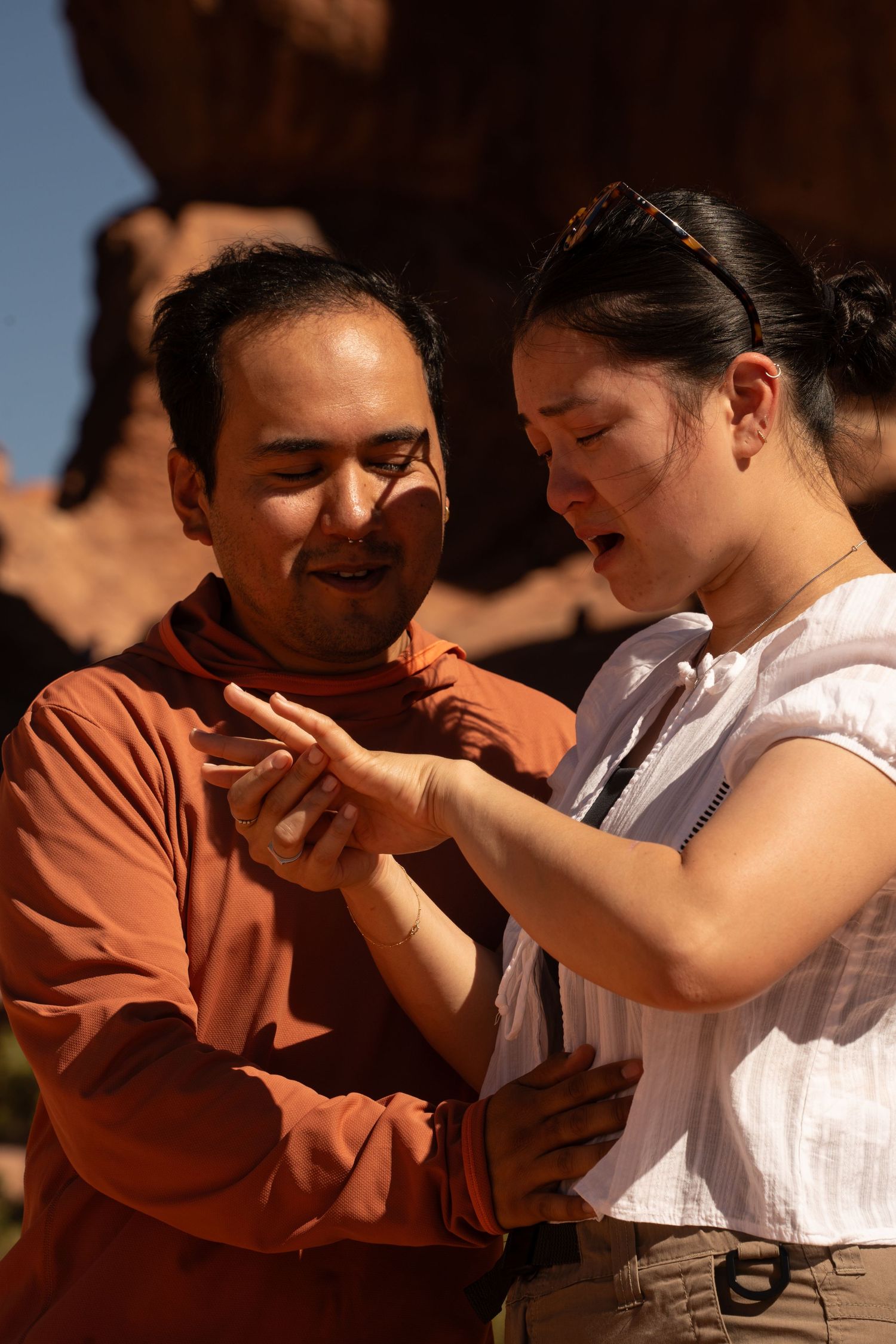
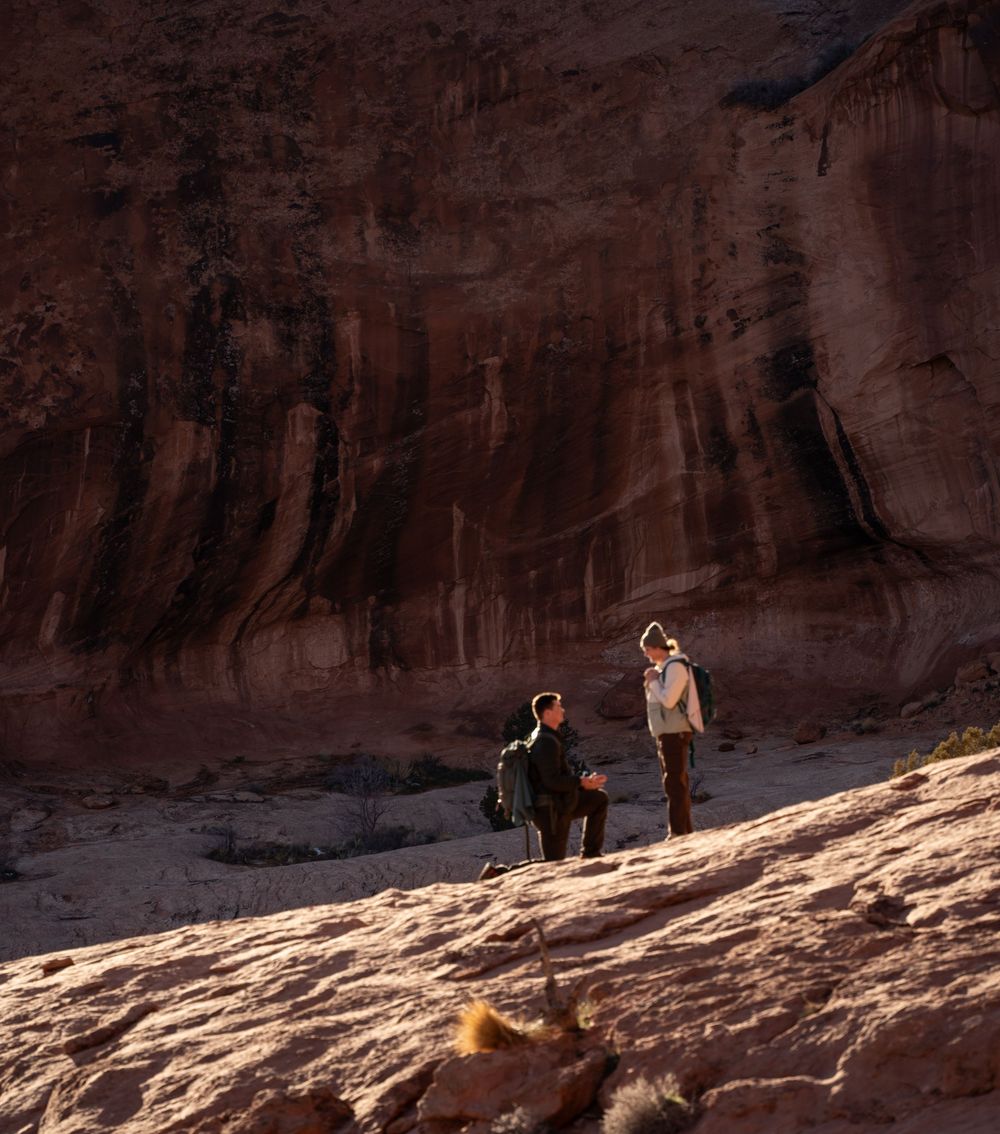
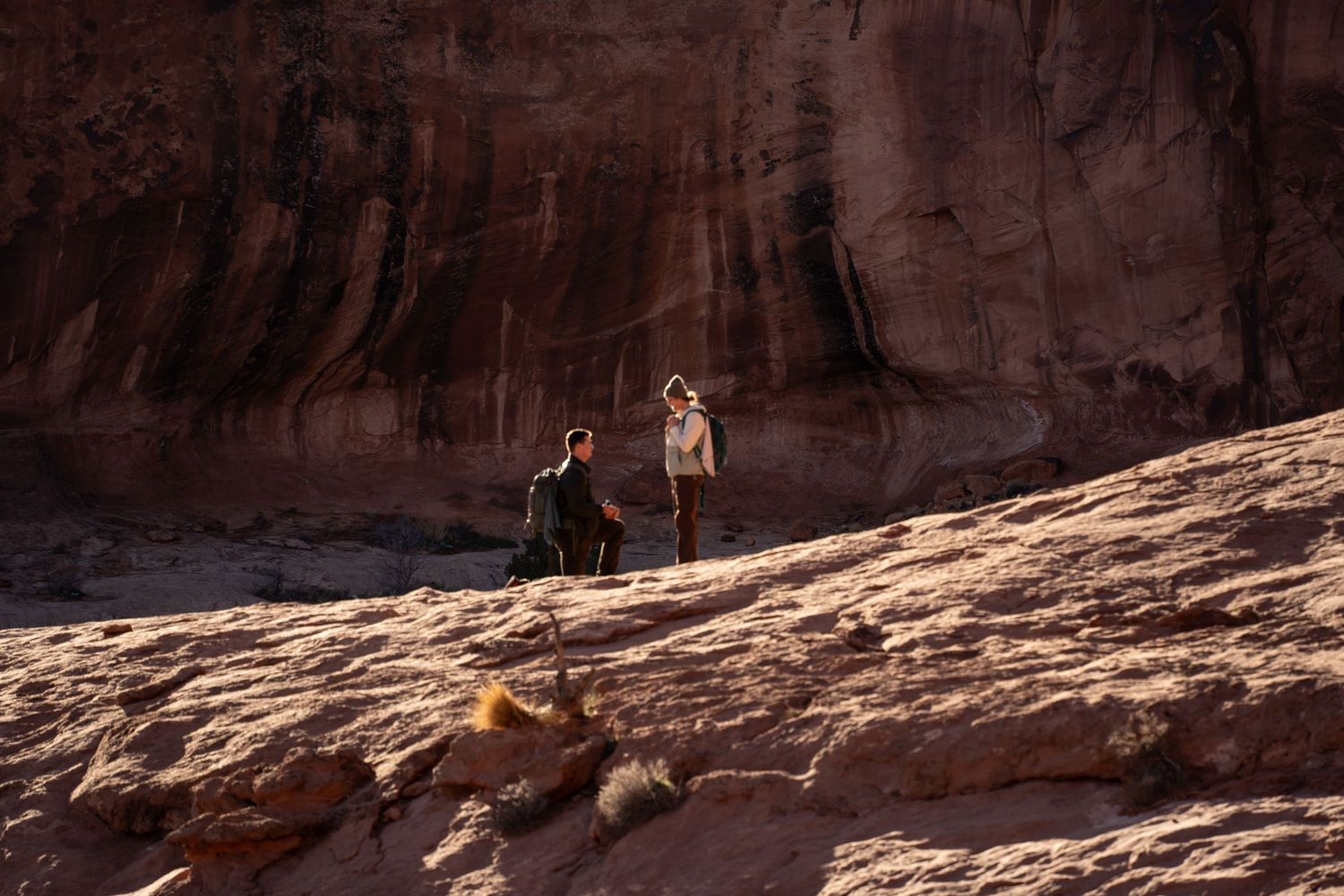
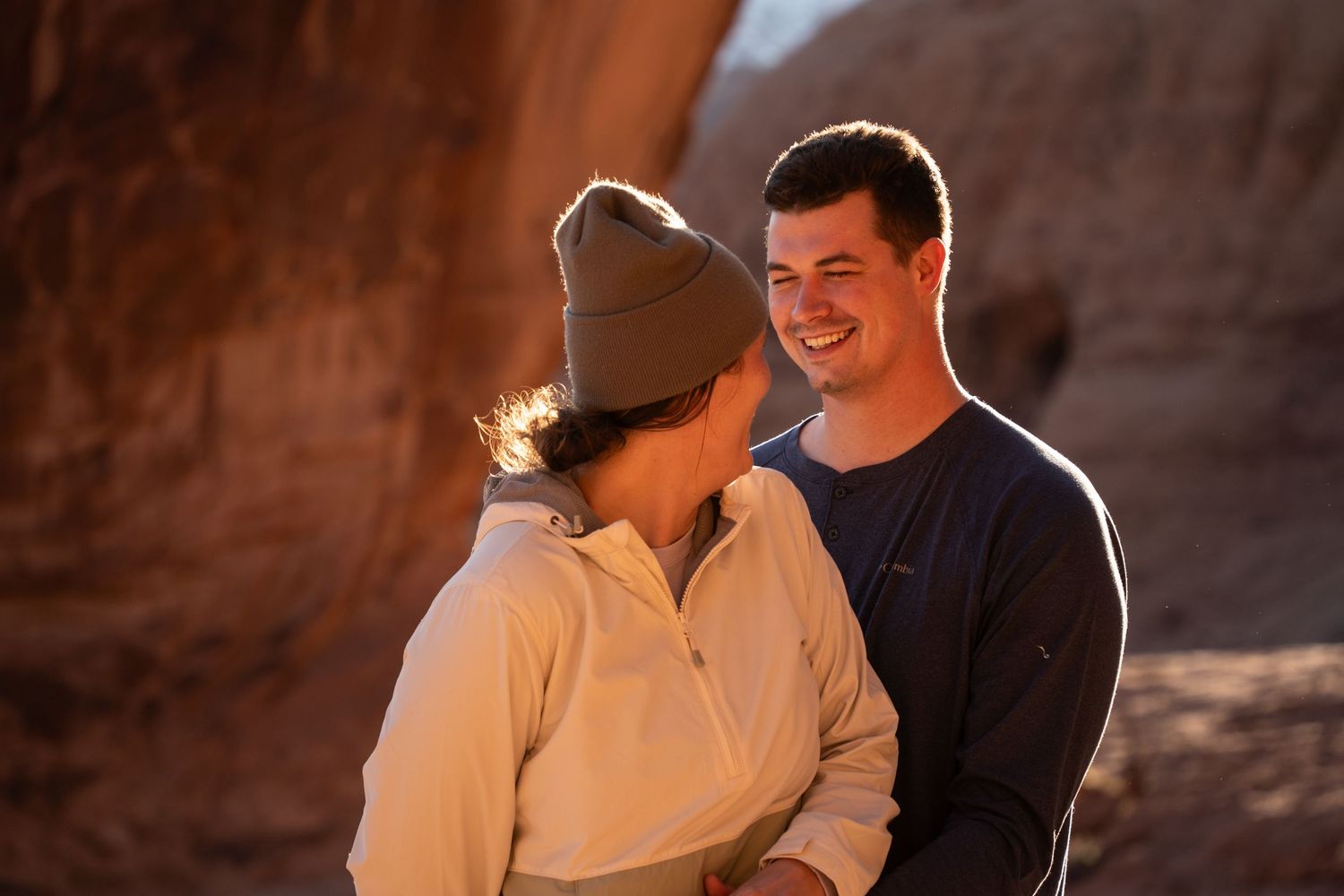
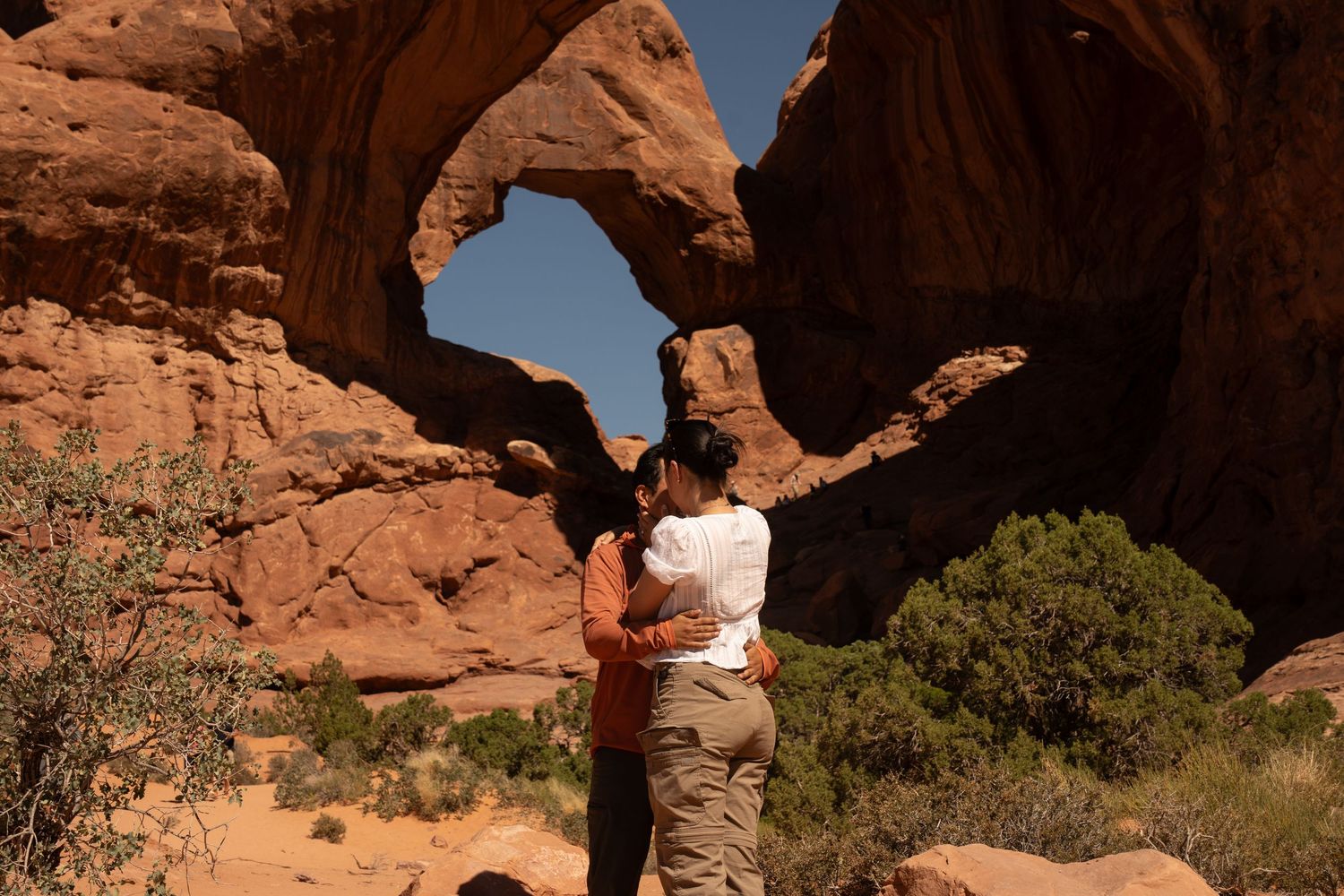
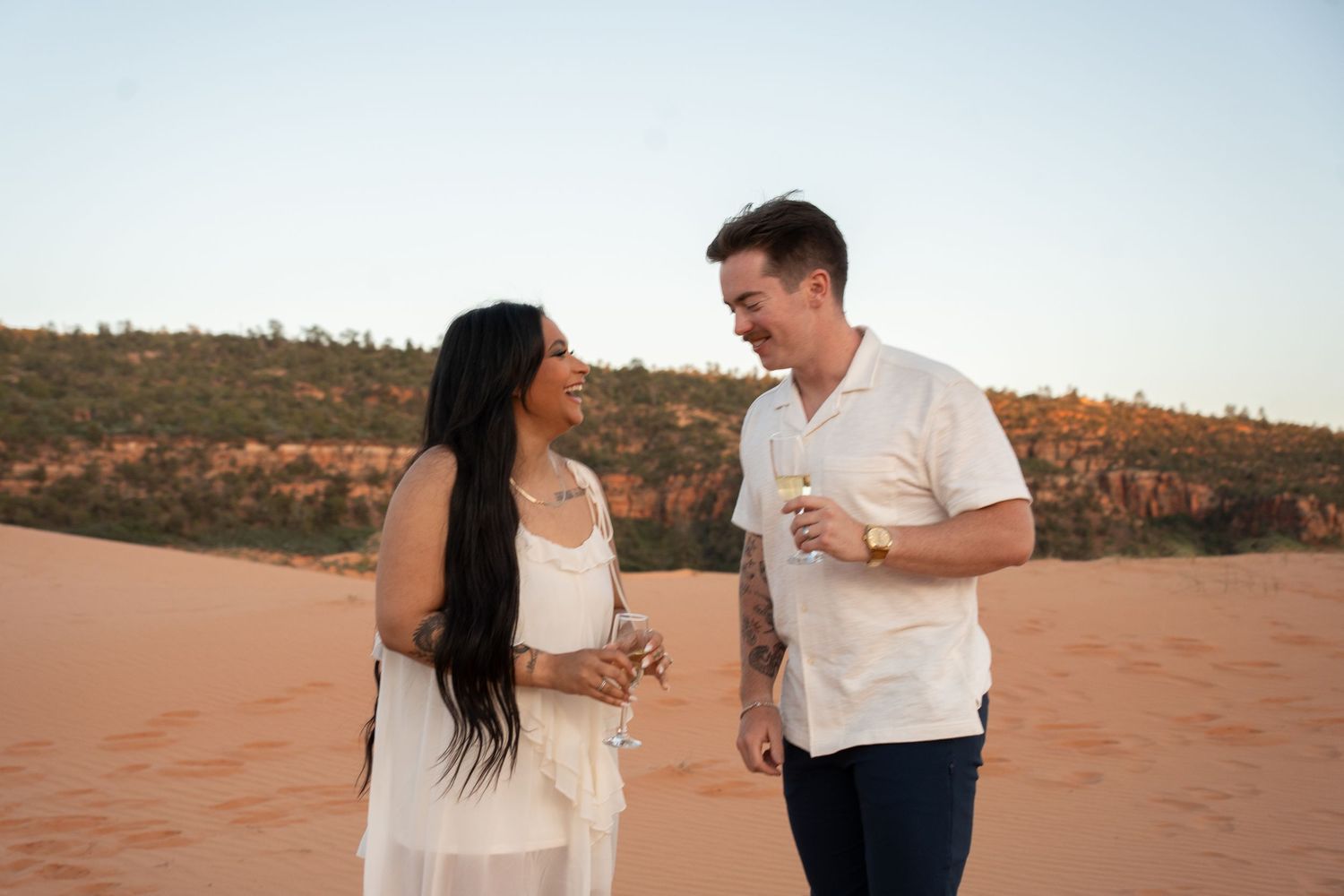
The three photos above are from proposals rather than ceremonies, but they’re shot at the exact spot I recommend for a Corona Arch elopement, and they show you how the light and the arch itself look in person. Read the full story of Jacob and Rae’s Corona Arch proposal for a closer look at the trail.
The Windows Region & Double Arch: Arches’ Easiest Big Payoff
If Corona Arch is the spot I shoot most outside a national park, the Windows region is the equivalent inside one, and it’s the easiest way to get a massive, unmistakably “Arches” backdrop for your vows without a serious hike.
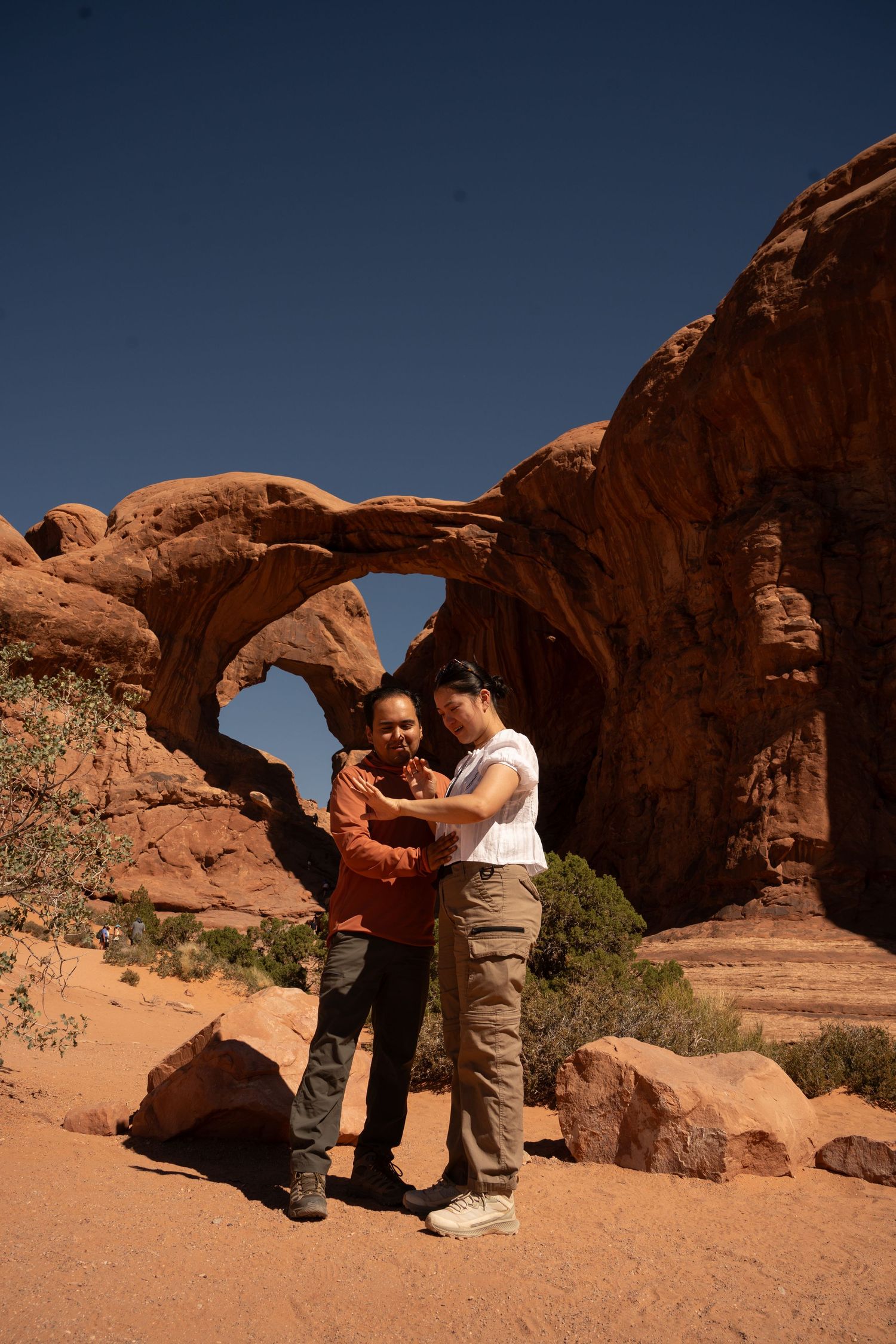
Double Arch sits a short, mostly flat walk from the Windows parking area, easy enough that you and your guests aren’t arriving sweaty and out of breath for the ceremony. Two enormous arches meet overhead at roughly the same point, which gives you a natural, ready-made arbor that no florist could build. The tradeoff is popularity: it’s one of the more visited spots in the park, so timing matters if you want the frame to yourselves for your vows.
Arches National Park charges a standard entrance fee ($30 per vehicle, $25 motorcycle, $15 per person on foot or bike, as of this writing), and as of this writing the park isn’t running a timed-entry reservation system for 2026. That system has come and gone before, so it’s worth a quick check on nps.gov before you lock in your date. What matters more for your planning: an actual ceremony inside Arches, anywhere in the park, requires a $185 NPS Special Use Permit through Form 10-930 on Pay.gov, regardless of your group size. Photography alone, with no vows exchanged, doesn’t need that permit in public areas of the park, which is the exact distinction that catches couples off guard when they assume a proposal-style shoot and a ceremony follow the same rules.
If you want the full breakdown of every arch worth considering for a photo session in the park, and why I steer most couples toward Double Arch over Turret Arch for framing, I’ve covered that in the complete guide to the best spots in Arches, written from the proposal side but just as useful for scouting the same formations for a ceremony.
Distance: Double Arch trailhead is an easy, mostly flat walk from the Windows parking lot.
Fee: $30/vehicle Arches entrance fee (as of this writing).
Ceremony permit: $185 NPS Special Use Permit, required for any ceremony regardless of group size; not required for photography alone.
Timed entry: Not required for 2026 as of this writing; confirm on nps.gov before your trip.
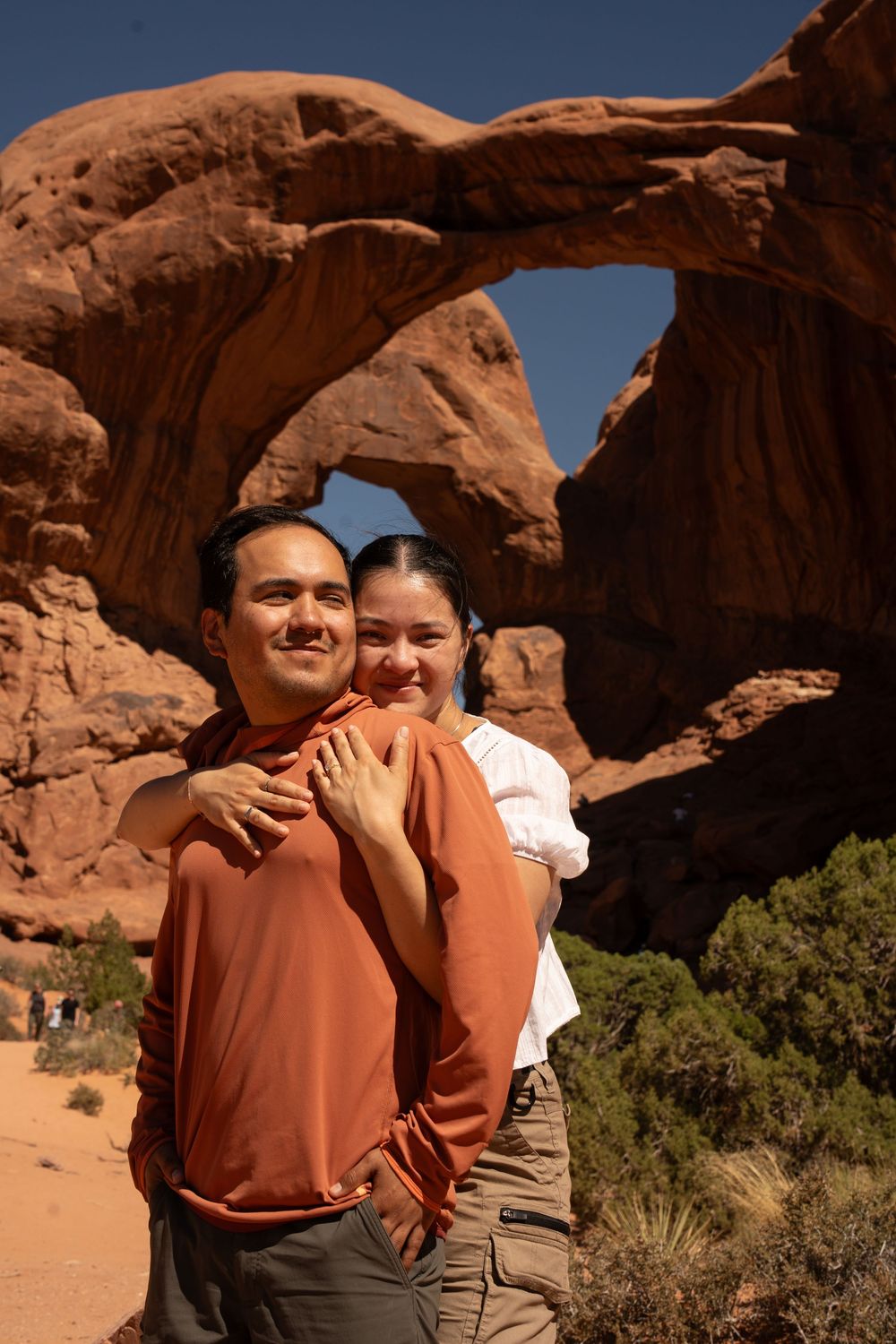
The two photos above are from Aaron and Lyna’s proposal, not a ceremony, but they’re shot right at Double Arch and give you a sense of scale and light. Read the full story of Aaron and Lyna’s Double Arch proposal for more of the trail itself.
Delicate Arch: The One I Usually Talk Couples Out Of (and When I Don’t)
Delicate Arch is the one on the license plate, the single most photographed formation in Utah, and the spot almost every couple asks about first for their ceremony. It’s also the one I steer most couples away from, though not always.
The hike itself is a serious commitment: about 3 miles round trip with roughly 480 feet of elevation gain, mostly exposed slickrock, and a narrow ledge for the final stretch. The National Park Service rates it difficult, and it earns that rating in summer heat especially, with almost no shade the entire way. That’s a serious consideration if you’re walking it in a dress or getting an officiant and witnesses up there too.
The bigger issue for a ceremony specifically is the crowd. Delicate Arch is one of the most popular hikes in the park, and it’s rare to get it to yourselves, especially at sunset when everyone else has the same idea. Exchanging vows in front of a packed viewpoint can turn an intimate ceremony into a performance for strangers, and the permit itself doesn’t reserve you private access, it just authorizes the ceremony to legally happen there alongside whoever else is on the trail that day.
If the audience doesn’t bother you, or you’re set on this specific arch no matter what, it’s still doable. I’d plan around sunrise instead of sunset (a noticeably smaller crowd shows up for it), and the same $185 NPS Special Use Permit that covers Double Arch covers Delicate Arch too, since it’s the same park-wide ceremony permit, not a per-location one. Most of the crowd and timing considerations I’d walk you through for a Delicate Arch proposal apply just as well to a ceremony there.
I haven’t documented an elopement ceremony at Delicate Arch myself, so I won’t put up a photo here that wasn’t taken at this specific spot. I know the trail well from scouting it, and I’m glad to plan a wedding there if this arch is the one you’re set on, I’d just rather tell you the tradeoffs upfront than let you find them out on your wedding day.
Distance: ~3 miles round trip, ~480 ft elevation gain, rated difficult by the NPS.
Crowds: Consistently one of the busiest hikes in the park, especially at sunset.
Ceremony permit: $185 NPS Special Use Permit, same permit that covers any ceremony location inside Arches.
Photos on this page: None yet; I haven’t documented an elopement here, and I won’t pass off a stand-in as if it were taken here.
Dead Horse Point & Canyonlands: The Big Overlook Option
If your ceremony vision is a sheer drop into a canyon carved by the Colorado River behind you as you say “I do,” this is where you go, not Arches.
Dead Horse Point State Park sits on a mesa with a nearly 2,000-foot overlook straight down into a gooseneck bend of the Colorado River, with Canyonlands National Park’s Island in the Sky district spread out beyond it. It’s a short, flat walk from the parking area to the main overlook, so this is a strong option if a long hike in wedding attire isn’t realistic for you or your guests.
The park charges a $20 day-use fee per vehicle (up to 8 people), $15 for Utah seniors 65+, $10 for motorcycles, or $10 per group of up to 4 walk-ins or cyclists. Unlike a proposal, an elopement ceremony at Dead Horse Point always needs a Special Use Permit from Utah State Parks on top of that day-use fee, since any wedding or ceremony there triggers the permit requirement regardless of headcount. It’s a state park process, separate from both BLM and NPS paperwork, so build in time to apply through the park directly.
Canyonlands National Park’s Island in the Sky district sits right next door and runs on national park rules instead: a $30 vehicle entrance fee, no timed-entry requirement, and the same $185 NPS Special Use Permit that applies anywhere inside the park for an actual ceremony. Mesa Arch, one of the park’s signature spots, is famous for framing sunrise through the arch itself, though be ready to share that specific view: it draws a dedicated crowd of photographers before dawn.
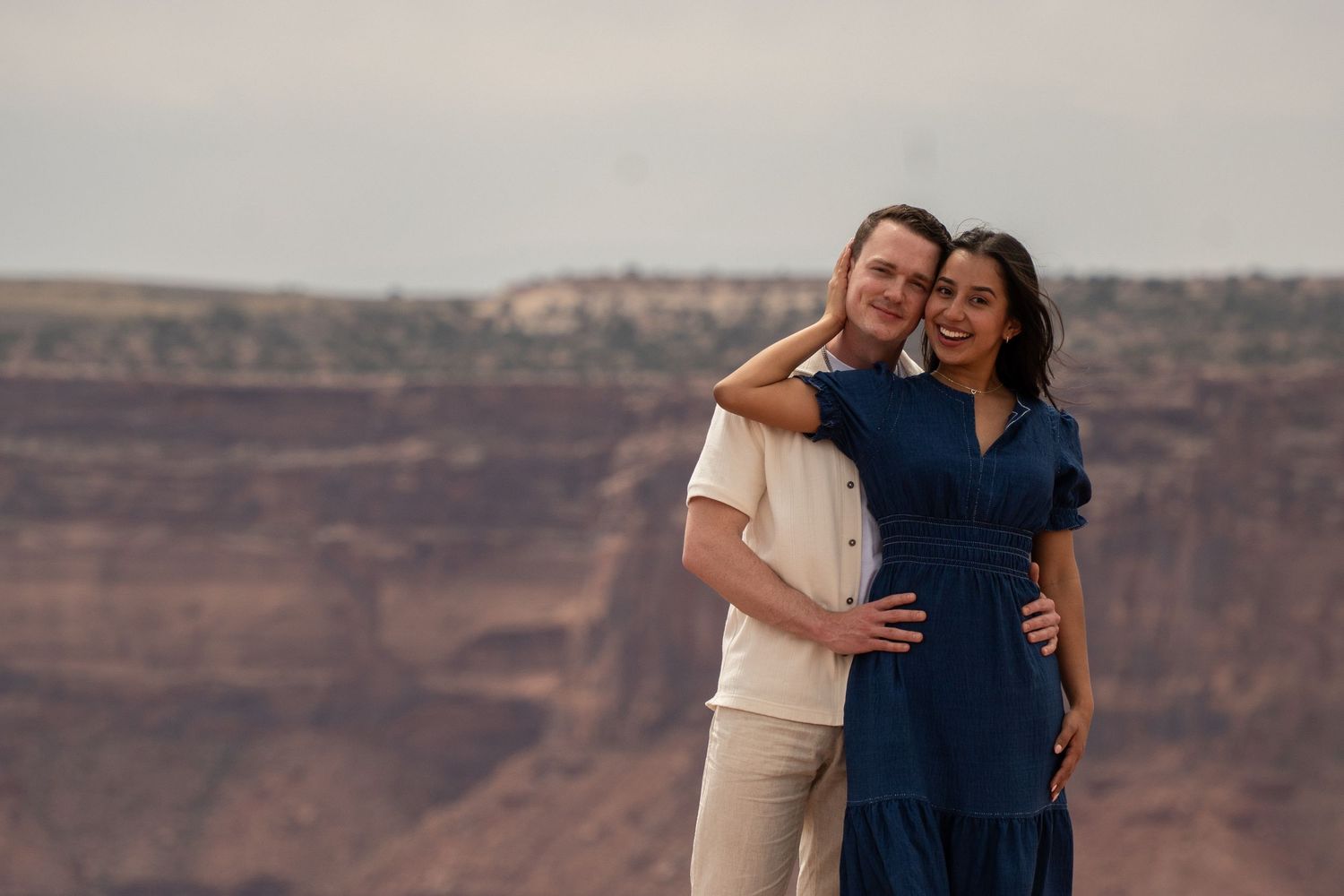
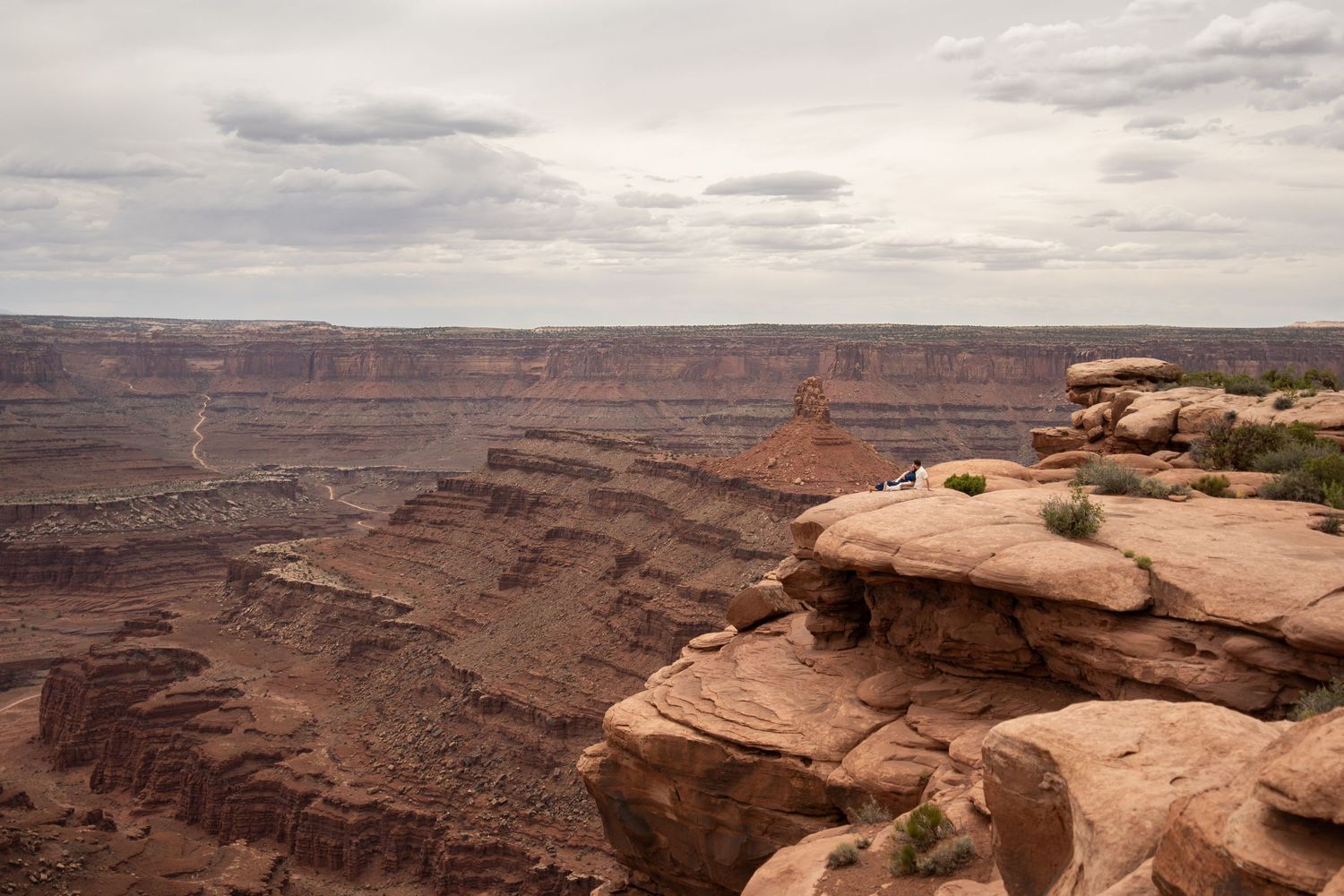
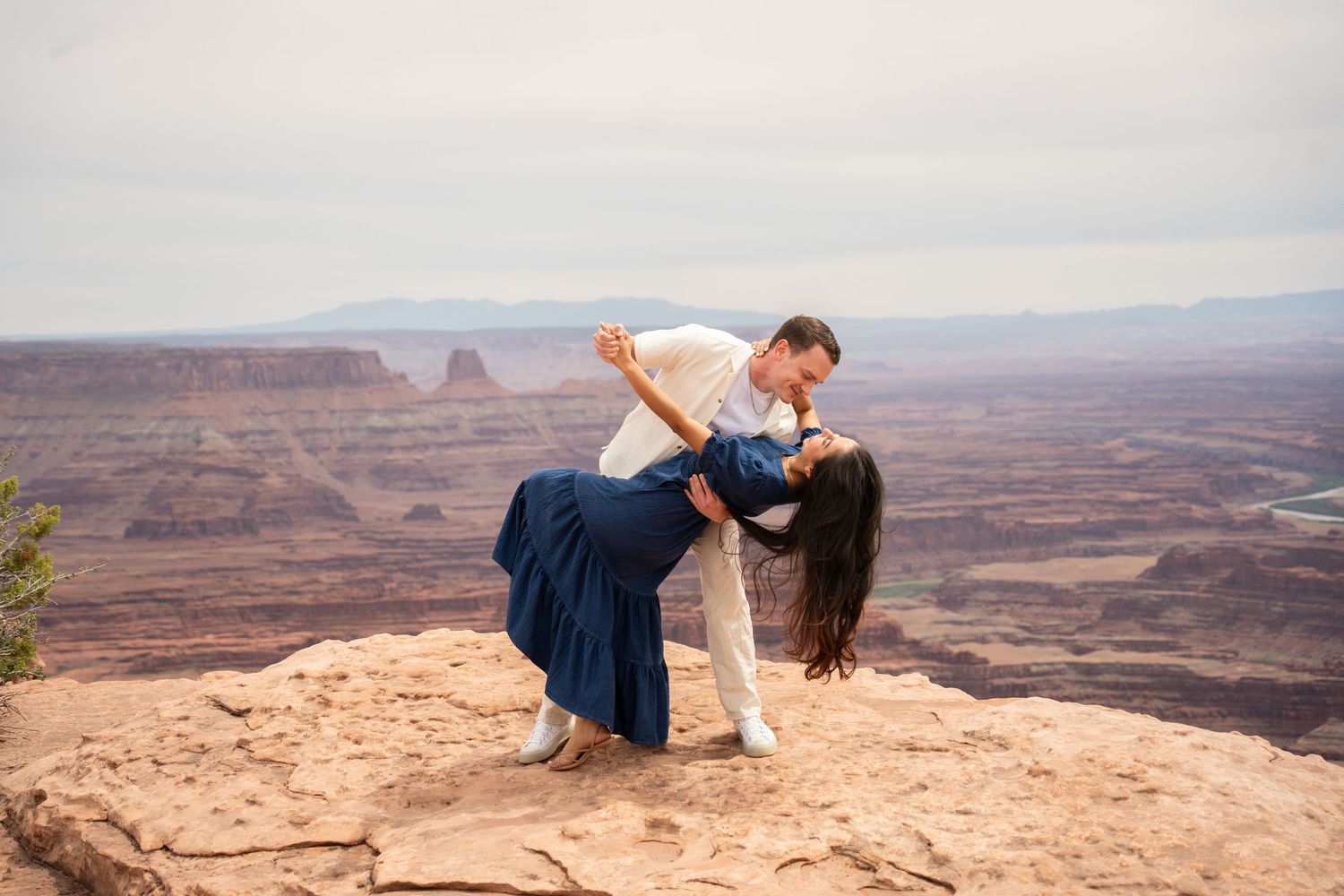
The photos below are documented ceremony photos, Luke and Karen’s elopement at Dead Horse Point overlooking Canyonlands, not a stand-in from another kind of session.
Because Canyonlands and Dead Horse Point deserve their own deep dive, permits, ceremony sites, every overlook worth considering, I’ve built that out in full on the dedicated Canyonlands elopement photographer page. Start there if this is the option you’re leaning toward.
Dead Horse Point fee: $20/vehicle (up to 8 people); $15 UT seniors 65+; $10 motorcycle.
Ceremony permit: Special Use Permit required, always, for any wedding or ceremony at Dead Horse Point.
Canyonlands (Island in the Sky) fee: $30/vehicle; $185 NPS Special Use Permit required for a ceremony.
Best known spot: Mesa Arch at sunrise, though expect company.
Fisher Towers: For Couples Who Want an Adventure Built Into the Day
Fisher Towers is the spot for a couple who wants the hike itself to be part of the wedding story, not just the backdrop at the end of it.
The towers sit about 20 miles northeast of Moab off Highway 128, the scenic route that follows the Colorado River instead of the highway through town. The trail loops roughly 4.5 to 5 miles around the base of the towers, with about 1,300 feet of elevation gain, a six-step metal ladder down into a canyon along the way, and close-up views of the Titan, the tallest freestanding sandstone spire on Earth. It’s BLM land, so the same rule applies as Corona Arch: no NPS-style permit for a small ceremony, though a larger group still needs to check in with the Moab Field Office about a Special Recreation Permit.
This is a distinctly different kind of red rock than Arches or Corona Arch: instead of a clean arch or a smooth overlook, you get jagged, almost otherworldly spires that look like something out of a different planet. It photographs dramatically different from anywhere else on this page, which is why some couples choose it for a ceremony that doesn’t look like everyone else’s.
Plan for a half-day commitment here, not an hour. The elevation gain and the ladder section mean this isn’t the spot for a wedding party that isn’t already comfortable hiking, and there’s no water source anywhere on the trail, so pack more than you think you and your guests need, especially if anyone’s in formal shoes for part of the day.
I don’t have a documented elopement from Fisher Towers on this page yet. I’ve scouted the trail and know it well enough to plan an actual ceremony there, I just haven’t had a couple choose it yet. If the idea of exchanging vows surrounded by the strangest rock formations in Moab appeals to you more than a classic arch, tell me, and let’s be among the first.
Distance: Roughly 4.5–5 miles round trip loop, ~1,300 ft elevation gain.
Land & permit: BLM land; no NPS-style permit for a small ceremony, BLM Special Recreation Permit past a small group size.
Access: About 20 miles northeast of Moab via Highway 128 (the Colorado River scenic route).
Photos on this page: None yet; I know the trail from scouting it, not yet from a documented elopement there.
Potash Road: River Views Without a Hike
If you want the Colorado River in your ceremony photos and zero interest in a trail beforehand, Potash Road is the answer.
Officially the Potash-Lower Colorado River Scenic Byway (Utah Route 279), it’s a paved 17-mile road that traces the river between sheer sandstone walls locals call Wall Street, popular with rock climbers for a reason. It starts about 4 miles north of Moab off Highway 191 and ends at the Potash boat ramp, with pull-offs along the way for the Moab Valley overlook, petroglyphs, dinosaur tracks, and two more arches, Bow Tie and Jug Handle, beyond the Corona Arch trailhead that starts along the same road.
Since it’s a drive-up option on BLM land, a small ceremony here doesn’t need an NPS-style permit, and there’s no hike required at all, which matters if grandparents or anyone with mobility limitations want to be part of your day. That also makes it one of the more flexible spots on this page for a couple working with a wedding party that isn’t up for a trail.
The tradeoff is privacy: it’s a public road with regular traffic, especially climbers heading to the crags along Wall Street, so a pull-off ceremony isn’t as isolated as a mile into a desert trail. Early morning is your best window, both for the light on the canyon walls and for having a pull-off mostly to yourselves.
I don’t have a documented elopement from a Potash Road pull-off yet, separate from the Corona Arch trailhead that sits along the same road. If a river view without any hiking is what you’re picturing for your vows, let’s talk about which pull-off gives you the best combination of light and privacy for your date.
Distance: Zero hiking required; multiple roadside pull-offs along a 17-mile paved road.
Land & permit: BLM-managed scenic byway (UT-279); no NPS-style permit for a small ceremony.
Best time: Early morning, for both the light and lighter traffic.
Along the way: Corona Arch trailhead, Bow Tie Arch, Jug Handle Arch, and Colorado River views.
The La Sal Mountains: The Cool-Weather Option
When Moab’s desert floor is pushing 100°F, the La Sal Mountains are sitting 30, sometimes 40 degrees cooler, fifteen minutes away, which matters a lot more for a ceremony where you and your guests are standing still than it does for a quick photo.
The La Sal Mountain Loop Road is a 60-mile paved scenic drive that starts about 6 miles south of Moab off Highway 191 and climbs into the Manti-La Sal National Forest. Near the top of the climb, an overlook around 8,300 feet gives you a sweeping view back over the red rock desert below, with Canyonlands and the surrounding mesas visible in the distance, evergreens and alpine meadows framing you on one side, and the whole desert spread out on the other. Another well-known pull-off looks out toward Castleton Tower, one of the more striking spires in the area.
This is national forest land, not BLM or NPS, so the permit path runs through the U.S. Forest Service instead. Manti-La Sal National Forest generally requires a special-use authorization for an organized wedding gathering, and current requirements are worth checking directly with the ranger district before you build a whole ceremony plan around it. If you book with me, this is the kind of paperwork my Half Day, Full Day, and Multi-Day elopement packages already fold in as an included National Forest permit, so you’re not the one tracking down a ranger district on your own.
There’s a defined seasonal window here: June through October is when the road is reliably clear and the wildflowers and meadows are at their best. Snow closes sections of the loop in winter, so this isn’t a year-round ceremony option the way most of the spots on this page are.
I haven’t documented an elopement in the La Sal Mountains yet. If pairing alpine and desert in the same ceremony, or just escaping a brutal July afternoon for your vows, sounds right for you, this is worth a proper conversation before you rule it out in favor of the more obvious desert spots.
Access: La Sal Mountain Loop Road, starting ~6 miles south of Moab off Highway 191.
Elevation: Main overlook sits around 8,300 ft, dramatically cooler than the desert floor.
Season: Reliably open June through October; snow closes sections in winter.
Land & permit: Manti-La Sal National Forest; special-use authorization generally required for an organized ceremony, check current USFS rules.
Moab Rim: The Panoramic Valley View
Moab Rim gives you the view that puts your whole wedding trip in context: the Moab Valley, Arches National Park, and the La Sal Mountains, all from one overlook behind you as you say your vows.
It’s better known as a serious 4x4 trail, which throws people off, but it’s also a legitimate hike. From the trailhead off Kane Creek Boulevard, about 2.6 miles from Highway 191, the route climbs steadily to a viewpoint at roughly 1.4 miles in. It’s steep and exposed the whole way, with no water source anywhere along the trail, so this one leans toward a couple who are already comfortable hikers, not a spot for a wedding party in dress shoes.
Because it’s also an active Jeep trail, you’ll likely share it with off-road vehicles heading up or down, worth knowing if total seclusion during your ceremony is the priority. What you get in return is one of the widest, most complete views of the Moab area available from any single spot on this page.
It’s BLM land, so the same rule applies here as Corona Arch and Fisher Towers: a small ceremony doesn’t need an NPS-style permit, and there’s no wait between deciding on this spot and booking it.
I haven’t photographed an elopement at Moab Rim yet. If a sweeping, take-in-the-whole-trip view matters more to you than a single dramatic formation, it’s worth a closer look before you default to Corona Arch just because it’s the one everyone’s heard of.
Distance: ~1.4 miles to the main viewpoint, steep and exposed.
Access: Trailhead off Kane Creek Blvd, ~2.6 miles from Highway 191.
Shared use: Also an active 4x4/Jeep trail; expect some vehicle traffic.
Land & permit: BLM land; no NPS-style permit for a small ceremony.
Found Your Spot? Let’s Lock In the Permit and the Timing
Once you know which of these eight fits you, the next call is the paperwork: which permit, if any, applies, and what timing gets you the light you’re picturing. I’ll walk you through both.
Best Time of Year to Elope in Moab, Month by Month
Moab’s desert heat is the main planning factor here, more than the label on the season, and it matters even more for a ceremony where you and your guests are standing still in wedding attire than it does for a quick hike-through. Here’s how each month plays out.
January: Cold, quiet, and often beautiful if a light dusting of snow hits the red rock. Daytime highs hover around 41°F, nights drop well below freezing. Trails are close to empty, so if privacy for your vows matters more than comfort, this is one of the best-kept-secret months in Moab. Dress for actual winter and expect icy sections on shaded trails.
February: Similar to January but starting to warm, daytime highs around 50°F. Still quiet, still cold at night. A solid month for winter’s privacy without quite as much bite, though layers under your ceremony attire still matter.
March: Highs climb into the low 60s, and Moab starts waking up. Easter Jeep Safari, one of the biggest off-road events in the country, typically lands in Moab this month and fills the town with off-roaders, which affects lodging availability more than trail crowds. Book your stay early if your date overlaps with it, and check current dates before you lock in.
April: One of the two truly ideal months. Highs around 70°F, comfortable temperatures for standing outside in a dress or suit, and wildflowers starting to show up on some trails. It’s also peak spring-break season, so the popular spots (Delicate Arch, Double Arch, Corona Arch) get busy midday. Sunrise and sunset timing matters more here than almost any other month if privacy is part of your vision.
May: Highs push into the upper 70s, and 100°F days can start showing up by the end of the month. Still comfortable for most of the day if you avoid midday. Crowds are heavy, this is one of Moab’s busiest windows, so plan your ceremony spot and timing carefully if privacy matters.
June: Highs average around 91°F, with plenty of afternoons well past 100°F. This is where sunrise and the last hour before sunset stop being a preference and become a requirement for anyone standing in wedding attire for more than a few minutes. Trails thin out fast after 10am.
July: The hottest month, average highs around 97°F, and about half of July’s days regularly hit 100°F or more. A pre-dawn ceremony start for a hike-in spot, or an evening ceremony at a drive-up location like Potash Road, are your best options if you’re set on a summer date.
August: Still brutally hot, highs around 93°F, but starting to ease slightly by the back half of the month. Same rules as July apply: sunrise or the final hour before sunset only. Afternoon monsoon storms become more common, which can make for dramatic sky photos if timed right and safely, though it’s worth a weather-contingency conversation if your spot needs a permit tied to a fixed date.
September: The other truly ideal month. Highs drop to a comfortable 86°F early in the month and keep falling, crowds ease off after Labor Day, and the light turns noticeably softer. If your travel dates are flexible, this is one of the two best windows on the calendar for a ceremony.
October: Highs around 70°F, similar comfort to April but with fall color starting to show in the cottonwoods along the rivers. Crowds are lighter than spring. This is widely considered one of Moab’s best all-around months for a wedding: comfortable temperatures, manageable crowds, and excellent light.
November: Highs drop to around 55°F, and the crowds thin out fast after the first couple weeks. A quiet month if you want the desert closer to yourselves for your vows, with mild enough weather that a coat over your ceremony attire handles it.
December: Cold and quiet again, highs around 41°F, similar to January. Holiday week can bring a small crowd bump, but otherwise this is one of the emptiest stretches of the year on the trails, good news if seclusion is the priority and you don’t mind the cold.
How to Plan Your Moab Elopement: My 3-Step Process
Planning a Moab elopement from out of state doesn’t have to mean months of untangling permit websites. Here’s how it works once you reach out, broken into the three decisions that matter: where, what permit path it needs, and when.
Step 1
Tell Me Your Dates, Headcount, and Vision
Once you know your travel window and roughly how many people are standing with you, that’s the two pieces I need to start. Tell me what you’re picturing, big classic arch or a quiet overlook, hiking ceremony or an easy walk-up, and I’ll match that to the spots on this page that fit both your vision and the permit path that makes sense for your group size.
Step 2
We Lock In the Permit, the Officiant, and the Marriage License Timing
If your spot needs a BLM Special Recreation Permit or an NPS Special Use Permit, I start that paperwork as early as possible since it’s the longest lead time on the trip. I handle your officiant booking too. Then we time your marriage license pickup, 32 days before your ceremony at most, so it’s not expired and not too fresh either.
Step 3
I Show Up Early and Document Every Unscripted Moment
I’m on location before you arrive, scouting the exact light and angle for your ceremony spot. I shoot candidly through your vows, the signing of your license, and whatever adventure comes after, not a posed re-creation. You focus on your partner. I handle the rest.
What to Expect on Elopement Day
Here’s the full timeline of a Moab elopement day, start to finish, so nothing on the actual day catches you off guard.
HOUR −1
Getting Ready, Wherever That Is
Whether that’s a hotel room downtown or the tailgate of your car at the trailhead, I catch the quiet moments before the day gets moving, boots going on, a last look in the mirror, your officiant reviewing the ceremony with you.
ARRIVAL
Getting to the Ceremony Spot
We hike, drive, or walk in together, however your chosen spot requires. If your permit is tied to a specific window of time, I’ve already built the schedule backward from it so there’s no rushing the last stretch of trail in your ceremony attire.
THE CEREMONY
Vows, Rings, and the License
This is the part the whole day is built around. I shoot candidly through your officiant’s words, your vows, the ring exchange, and the moment you sign your marriage license, so you have documentation of the exact minute you got married, not a staged recreation of it afterward.
AFTER
Portraits and Whatever Adventure Comes Next
Once the ceremony wraps, we shoot portraits of the two of you as newlyweds, then roll into whatever else is on your day, a hike further down the trail, a celebration meal, a champagne toast against the view you just got married in front of.
Getting to Moab, Where to Stay & Eat, and What to Budget
Getting There
Moab doesn’t have major commercial air service, so most out-of-state couples drive in. Salt Lake City International Airport is the closest major airport, but it’s a long haul: about 324 miles and 4.5 hours by car. Grand Junction Regional Airport in Colorado is the faster option for a lot of routes, about 100 miles and 2 hours of driving. If you’d rather skip the drive entirely, Canyonlands Field Airport (CNY), about 18 miles north of town, has had direct flights from Salt Lake City and Denver through smaller carriers, worth checking directly since regional flight schedules change often.
However you get here, build in buffer time. This isn’t a spot you fly into the morning of and get married that afternoon; between the drive or the connection, plus needing rest before an early sunrise ceremony, plan at least one full night in town before your wedding day.
Where to Stay
Most lodging clusters along Main Street (Highway 191). Staying on the north end puts you 5 to 10 minutes from the Arches entrance, useful if your ceremony spot is Double Arch or Delicate Arch and you want to beat the day-trip crowd in. Staying downtown puts restaurants, outfitters, and the visitor center within walking distance, which matters more if Corona Arch, Potash Road, or Moab Rim (all southwest of town) are your spot. The south end of Highway 191 tends to run a little cheaper and a little quieter than downtown.
If you want something more memorable than a standard hotel room for your wedding trip, a handful of properties lean into the setting, think Colorado River views, historic ranch grounds, or a private balcony facing red rock. Whatever you book, reserve early if your dates land anywhere near Easter Jeep Safari (typically March or April) or a summer holiday weekend; those windows sell out fast.
Where to Eat
Moab’s food scene punches above its weight for a town this size. Milt’s Stop & Eat has been serving burgers and hand-spun shakes from a roadside stand since 1954, a beloved local institution worth the stop before or after your ceremony. For a celebration dinner, Antica Forma (wood-fired Neapolitan pizza) and Pasta Jay’s (Italian, around for decades) both work well. Fiesta Mexicana is the local favorite for Mexican food, and Sabaku Sushi is the surprise standout if you want something completely different from red rock and burgers for your wedding-night meal. Book ahead if you’re planning a celebratory dinner right after your ceremony, especially in peak season, small-town restaurants fill up fast on a Friday or Saturday night.
Budget Considerations
Beyond the photography and permit itself, plan for: a park entrance fee if your spot is inside Arches or Canyonlands ($30/vehicle, covers your whole group for the visit); the Dead Horse Point day-use fee if that’s your spot ($20/vehicle); your marriage license ($30 to $50 through the county clerk); lodging, which swings widely by season (expect summer and Easter Jeep Safari weekend rates well above a quiet November night); gas for driving in, especially from Salt Lake City; and a celebration meal or activity afterward if you’re building that into the day. If you book through me, permit paperwork is folded into the Half Day, Full Day, and Multi-Day packages rather than an extra line item you have to track down yourself. Your biggest actual cost beyond the trip itself is the photography package, and that’s the one piece I can give you an exact number on before you book anything.
Your Permit Timeline Is the Deadline That Matters Here
An NPS Special Use Permit or a state park permit takes substantial lead time to process. A small BLM elopement doesn’t. Either way, the sooner you tell me your date and headcount, the sooner I can tell you what to file and when.
Skip the heels. Corona Arch, Fisher Towers, and Moab Rim all cross loose sand and slickrock, and a heel makes the hike miserable and the ceremony photos worse. A low block heel or a dressy flat sandal works for the easier walk-up spots like Double Arch, Dead Horse Point, or Potash Road; save anything with more height for a celebration dinner afterward.
Think through your ceremony attire in layers, not just for style but for the trail. A dress with a shorter underlayer and a longer overlay you can bustle or remove works better on a hiking spot than a full-length gown with a train dragging across slickrock. If a suit’s part of your look, breathable fabric matters more than it does for an indoor venue.
Water matters more than people expect, even for a short walk, and it matters for your whole wedding party, not just the two of you. Desert air pulls moisture out of you faster than it feels like at the time, especially above 80°F. Bring more than you think you need, and bring extra if your spot is Fisher Towers or Moab Rim, neither has a water source anywhere on the trail.
Sun protection is non-negotiable for anything outside the shoulder-season months: most of these spots offer little to no shade. A hat, sunscreen, and sunglasses cost you nothing in the ceremony photos and save you a bad sunburn on your wedding day.
If you’re timing the ceremony around sunrise or sunset, which most of these spots call for, bring a light layer too, something you can throw over your shoulders during vows and shed for portraits after. Desert temperatures swing hard once the sun’s off the rock, even on a hot day; a 95°F afternoon can drop 30 degrees within an hour of sunset.
For a winter elopement, add proper layers underneath your ceremony attire: a warm coat you can wear right up until the vows start, gloves, and traction if you’re headed anywhere with shaded, icy sections. Camera batteries handle cold just fine on my end; it’s usually a couple’s fingers that struggle first while exchanging rings, so hand warmers are worth the extra ounce in your bag.
Don’t forget the paperwork itself: your signed marriage license (bring it with you, don’t leave it at the hotel), valid photo ID for both of you, and if your spot requires a permit, a printed or downloaded copy of it in case anyone on the trail asks. Wondering what to wear against all that red rock beyond the practical basics? I’ve put together a full breakdown of colors, fabrics, and footwear that hold up for a Utah red-rock session in what to wear for photos in Zion, Arches, Canyonlands, and southern Utah’s red rocks.
Which Moab Elopement Spot Fits You?
Eight options is a lot to compare from your couch. Here’s the short version: match your priority in the left column to the spot that delivers it.
If you want…
Best spot
Effort
Ceremony permit
The classic red-rock-arch ceremony, simplest permit path
Corona Arch
Moderate, ~3 mi
None (small group)
A big national-park arch with minimal walking
Windows / Double Arch
Easy, short walk
$185 NPS
The single most iconic formation in Utah
Delicate Arch
Difficult, ~3 mi
$185 NPS
A sheer canyon overlook, little to no hike
Dead Horse Point
Easy
State Parks Special Use Permit
Sunrise drama and a national park backdrop
Canyonlands (Mesa Arch)
Easy–moderate
$185 NPS
A serious hike and dramatic, unusual rock spires
Fisher Towers
Difficult, ~5 mi
None (small group)
River views with zero hiking, easiest for guests
Potash Road
None
None (small group)
Cooler temps and mountain scenery
La Sal Mountains
None–easy
USFS special-use authorization
A sweeping panoramic view of the whole valley
Moab Rim
Difficult, ~1.4 mi
None (small group)
Still not sure? A few patterns from couples I’ve worked with: the pair who wants their whole wedding morning to feel like an adventure usually ends up at Fisher Towers or Corona Arch. The couple who wants the photos to look unmistakably like a national park chooses Double Arch or Mesa Arch and builds the NPS permit lead time into their planning from day one. The couple bringing grandparents or anyone who can’t manage a demanding hike goes for Dead Horse Point or Potash Road. And more couples than you’d expect end up choosing the La Sal Mountains specifically for a summer date, trading a slightly more involved Forest Service permit for a ceremony that doesn’t require anyone to stand in 100°F heat.
Permits, Legal Requirements & the Marriage License
Here’s the section most guides bury in fine print halfway down the page. I’m putting it up front and making it simple. The short version: a small ceremony on BLM land skips the federal permit process, a ceremony inside a national park always needs the $185 NPS permit, and everyone needs a Utah marriage license no matter which spot they choose.
Spot
Land manager
Entrance fee
Small elopement (2–4 people)
Larger group ceremony
Corona Arch
BLM
None
No permit
BLM Special Recreation Permit
Windows / Double Arch
NPS (Arches)
$30/vehicle
$185 NPS Special Use Permit
$185 NPS Special Use Permit
Delicate Arch
NPS (Arches)
$30/vehicle
$185 NPS Special Use Permit
$185 NPS Special Use Permit
Dead Horse Point
Utah State Parks
$20/vehicle
State Parks Special Use Permit
State Parks Special Use Permit
Canyonlands (Island in the Sky)
NPS
$30/vehicle
$185 NPS Special Use Permit
$185 NPS Special Use Permit
Fisher Towers
BLM
None
No permit
BLM Special Recreation Permit
Potash Road
BLM
None
No permit
BLM Special Recreation Permit
La Sal Mountains
Manti-La Sal National Forest
None
Check current USFS rules
USFS special-use authorization
Moab Rim
BLM
None
No permit
BLM Special Recreation Permit
The pattern here is simple once you see it laid out: BLM land (Corona Arch, Fisher Towers, Potash Road, Moab Rim) has essentially zero red tape for a small ceremony, though the Moab Field Office steps in with a Special Recreation Permit once your group grows past a small handful of people, a process that can take months. National park land (Arches, Canyonlands) always needs the $185 NPS Special Use Permit for a ceremony, regardless of headcount, since the permit covers the legal act of marrying, not the crowd size, though photography alone with no vows exchanged doesn’t trigger it. Dead Horse Point runs its own separate state park process on top of the day-use fee. Fees and permit rules change over time, so double-check current details on the relevant agency’s website before you travel, and I’m always glad to help you sort out the current rules for your exact spot and date.
Your Utah Marriage License
Every ceremony on this page, no matter the location or the permit, needs the same legal foundation: a Utah marriage license. Any county clerk in the state can issue one, so you can pick one up in Salt Lake City on your way down or right in Moab at the Grand County Clerk’s office, whichever fits your travel route better.
There’s no waiting period between applying and receiving it, so you can walk out with a valid license the same day. It’s good for 32 days from the date it’s issued, which matters if you’re arriving in Moab well ahead of your ceremony date; get it too early and you risk it lapsing before you say “I do.” Bring valid photo ID for both of you, and budget $30 to $50 for the license fee, which varies a little by county.
Utah requires an officiant and 2 witnesses present at the ceremony itself. Once your officiant signs the license along with your witnesses, it gets filed with the county, and you’re legally married, no courthouse trip required afterward. If you’d rather have someone you love lead the ceremony instead of hiring a stranger, Utah allows a friend or family member to become ordained online specifically for this, which plenty of couples choose to do. If you’d rather not deal with that paperwork, every one of my elopement packages includes officiant coordination: I find, book, and confirm one before you arrive, and the officiant's fee is separate.
Why Book Someone Who Already Knows Moab
Permit paperwork handled, not guessed at. I know which agency to file with for which spot, and I fold BLM and NPS permit coordination into my Half Day, Full Day, and Multi-Day packages so it’s not sitting on your plate.
Scouted, not guessed. I’ve hiked every trail on this page, several more than once, in more than one season, so the spot I recommend is based on what works for a ceremony, not what has the most tagged photos.
A marriage officiant already lined up. Every package includes one, booked and confirmed before you arrive, so that’s one fewer vendor you have to track down from out of state.
Local knowledge you can’t get from a blog post. Which trailhead fills up by 8am, which overlook holds golden hour longest, which spot to skip entirely on a given day. That comes from being here, repeatedly, not from a single scouting trip.
One quote, no surprises. Since Moab sits inside Utah, there’s no extra travel fee tacked onto your package the way there would be for an out-of-state or international elopement, and I’ll walk you through which package tier fits your ceremony spot before you book anything.
Moab Elopement Photos
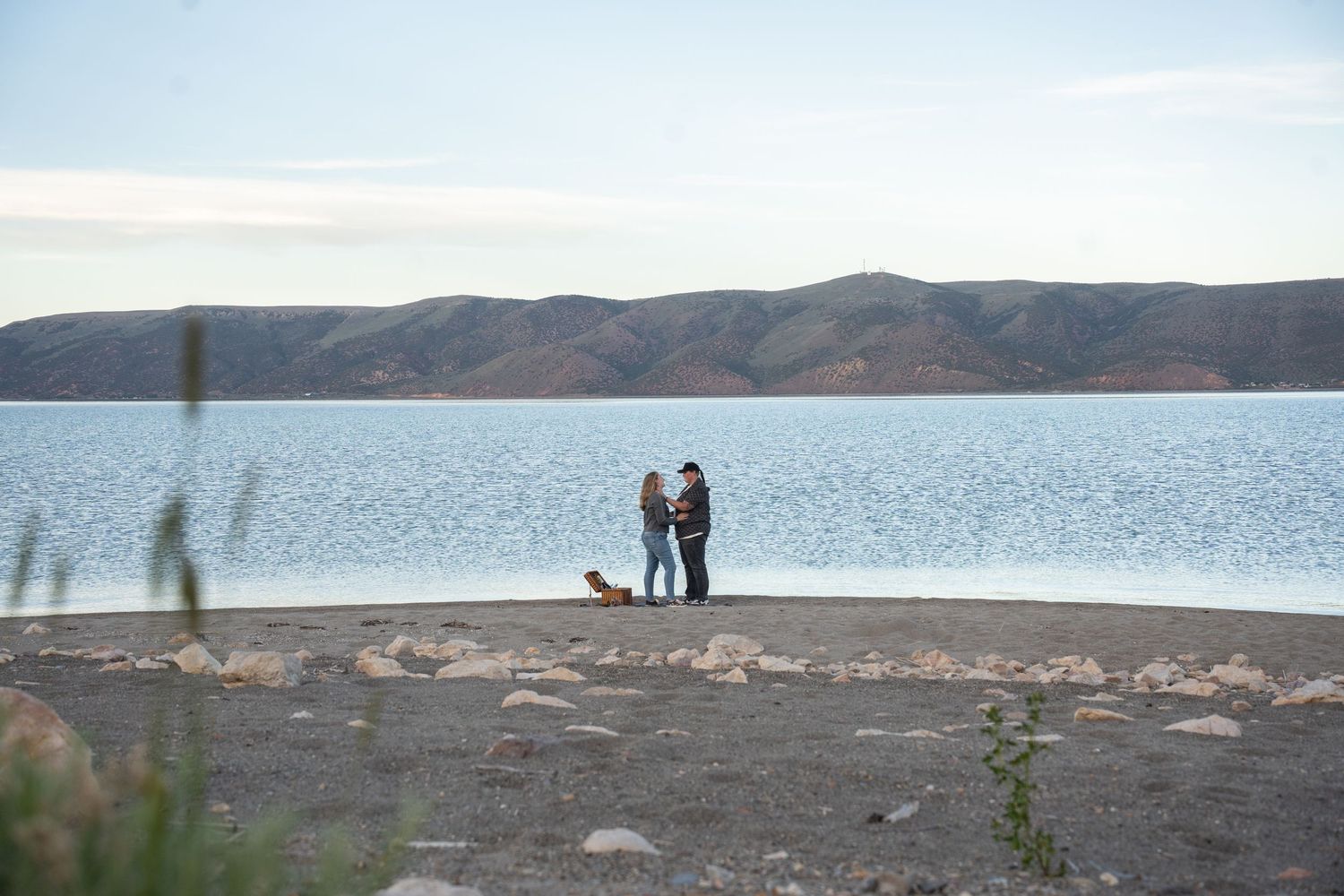
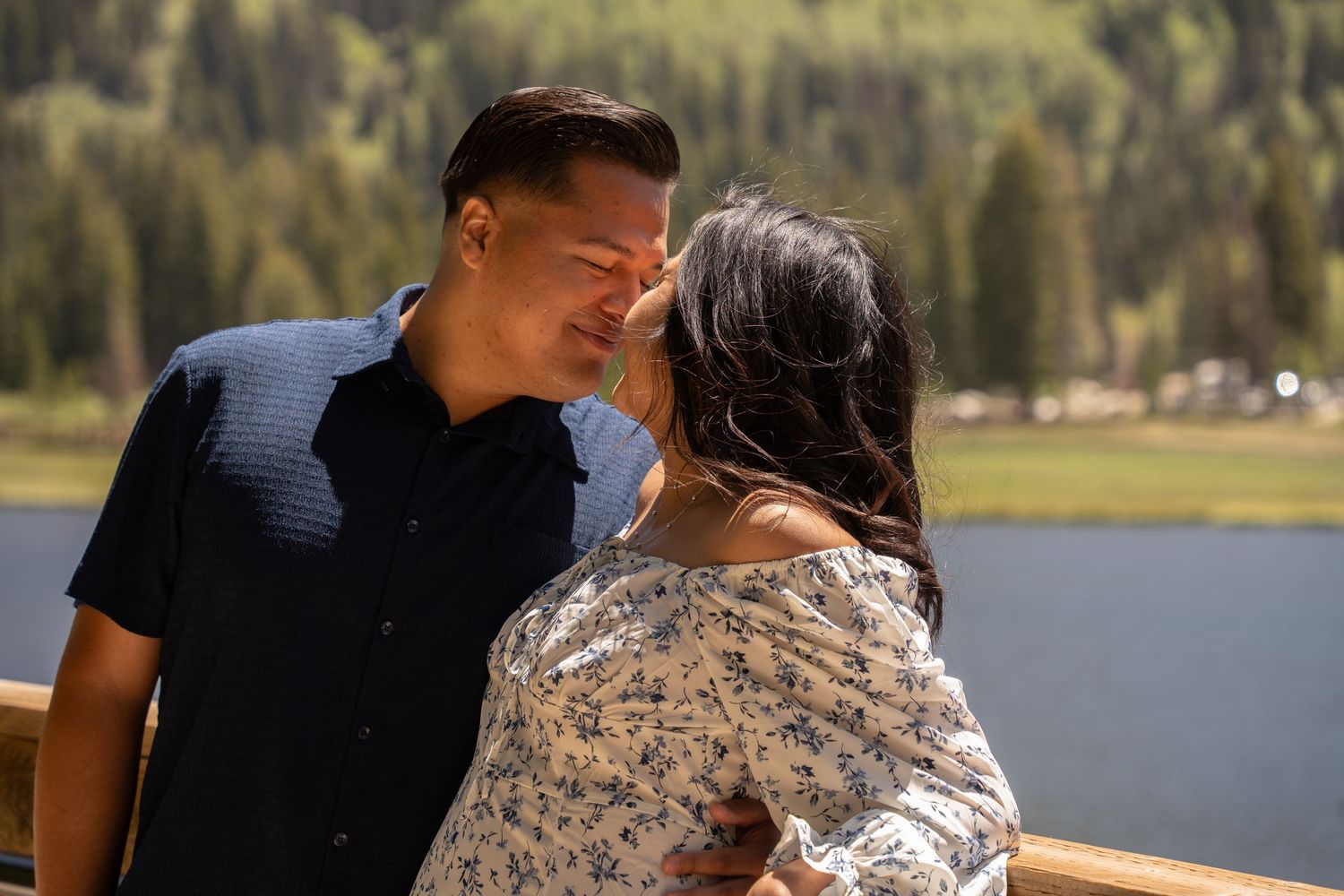
A mix of documented ceremonies and location scouting from across Moab: Luke and Karen’s Dead Horse Point elopement, plus location photography from Corona Arch and Double Arch that shows you how those spots look for a wedding.
The last two photos above are from proposals rather than a ceremony, but they’re shot at Corona Arch and Double Arch, two spots I recommend for an elopement, and they show you the light and scale you’d get on your wedding day too. Read the full story behind Luke and Karen’s Dead Horse Point elopement for a closer look at what a documented Moab-area ceremony looks like start to finish.
Photographer
Your Moab Elopement Photographer
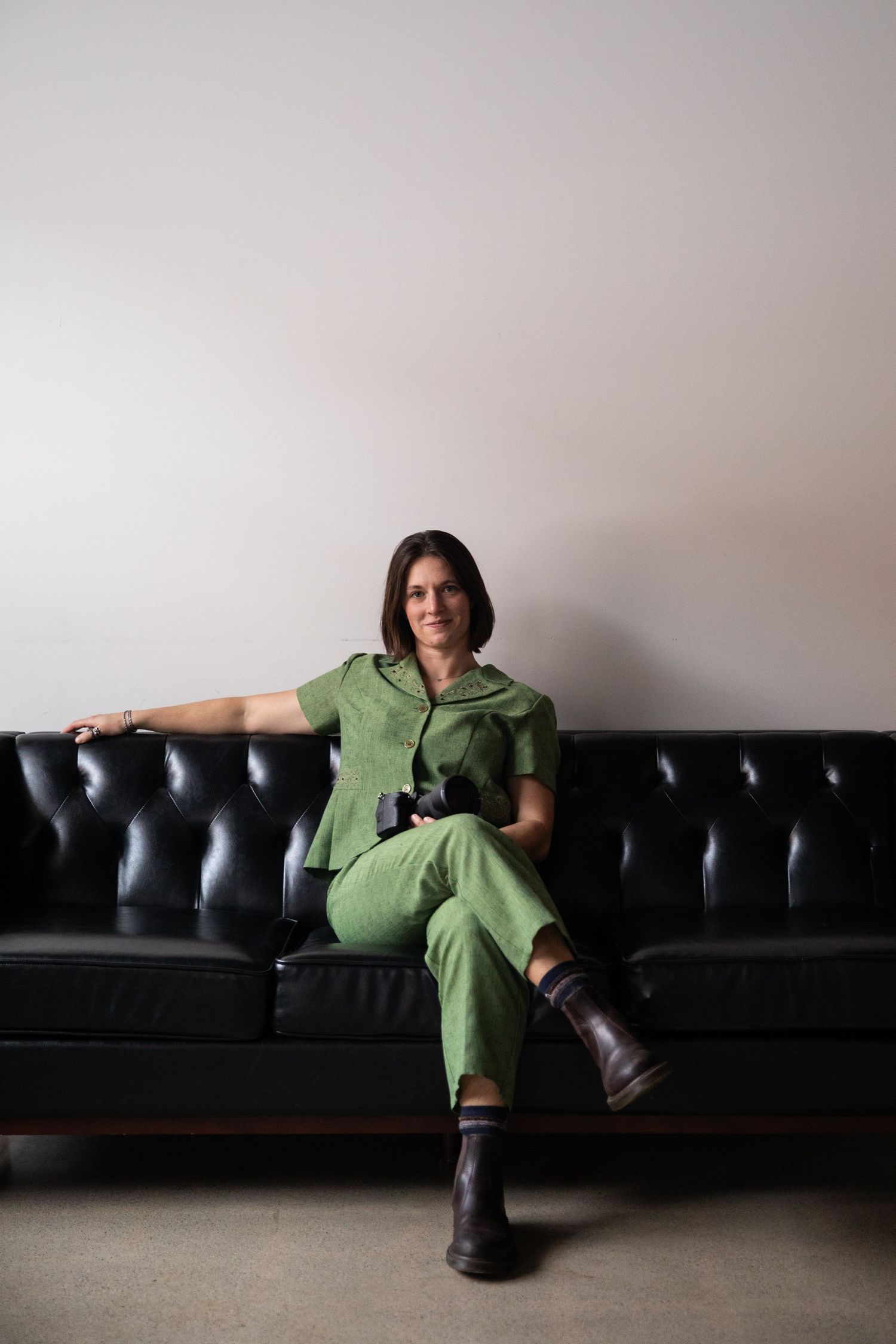
I’m Jade, a Utah-based elopement photographer, and Moab is one of my favorite places to marry a couple. I’ve spent the last several summers exploring this stretch of desert, scouting the trails at different times of day and different seasons, and learning which spots hold up for an actual ceremony, not just a quick photo. I know which locations need a $185 NPS permit, which ones skip that process entirely on BLM land, and how the heat moves through the day so your vows happen in the best light instead of the worst of it.
Corona Arch is the spot I shoot most, but Dead Horse Point, Arches, and the quieter BLM spots on this page are all worth considering depending on your headcount and what you want the ceremony to feel like.
My elopement packages start at $3,100 for the Half Day, which covers a ceremony anywhere in Utah with National Forest permits included, or $4,100 for the Full Day if your spot sits inside Arches or Canyonlands, since that’s the tier that bundles the National Park Service permit in alongside the National Forest one. Since Moab is inside Utah, there’s no extra travel fee added to either package. Every package includes officiant, florals, and hair and makeup coordination, with each vendor’s fee added to your second invoice. Tell me your headcount and your ceremony spot, and I’ll tell you which package fits before you book anything.
Ready to Plan Your Moab Elopement?
Tell me your dates, your headcount, and whether Corona Arch, Dead Horse Point, or somewhere else is calling your name, and I’ll build a day that’s completely your own, permits and all.
For a small elopement (just the two of you, your officiant, and me), BLM land like Corona Arch, Fisher Towers, Potash Road, or Moab Rim doesn’t need the NPS-style permit process. Where it changes: the Moab Field Office requires a Special Recreation Permit once your group grows past a small handful of people, and that permit can take months to process, so if you’re picturing a bigger group ceremony on BLM land, tell me early and I’ll get the paperwork moving well ahead of your date. Choosing Arches National Park instead is a more predictable process regardless of group size: a $185 NPS Special Use Permit, every time, for the ceremony itself.
Can we elope inside Arches National Park instead of on BLM land?
Yes. Spots like Double Arch are stunning and very doable: you’ll need a $185 NPS Special Use Permit for the ceremony itself, applied for through NPS Form 10-930 and Pay.gov, ideally as early as you can since more involved requests take longer to process. Photography alone, with no ceremony taking place, doesn’t need a permit in public areas of the park, which is a different rule than the one for your actual vows. Timed entry isn’t in effect for 2026 as of this writing, though that’s worth double-checking again as your date approaches since it’s changed from year to year. I handle the permit coordination so you’re not stuck untangling NPS paperwork two states away.
How do we get a marriage license for a Moab elopement?
Utah marriage licenses are issued statewide by any county clerk, so you can pick one up in Salt Lake City on your way down or right in Moab at the Grand County Clerk’s office. There’s no waiting period, it’s valid the moment it’s in your hands, and it’s good for 32 days, so time it close to your ceremony date. Bring valid photo ID for both of you, and budget $30 to $50 for the license fee, which varies a little by county. If either of you isn’t a U.S. citizen, call ahead: the clerk’s office can tell you which form of ID they’ll accept before you make the trip.
Do we need to be experienced hikers to elope at Corona Arch?
No trail experience required, just sturdy footwear and reasonable stamina for a few miles of uneven ground. Once we’ve locked in which spot you’re eloping at, I’ll walk you through what pace and terrain to expect, plus how your ceremony attire holds up on that specific trail, so there aren’t any surprises on the day.
How many people can come to a BLM elopement before we need a Special Recreation Permit?
The Moab Field Office doesn’t publish one fixed headcount that applies to every situation, since the threshold depends partly on the specific site and how it’s used, but the practical rule of thumb is a small elopement, the two of you, an officiant, a witness or two, and me, stays under it comfortably. Once you start adding a formal guest list, string lights, chairs, or anything that reads as an organized event rather than two people and their photographer, that’s when the permit conversation starts. Tell me your planned headcount as soon as you have it, and I’ll flag it if you’re close to that line.
Can our officiant be a friend or family member instead of someone we hire?
Utah allows a wide range of people to legally solemnize a marriage, including a friend or family member who becomes ordained online, which plenty of couples do specifically so someone they love can lead the ceremony. If you’d rather not deal with a stranger’s ordination paperwork, every one of my elopement packages includes officiant coordination: I find, book, and confirm one before you arrive, and the officiant's fee is separate, so that’s one fewer vendor for you to track down.
Is Dead Horse Point a good elopement spot even though a permit is required there too?
Yes, and the permit is more straightforward than it sounds. Dead Horse Point State Park requires a Special Use Permit for any wedding or ceremony on top of the standard $20 day-use fee, but unlike Arches, it’s a state park process rather than a federal one, and the payoff is a nearly 2,000-foot overlook into a gooseneck bend of the Colorado River with almost no hiking required to reach it. If a big canyon view matters more to you than avoiding paperwork, it’s worth the extra step.
What if we want a legal ceremony privately and a bigger celebration with guests somewhere else?
This is more common than couples expect, and it sidesteps a lot of the permit conversation entirely. Sign your marriage license in front of your officiant and two witnesses at a small, private ceremony on BLM land, then treat a second gathering, at a restaurant, a rental house, or even back home, as the celebration rather than the legal event. Only the small ceremony needs to satisfy Utah’s officiant-and-witnesses requirement; the second gathering can be as big or as low-key as you want without any permit tied to it.
What happens to our permit if the weather forces us to change our date or location?
An NPS Special Use Permit or a state park Special Use Permit is tied to a specific date and location, so a weather-driven change usually means contacting the issuing office directly to amend it, which can take time you may not have on a short trip. This is the tradeoff a permitted ceremony carries that a small BLM elopement doesn’t: on BLM land, a same-day pivot in timing or a nearby spot doesn’t require anyone’s sign-off. If a permitted site is the one you want regardless, I build a weather contingency into your plan ahead of time so a shift in forecast doesn’t turn into a scramble.
How far in advance should we book a Moab elopement photographer?
As soon as your permit timeline is clear, since that’s usually the longer lead time on the whole trip, not my calendar. If Arches is your spot, start the $185 NPS Special Use Permit application as early as you can and book me alongside it. If you’re eloping on BLM land with a small group, my calendar becomes the limiting factor, and a summer sunrise or sunset slot is safer booked 2 to 3 months out. A quieter month like November or January usually still has room 2 to 4 weeks ahead.
Does a Utah elopement package cover the marriage license fee too?
No, the county clerk’s license fee ($30 to $50, paid directly to the county) is separate from your photography package and isn’t something I collect or mark up. What my Half Day and Full Day packages do cover is the marriage officiant who signs it with you, plus permit handling for the location itself: National Forest permits on the Half Day tier, and both National Forest and National Park permits on the Full Day tier.
Written by
Jade Jarvis
Utah-based wedding, elopement, and proposal photographer since 2025. I’ve scouted these locations myself, so the advice here comes from firsthand experience, not guesswork.