Delicate Arch Proposal Timing: How to Avoid Strangers in Every Photo
Every couple who’s watched a Delicate Arch proposal video pictures the same scene: red rock, gold light, nobody else in the frame. What they don’t picture is the forty other people standing right there with them, phones out, waiting for their turn under the same arch.
That crowd is the problem. It’s not your photos.
I can select and erase a stray hiker from an image in about thirty seconds of editing. What I can’t edit after the fact is the two of you getting down on one knee in front of forty strangers who are all watching it happen live. Delicate Arch proposal timing is a question about privacy in a public place, not about camera tricks or clever angles.
So that’s what this guide covers, in more depth than most: the hour-by-hour crowd pattern at sunrise, which months do the most work thinning the trail out, which days to avoid, and the specific way I stage a couple inside that famous rock bowl so the moment still feels like yours, crowd or no crowd.
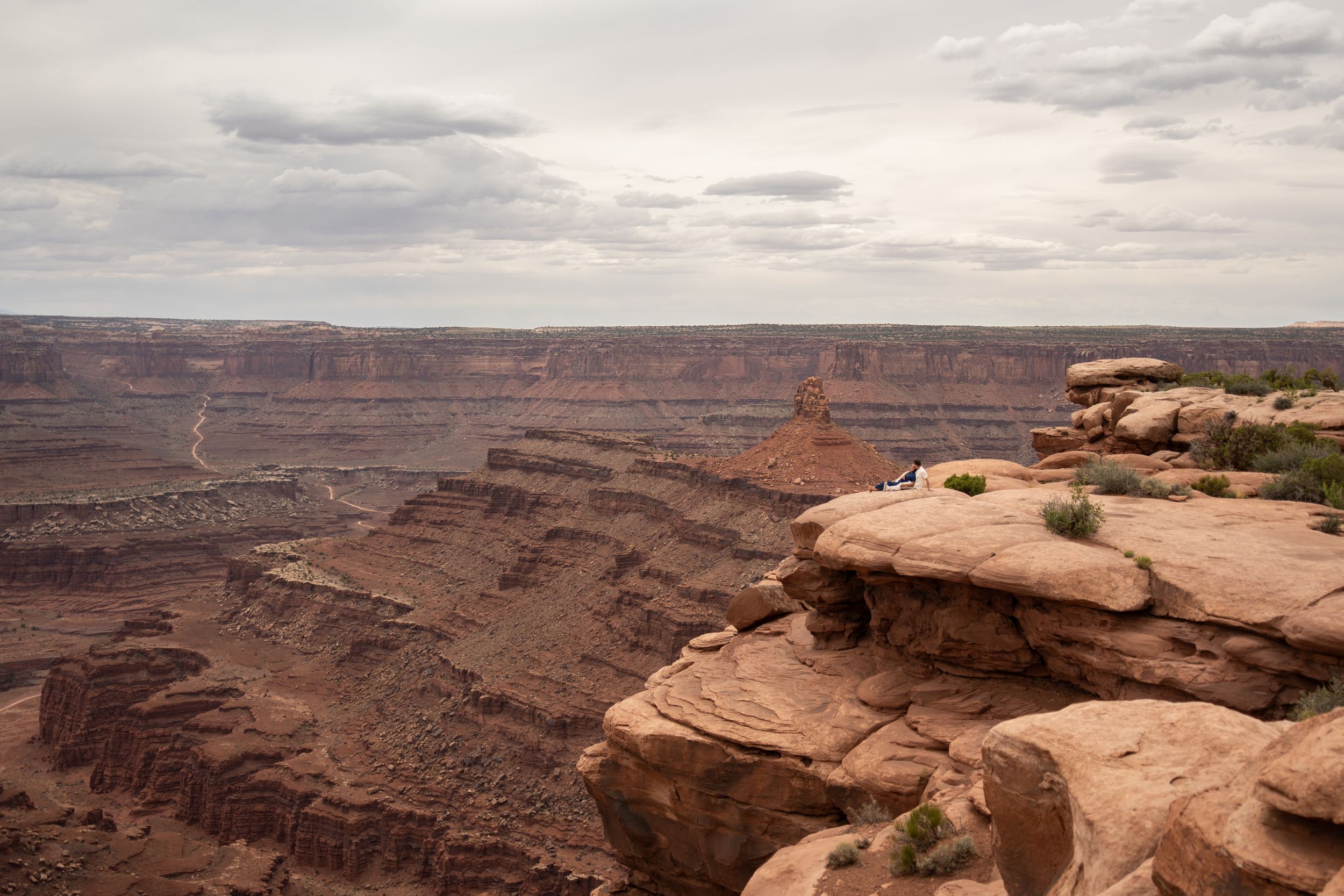
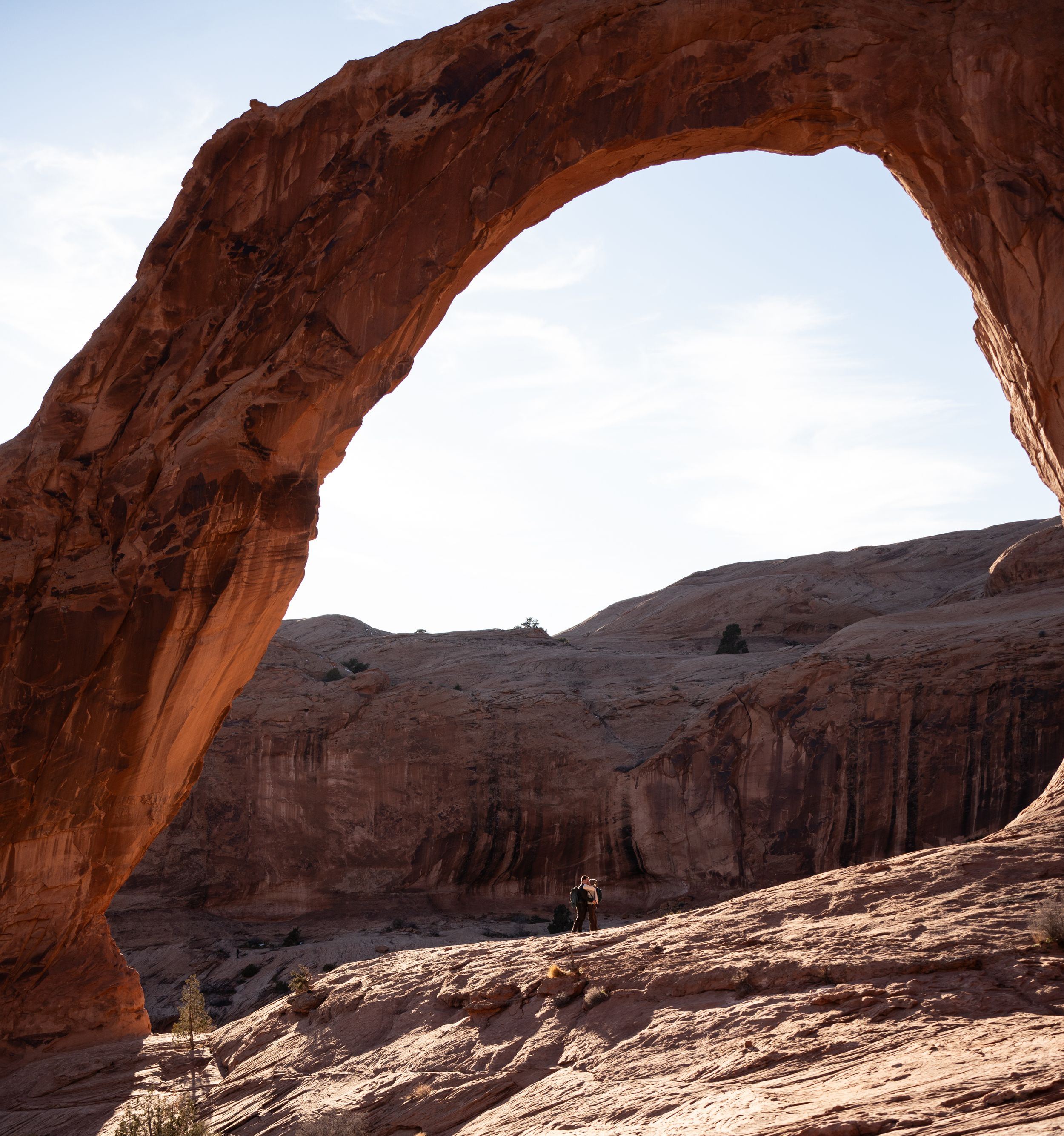
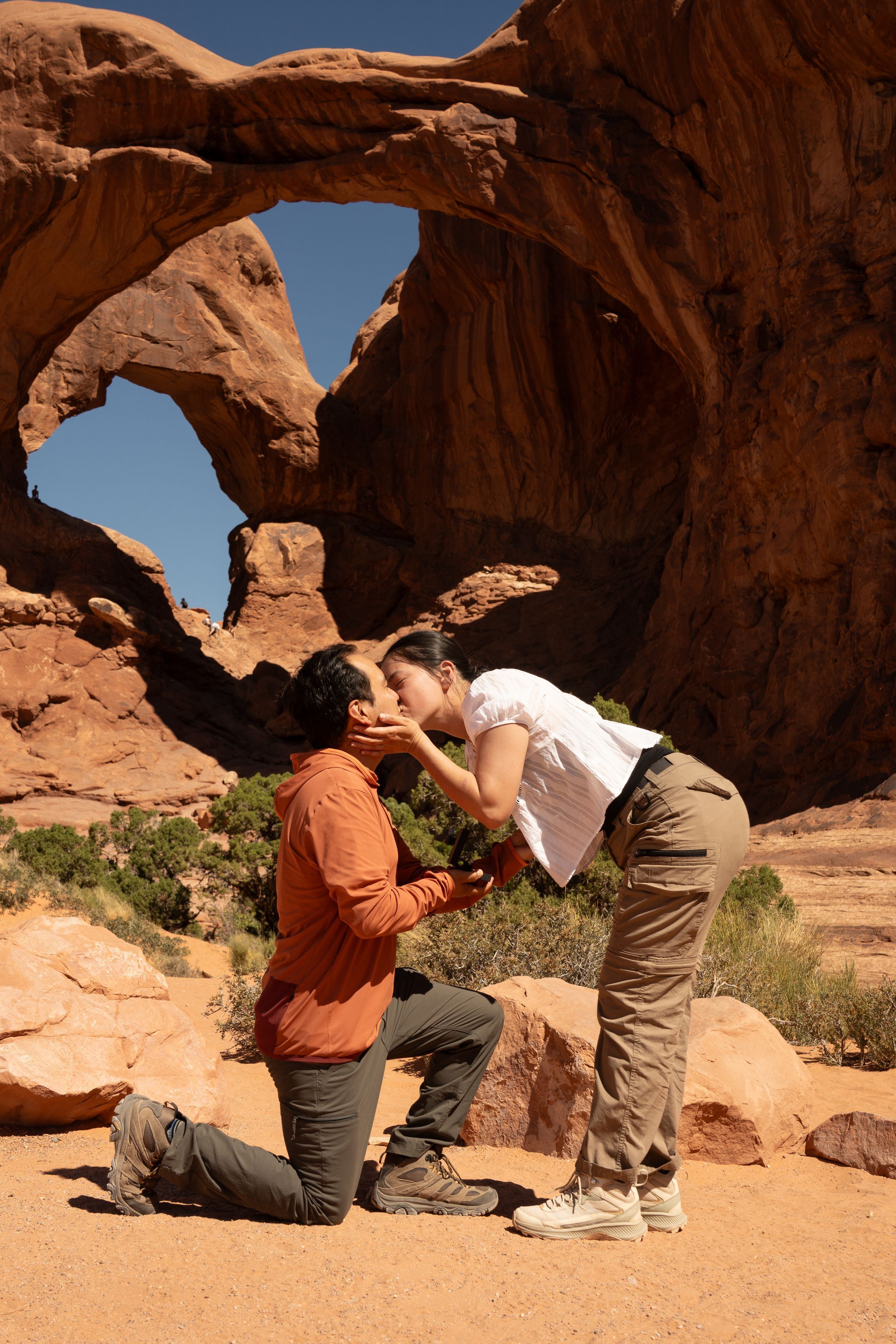
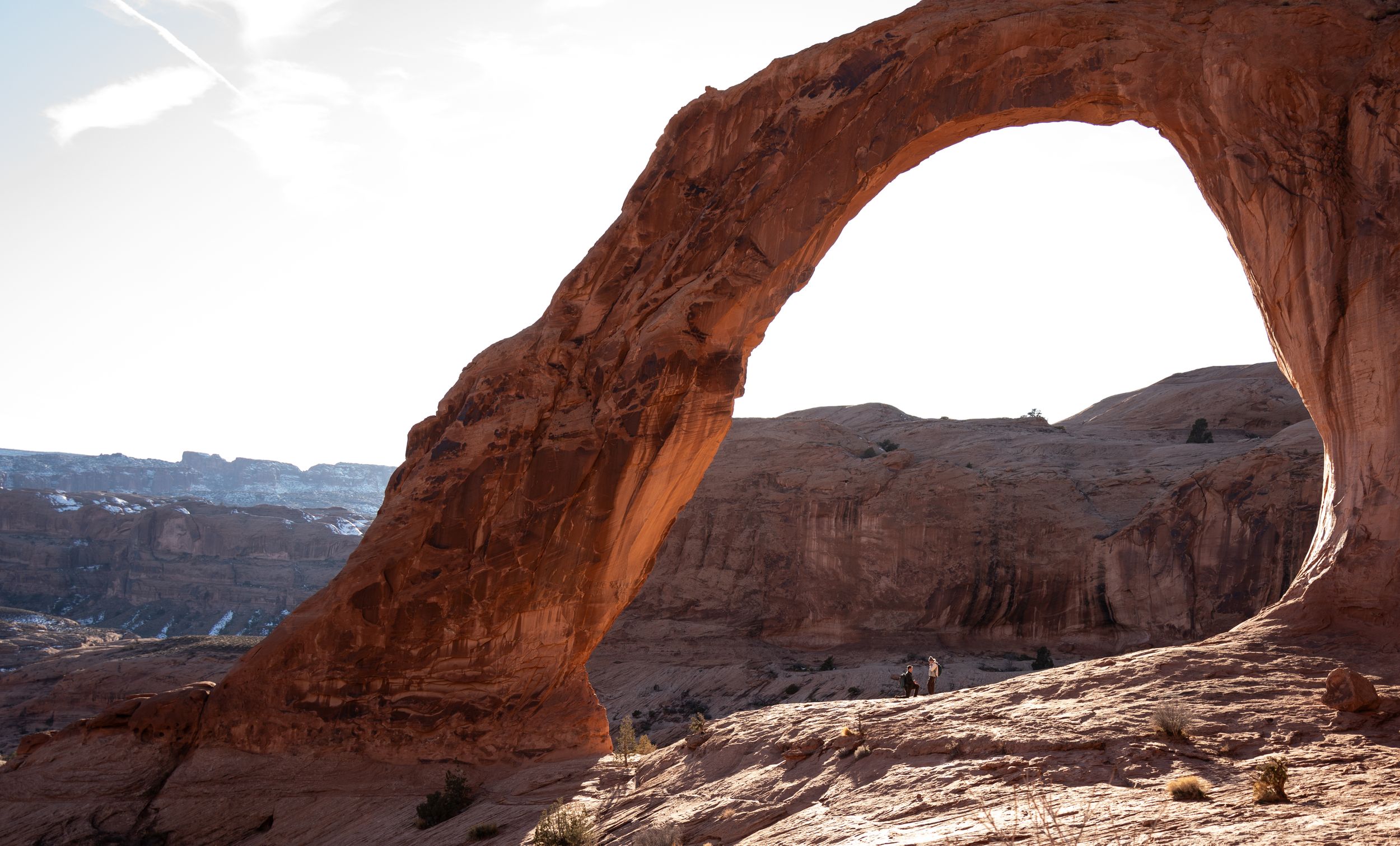
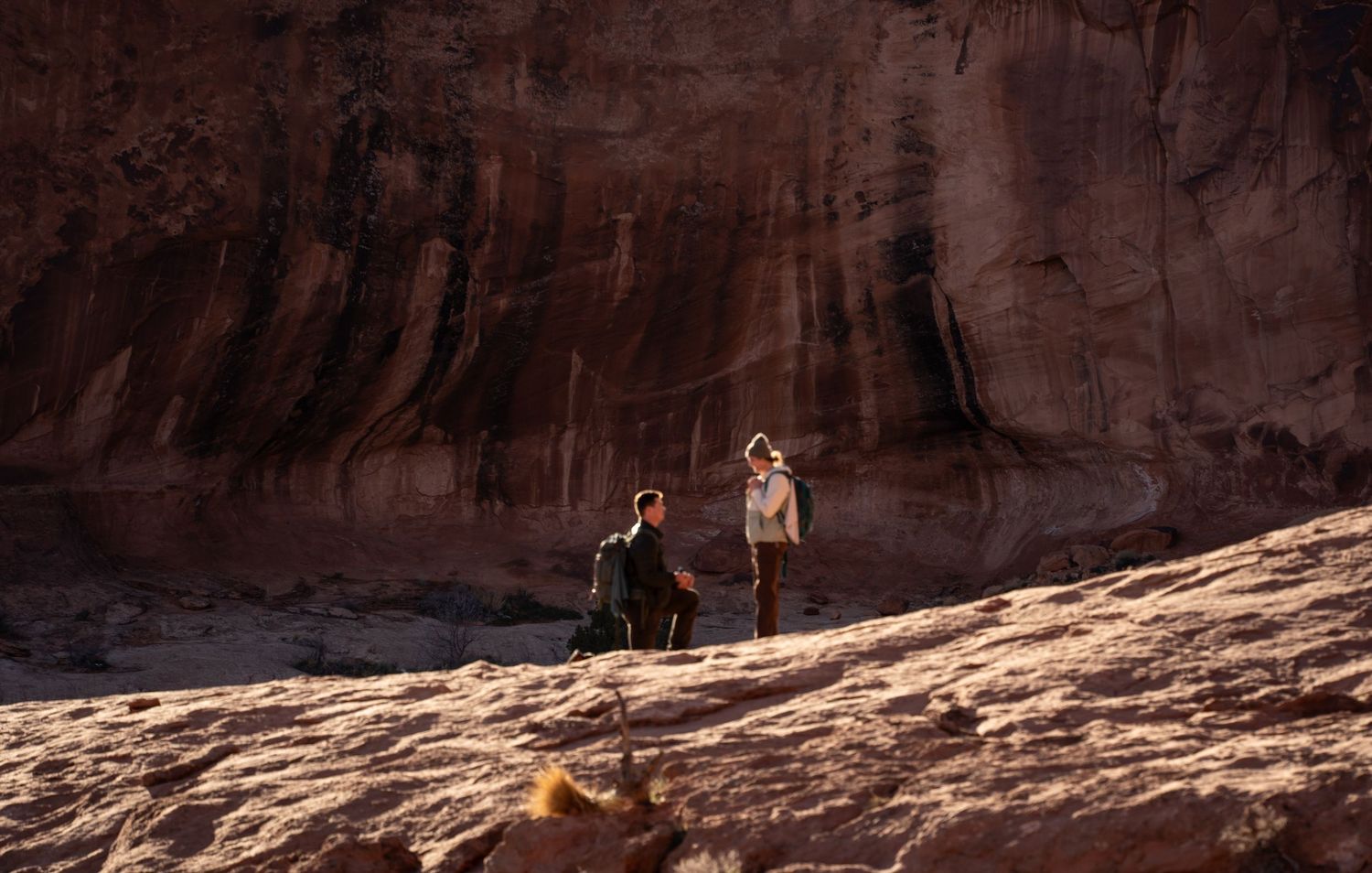
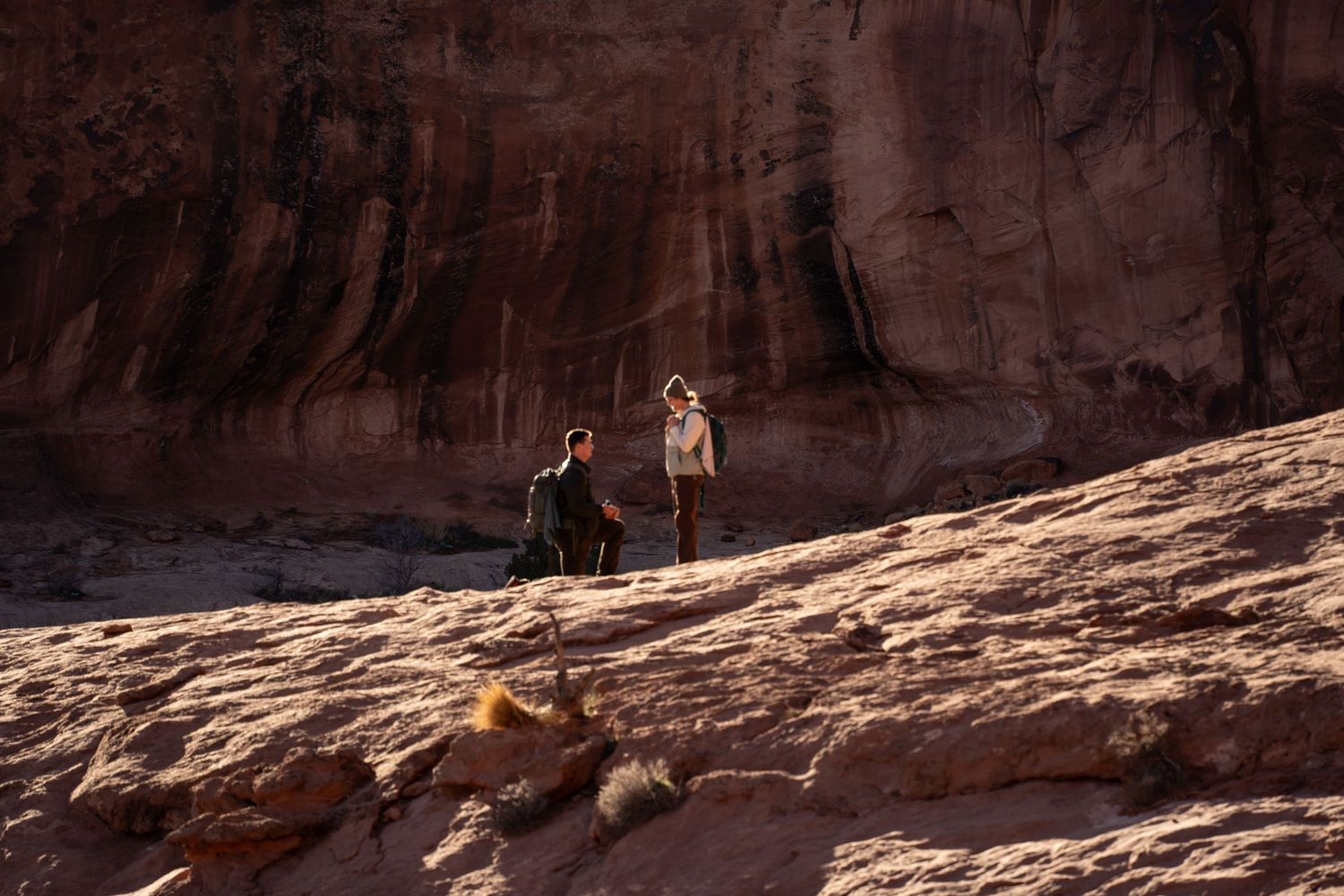
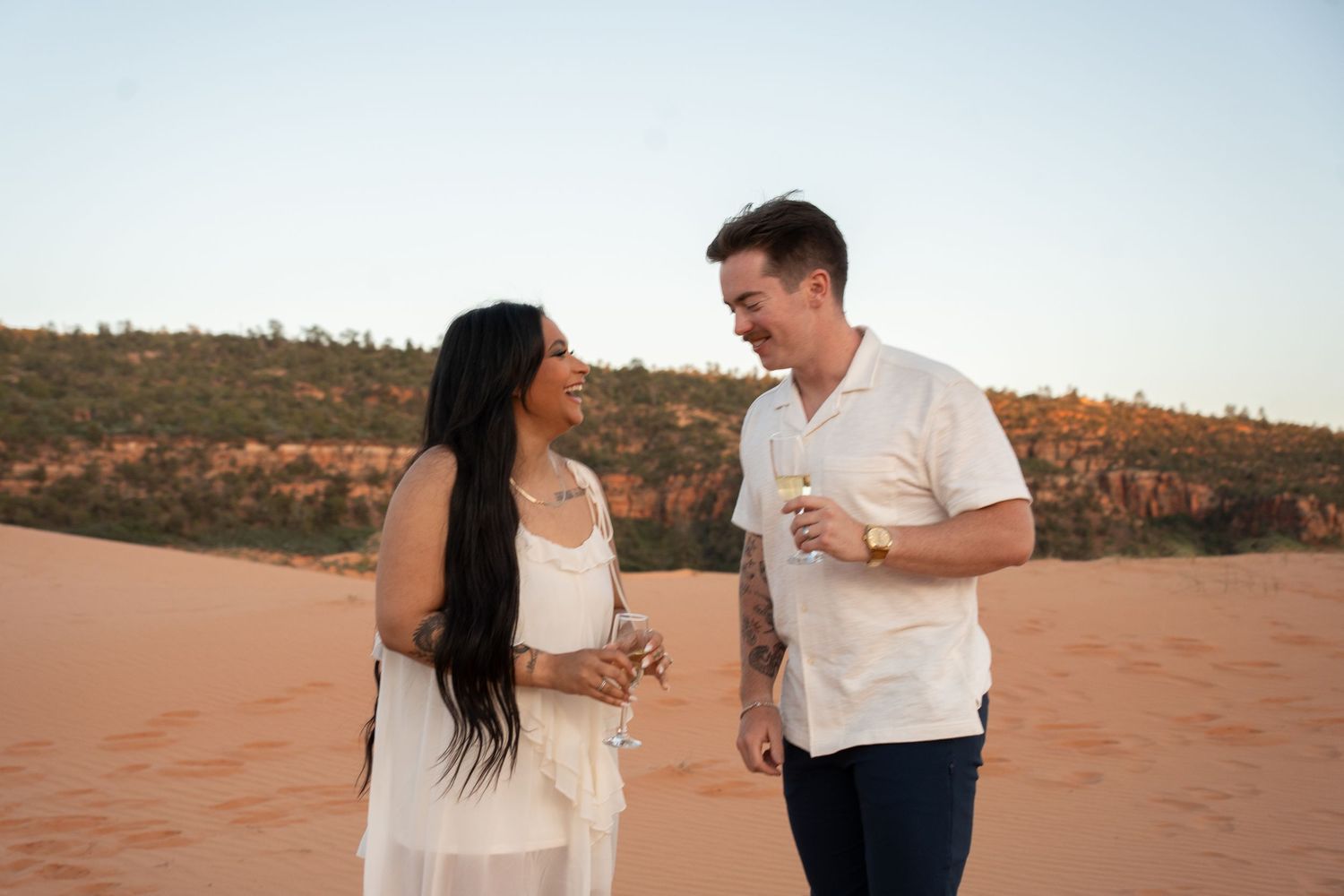
A quick, upfront note: I don’t have a documented Delicate Arch proposal to show you yet, so you won’t find a gallery of Delicate Arch proposal photos on this page. What you will find is photos from other sessions I’ve shot around Moab and Arches (Corona Arch, Double Arch, Canyonlands), each labeled for what it is rather than passed off as Delicate Arch.
TL;DR
Sunrise beats every other time of day at Delicate Arch, cutting out the crowd before you even hike.
By 6:30am, roughly 15 to 20 people are already at the arch. By 7:30am in summer, that can climb past 40 to 50. Sunset routinely draws hundreds.
Weekday mornings (Tuesday, Wednesday) beat weekends by a wide margin; skip Saturdays and holiday weekends entirely.
May, June, and July are the park's busiest months; November through March, especially January, are the quietest.
The arch sits inside a C-shaped rock bowl, which lets me stage you underneath it while I blend in at the far end, even with other people around.
Arches dropped its timed-entry reservation for 2026, so the only scheduling issue left is midday parking closures.
Corona Arch and Broken Arch are solid alternatives if privacy matters more than the license-plate view.
The Problem Isn’t Your Photos
Most “avoid the crowds at Delicate Arch” articles online are written for hikers, not couples. They’ll tell you which trail junction to skip or which parking lot fills up first. None of them are written for the specific worry a groom has: what if a stranger walks right into the moment itself, not just the photo.
Here’s the part that fixes that. Modern editing tools let a photographer select a person in a frame and remove them cleanly, background and all. If someone wanders into the corner of a shot mid-hike, that’s not a problem for your gallery.
What editing can’t touch is the feeling of the moment. You can’t retroactively make a proposal feel private after it happened in front of an audience. That’s the part timing and staging fix, and it’s the part the rest of this guide is built around.
Worth naming clearly: this page is deliberately narrow. It won’t walk you through permits, the full trail description, or every arch in the park, that ground is already covered in depth on the complete Arches proposal guide and the Moab proposal guide. What’s here is everything I know about the one variable that decides whether Delicate Arch feels crowded or feels like yours: when you go.
Why Sunrise Wins
Sunrise is the best window for a Delicate Arch proposal, and it’s not just about the light.
The Delicate Arch trail is a serious hike: 3 miles round trip with 480 feet of elevation gain, a steep, exposed climb across open slickrock with no shade, and a narrow ledge along the final stretch before the arch comes into view. The National Park Service is blunt about it: rangers frequently rescue people who underestimated the trail’s difficulty. Most visitors are not willing to do that hike in the dark before sunrise. That effort is doing your privacy work for you before you’ve even parked the car.
There’s a practical reason too. Arches regularly climbs into the upper 90s and past 100°F in the afternoon during the summer, and even outside peak summer, midday heat on that exposed rock is rough in nice clothes. Sunrise gives you cooler air, softer light, and a trail that hasn’t filled up yet.
One more detail worth knowing if you’re planning a summer trip: rangers will sometimes close the parking areas at Delicate Arch, the Windows, and Devils Garden for a few hours once they fill up, generally sometime between 8am and 4pm from May through October. Getting there before sunrise sidesteps that entirely.
There's also a version of this hike most first-time visitors don't know exists. If your priority shifts from "propose under the arch" to "get a photo of the arch without the hike or the crowd," the National Park Service maintains a Lower Viewpoint, a flat, 100-yard walk that views the arch from about a mile away, and an Upper Viewpoint, a half-mile walk with stairs for a closer, less obstructed angle. Neither replaces standing directly beneath the arch itself, and I wouldn't recommend either as the actual proposal spot, but they're worth knowing about as a fallback if conditions on a given morning make the full hike a bad idea for your group.
Hour by Hour: What Sunrise Really Looks Like
"Sunrise beats sunset" is true but vague. Here's the more useful version: what the crowd at Delicate Arch tends to look like at each stage of the morning, based on patterns reported consistently by hikers who've made this trip repeatedly.
Pre-dawn (roughly an hour before first light): The trail is close to empty. The handful of people making the climb this early are almost always couples on the same mission as you, or dedicated landscape photographers chasing the same soft light. This is the window with the best odds of having the bowl to yourselves, or close to it, for at least a few minutes.
Around 6:30am: Roughly 15 to 20 people are typically already gathered at the arch by this point on a normal morning, waiting for first light. Still a manageable number, and still well within what the bowl staging described further down this page can work around comfortably.
Around 7:30am, especially in summer: The crowd can climb past 40 to 50 people as the later-rising visitors catch up. This is roughly the point where "quiet morning" starts turning into "the version of Delicate Arch everyone complains about," so if the moment itself hasn't happened yet, this is your cue that the window is closing.
Mid-morning to midday: The crowd doesn't taper off after the early rush, it keeps building. This is also the window when the Wolfe Ranch parking lot is most likely to fill and trigger a temporary access closure during peak season, so a couple who missed the sunrise window and shows up at 11am isn't just facing a bigger crowd at the arch, they're facing a meaningful chance of not getting a parking spot at all.
Sunset, for comparison: Dozens of hikers are typically already in place by late afternoon, and by the time the sun sets, the crowd frequently swells into the hundreds. During the park's peak season, rangers are sometimes posted at the arch specifically to manage that congestion, which tells you plainly how large sunset crowds can get here.
The practical takeaway: if privacy is the priority, plan to be in position and ready before 6:30am, not after. A 15-to-20-person crowd is workable with the right staging. A 40-to-50-person crowd, and definitely a sunset crowd in the hundreds, is a fundamentally different environment to propose in.
How Sunrise Time Shifts Across the Year
"Sunrise" isn't a fixed number on the clock, and that trips up more couples than you'd expect. In the Moab area, sunrise swings from as early as roughly 5:50am in mid-June to nearly 7:45am in late fall, over an hour and a half of difference depending on your travel month.
That gap matters for two reasons. First, your wake-up and drive time changes a lot depending on season, a June trip means a punishingly early pre-dawn alarm if you want to be positioned ahead of the crowd, while a November trip lets you sleep in relative to the same "before sunrise" goal. Second, and more relevant to this guide's whole point, a later sunrise in fall and winter means the effort-averse crowd has an easier time catching a sunrise hike without the same pre-dawn commitment summer demands, which can chip away slightly at winter's privacy advantage on the clock, even as winter's overall lower visitor numbers still work strongly in your favor.
The practical fix is simple: don't plan around a generic "arrive at 6am" rule of thumb. Look up the specific sunrise time for your actual travel date, and plan to be in position at least 30 to 45 minutes before it, regardless of what month that lands in.
Skip Saturday at 10am
Once sunrise is locked in, the next lever is which day you go.
Weekends are the worst window at Delicate Arch, and Saturday around 10am is close to the worst single hour you could pick. That’s peak arrival time for day-trippers coming up from Moab after a leisurely breakfast, stacked on top of everyone who’s been up top since sunrise and hasn’t left yet.
A Tuesday morning at the same location looks completely different. Fewer people plan a weekday hike, so the trail and the bowl both thin out considerably. If your travel dates give you any flexibility at all, that’s the one schedule swap worth making.
Holidays work against you the same way weekends do, just worse. Labor Day, for example, is one of the single busiest days of the year in Moab, since it’s the day everyone else picked for the exact same long weekend getaway. Avoid the calendar’s biggest travel weekends if Delicate Arch is the plan, and note that even a slower season can spike hard around a specific holiday week, Christmas through New Year's is a good example of a period that draws a noticeable crowd bump even in the middle of the park's quieter months.
Season matters too, separate from day of the week. Going during the school year, rather than summer break, cuts out a meaningful slice of local and regional Utah traffic, since a lot of that crowd is families with school-age kids who can only travel in summer. International and cross-country tourist traffic stays fairly constant year-round, so you won’t eliminate every stranger by picking the off-season. But you will cut out a solid chunk of the crowd, and the next section breaks down which months do the most work.
Not sure which morning fits your trip?
Thinking through your travel dates and want a second opinion on which morning works best? Tell me your trip window and I’ll help you land on a day that isn’t fighting the crowds before we even talk about the proposal itself.
Arches draws around 1.5 million visits a year, and that traffic isn't spread evenly across the calendar. Knowing the shape of that curve is the difference between accidentally booking your trip into the park's single busiest stretch and landing on a week that quietly works in your favor.
May, June, July (busiest): This three-month stretch consistently runs the heaviest, with May typically edging out even June and July as the single busiest month of the year, often crossing well over 150,000 visitors in that month alone. If your travel dates are flexible and privacy matters more to you than guaranteed warm weather, this is the window to avoid if you can.
March, April, August, September, October (moderate, but not quiet): The rest of the traditional busy season, spring and fall shoulder months plus late summer. Crowds here are noticeable but generally more manageable than peak summer, and a sunrise weekday still does meaningful work during these months.
November through March (quietest): This is the park's slow season, and January in particular gets cited often as a strong month for a quiet, dramatic Delicate Arch photo, cold, but with a solid shot at having long stretches of the trail to yourselves outside of a holiday week. Winter conditions add their own planning wrinkle (icy sections on shaded parts of the trail, colder pre-dawn temperatures for a sunrise hike), worth weighing against the crowd reduction you're trading for.
Stack a quiet month on top of a weekday sunrise and you're combining three separate crowd reductions instead of one, by far the strongest timing combination available for this specific hike. None of it is a guarantee. Arches is popular enough, and international travel patterns steady enough, that some visitors will be on this trail no matter what week you pick. But the difference between a January Tuesday sunrise and a June Saturday sunset is, in practice, the difference between a handful of considerate strangers and a crowd you're competing with for space under the arch.
How I Stage You Inside the Bowl
Here’s the part almost nobody explains, because it’s specific to how Delicate Arch is shaped.
The area around the arch sits inside a rock bowl, roughly shaped like a big letter C, with the arch itself sitting up at the top of that C. The opening is sizable, about 46 feet high and 32 feet wide, the largest freestanding arch in the park, which gives a couple standing beneath it meaningful visual separation from anyone gathered at the entrance to the bowl. Most visitors who reach the top stay near that entrance and take their photos from there. The move I like is walking you the rest of the way around the C, so you end up standing directly underneath the arch itself, with your friend, or in this case, me, back at the far end of the bowl.
This isn’t a trick I invented. It’s how most people already photograph themselves at Delicate Arch: one person under the arch, another one back across the bowl with a camera. Because that’s the normal pattern everyone expects to see, people at the near end tend to stay put and give the couple under the arch some space, the same courtesy they’d want for their own photo.
That means even with other people around, you’re not proposing in the middle of a crowd. You’re proposing under the arch, with the crowd staying back at the far side of the bowl, the way visitors already do there for each other without being asked.
I also carry a longer lens specifically for this spot, so I don't need to stand close to get a tight, intimate frame of the two of you. Working from 50 feet or more away across the bowl means I never have to walk into the space between you and the arch to get the shot, which keeps the whole moment visually uncluttered even when the wider bowl behind me still has other visitors in it.
What I Do If the Bowl Is Still Crowded Despite Good Timing
Even with sunrise, a weekday, and a quiet month all stacked in your favor, there's no absolute guarantee the bowl will be empty when you arrive. If it's busier than expected, I have a short list of adjustments I'll work through with you on the spot: waiting 10 to 15 minutes to see if an early cluster clears out as people head back down, using the arch's own scale and the bowl's depth to frame you tighter so the background reads as open rock rather than a crowd, or, in a fully packed scenario, shifting the moment itself to a quieter pocket within the bowl instead of directly under the arch's center. None of these require abandoning the plan. They're the kind of on-the-spot judgment calls that come from having done this hike enough times to know the space, not just the schedule.
How Far Ahead to Plan This
There's no permit office and no application queue standing between you and a Delicate Arch date, so the calendar constraint here is almost entirely about coordinating my schedule with your travel window, not waiting on anyone's approval.
For a summer sunrise slot, especially a weekday one in the May-through-July stretch when the park runs busiest, book 6 to 8 weeks out if you can. That gives us time to talk through your exact date, confirm the sunrise time for that morning, and have a proper conversation about backup options if weather looks questionable as the date gets closer. A winter date, particularly a weekday in the quieter November-through-March window, usually still has room 2 to 4 weeks out, sometimes closer, though I'd still rather have more lead time than less if your travel dates are flexible at all.
One planning note specific to this location: because the whole point of this guide is picking a quiet window, locking in your date early also means locking in the sunrise time and crowd pattern for that date while there's still time to shift a day or two if something changes, a flight gets rescheduled, weather looks rough, you decide a different month fits better. The earlier we talk, the more room there is to adjust before it matters.
Once you’re staged, my job is to disappear into the scenery, not stand out as “the photographer.”
I set up across the bowl at the far end, in the spot people already expect to see someone with a camera. From there, I look like just another visitor photographing the arch, not someone photographing you specifically. That’s what lets me capture the moment instead of one you’re both aware is being staged for a camera.
You won’t be performing for an audience or for me. You’ll be having an unscripted conversation under the arch while I photograph it from a distance, the same way any stranger up there might catch it in the background of their own vacation photos.
Timing the walk into the bowl matters here too. If we arrive together and I set up in full view of you right as you're getting into position, it can feel staged even when nobody else notices. Instead, I'm usually already positioned and shooting casual, general shots of the arch and the sunrise before you even reach the top of the trail, so by the time you're walking into place, I already look like I've been there a while, just another early hiker who beat the crowd up.
A quiet signal helps too. Most couples and I work out a small cue in advance, a specific word, a hand on the shoulder, a certain place to stop walking, so you can tell your partner is about to propose without saying it out loud, and I know when to switch from casual shooting to shooting continuously.
Timing Mistakes Couples Make
Most of the ways this specific proposal goes sideways trace back to a handful of avoidable planning mistakes, almost all of them about timing rather than the location itself.
Treating "Sunrise" as a Single Fixed Time
Sunrise shifts by more than an hour across the calendar year, earlier in June, later in December. Couples who plan around a generic "6am" arrival without checking the actual sunrise time for their travel date sometimes show up too late for the quiet window, or too early and cold with nothing to do but wait. Check the specific sunrise time for your date before you set an alarm.
Assuming Any Weekday Works Equally
A Tuesday in June during a school break week, or a Wednesday that lands on a federal holiday, doesn't behave like an ordinary Tuesday or Wednesday. Cross-check your chosen weekday against the calendar for holidays and school break windows before assuming it's automatically quiet.
Assuming Winter Guarantees an Empty Trail
Winter thins the crowd considerably, but it doesn't erase it, and a holiday week like Christmas through New Year's can bring a noticeable bump even during the park's slowest months. Pair a quiet season with a quiet week, not just a quiet season alone.
Underestimating Pre-Dawn Trail Logistics
Hiking a steep, exposed, unlit trail in the dark takes longer and more caution than the same hike in daylight. Couples who cut their pre-dawn arrival time too close sometimes arrive right as the crowd is already building instead of ahead of it. Build in more buffer than feels necessary.
Not Telling Me About Family or Friends Joining the Reveal
If loved ones are hiking up separately to witness the moment, that changes how and where I stage the moment, and it's a detail I need well before the morning of, not as a surprise once we're all standing in the bowl together.
If You Want the Arch to Yourselves, There Are Better Options
Delicate Arch isn’t the only arch worth proposing at in this part of Utah, and it’s not even my favorite one for photos.
Corona Arch, out on BLM land off Potash Road near Moab, is a personal favorite: a massive freestanding arch that spans roughly 105 feet and stands around 140 feet tall, reached by a moderate desert hike with a couple of cable-assisted sections. Broken Arch, inside Arches itself, is an easy 1.2-mile round trip across open grassland to a quiet arch that barely anyone detours to see. Sand Dune Arch, also inside the park, is an even shorter walk tucked into a narrow sandstone corridor, small in scale compared to Delicate Arch, but reliably quiet even midday since most visitors skip it in favor of the bigger names.
The difference in one sentence: at Delicate Arch, you’ll be surprised to see nobody else there. At any of these three, you’ll be surprised to see anyone at all.
They’re also different hikes with a different feel, not just a quieter version of the same trail, so it’s worth telling me what kind of experience you’re picturing before you pick one. And if you still want Delicate Arch photos in your gallery without the proposal itself happening there, that’s an option too. I’m glad to photograph your actual moment somewhere private, then walk with you to Delicate Arch afterward for a second set of engagement photos once the pressure’s off.
For the full rundown of every arch in the park I send couples to, including why I usually steer people away from Delicate Arch as the actual proposal spot, my complete Arches proposal guide covers all of it. And if Moab logistics (permits, heat, timing) are still an open question for your trip, my Moab proposal guide walks through that separately.
Delicate Arch or a quieter arch?
Not sure whether Delicate Arch or a quieter arch fits your trip better? Tell me about your plans and I’ll help you pick the spot that matches what you two want, not just the one on the license plate.
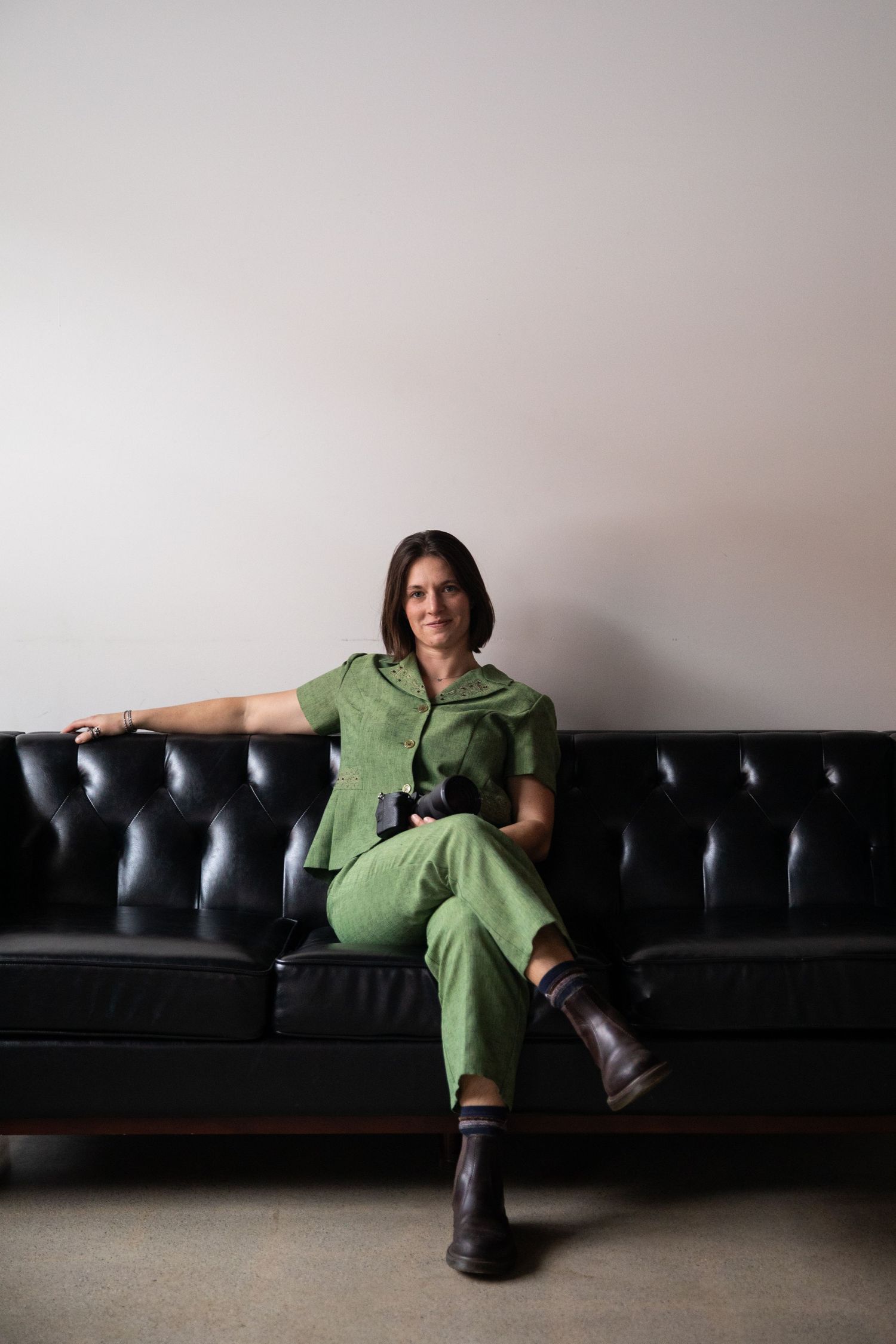
I'm Jade, a Utah-based proposal photographer, and I've scouted the Delicate Arch trail and bowl enough times, in enough light and enough crowd conditions, to plan around what you'll find there on a given morning. I haven't documented a proposal at this specific arch yet, and I'd rather tell you that plainly than pad this page with photos that weren't taken here. What I can offer instead is the timing knowledge: the hour the crowd tends to build, the months that quietly work in your favor, and the staging inside the bowl that keeps a shared trail from turning into a shared moment.
Proposal photography starts at $945, with travel added since Delicate Arch sits within the Moab area, outside the standard hour-of-Wasatch-Front radius. You'll have 40+ edited images and video within 24 hours, any stray hikers already cleaned out of the frame.
Frequently Asked Questions About Delicate Arch Proposal Timing
What’s the single best time to propose at Delicate Arch?
A sunrise hike on a weekday, ideally a Tuesday or Wednesday morning, outside of major holiday weekends and outside the May-through-July peak. That combination stacks three separate crowd reductions at once: the effort-averse crowd that won't hike before dawn, the weekend day-tripper crowd, and the highest-traffic months of the year.
How early do we need to arrive to beat the sunrise crowd?
Earlier than most couples expect. On a typical morning, roughly 15 to 20 people are already gathered at the arch by 6:30am, and that number can climb past 40 or 50 by 7:30am during summer. Arriving with enough buffer to be in position 30 to 45 minutes before first light gives you the thinnest version of the crowd this location ever sees.
Does the month we visit matter as much as the day of the week?
Close to it. Arches sees around 1.5 million visits a year, and May, June, and July consistently run the heaviest, with May typically the single busiest month. November through March is the quietest stretch, and January in particular is frequently cited as a strong month for photos with minimal crowds. A well-timed weekday sunrise in a slower month stacks two advantages instead of one.
Can you really edit other hikers out of my photos?
Yes. Removing a person from the background or edge of a frame is a standard part of editing modern proposal galleries, and it doesn’t affect the rest of the image. You’ll get 40+ edited images and video within 24 hours regardless, with any stray hikers already cleaned out. It’s just not a fix for the moment itself, which is why timing and staging matter more than most couples expect going in.
Do I need a permit to propose at Delicate Arch?
No. Permits at Arches apply to wedding ceremonies, not proposals or personal photography, so there’s no paperwork standing between you and booking a date. The one detail that surprises people: drones are banned park-wide in every national park, Arches included, so if aerial footage matters to you, that’s one more point in favor of a BLM spot like Corona Arch instead.
How hot does it get on the trail?
Arches regularly sees afternoon highs in the upper 90s to over 100°F during summer, and there’s no shade anywhere on the Delicate Arch trail. Bring at least 2 quarts of water per person since there’s no water source at the trailhead itself, and treat the heat as a scheduling factor, not just a comfort issue.
What if parking is full when we get there?
During peak season (roughly May through October), midday closures hit the park’s three biggest lots hardest: the Wolfe Ranch lot at the Delicate Arch trailhead (157 spaces), the Windows (92 spaces), and Devils Garden (160 spaces). Once one fills, rangers close the access road until it drains, generally sometime in the 8am-to-4pm window, and that can take several hours. Arriving before sunrise avoids this window entirely, which is one more reason sunrise beats every other time of day here.
Is Arches still requiring a timed-entry reservation to get in?
Not for 2026. The park announced in February 2026 that it’s dropping the timed-entry reservation system for the year, so you can drive in during standard hours with a regular entrance pass ($30 per vehicle, valid 7 days). That rule has changed before and could change again, so double-check nps.gov before you lock in your trip.
Is winter guaranteed to be empty?
Quieter, not empty. Delicate Arch is popular enough that even the slowest months still draw a steady trickle of visitors, and a holiday week (Christmas through New Year's, for example) can bring a noticeable bump even in an otherwise slow season. Treat winter as meaningfully better odds, not a guarantee, and still plan for a sunrise arrival if privacy is the priority.
What if we still end up with strangers nearby despite good timing?
That's what the bowl staging is for. Even a sunrise crowd of 15 to 20 people rarely clusters directly under the arch with you, since most visitors already default to the same pattern of one person under the arch and everyone else spread back across the bowl. Combined with the fact that stray hikers can always be edited out of the final gallery, a smaller crowd on a good morning is very workable, even if it isn't a fully empty trail.
Closing Thoughts
Delicate Arch is going to be crowded most of the time you could visit it. That’s just true, and no amount of planning erases it completely.
What sunrise, the right weekday, the right month, and the C-shaped bowl staging give you is a solid shot at privacy inside that crowd, not a promise of an empty park. If that’s not enough for the two of you and you’d rather skip the audience altogether, Corona Arch, Broken Arch, and Sand Dune Arch will get you there.
Either way, you don’t have to figure out the timing alone from another state.
Start Planning Your Moab Proposal
Tell me your travel dates and I’ll help you land on a morning that works, arch or no arch.
I respond within 24 hours, and we’ll plan the timing together.
Written by
Jade Jarvis
Utah-based wedding, elopement, and proposal photographer since 2025. I've scouted these locations myself, so the advice here comes from firsthand experience, not guesswork.