The short version: how to propose at Capitol Reef National Park starts with good news. A standard proposal here needs zero permits, since Capitol Reef only requires paperwork for an actual wedding ceremony. Add a historic pioneer orchard, some of the darkest night skies in the state, an entrance fee less than half of Zion's or Arches', and a fraction of the crowds you'd find at either, and you've got one of the quietest, most dramatic proposal spots in Utah.
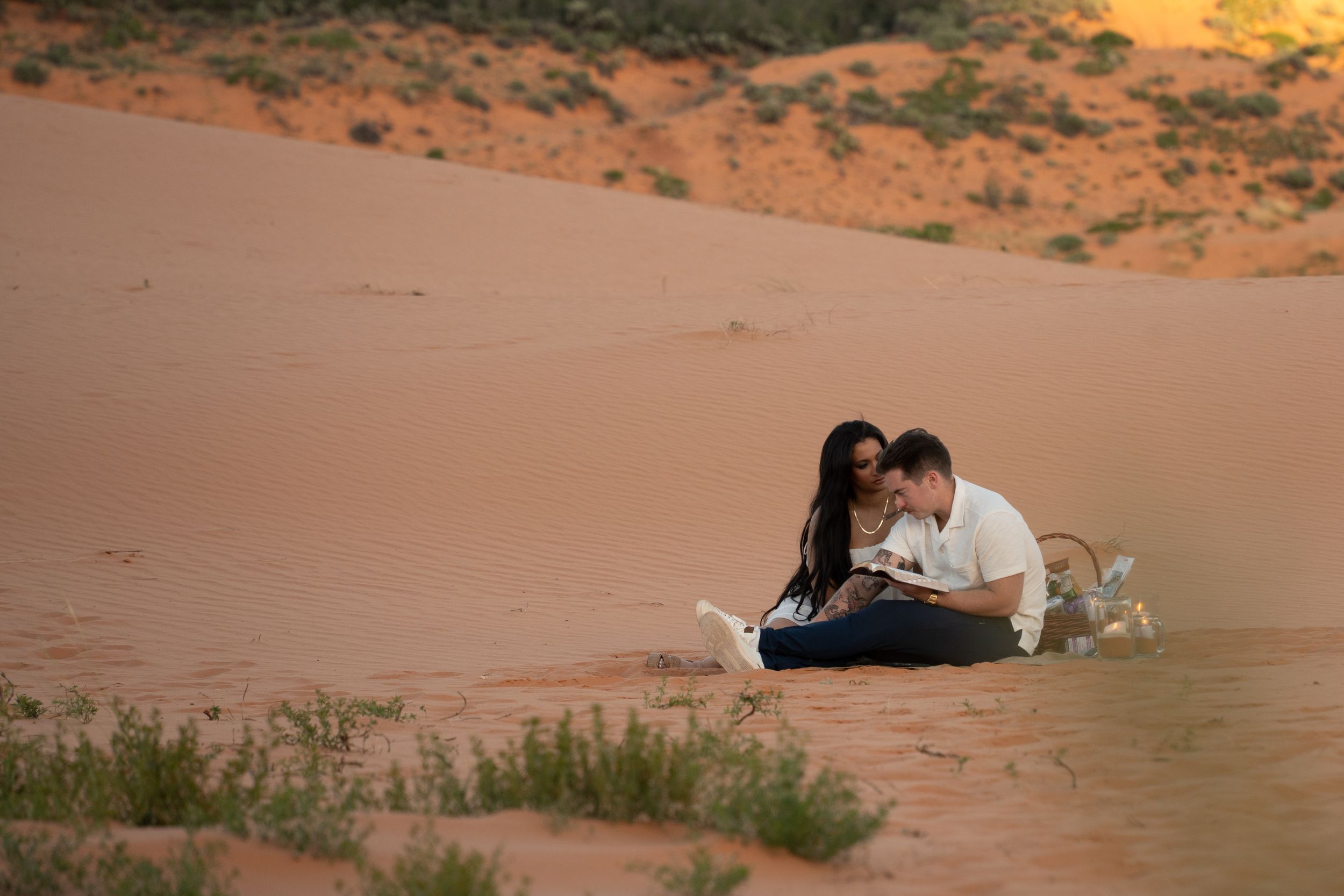
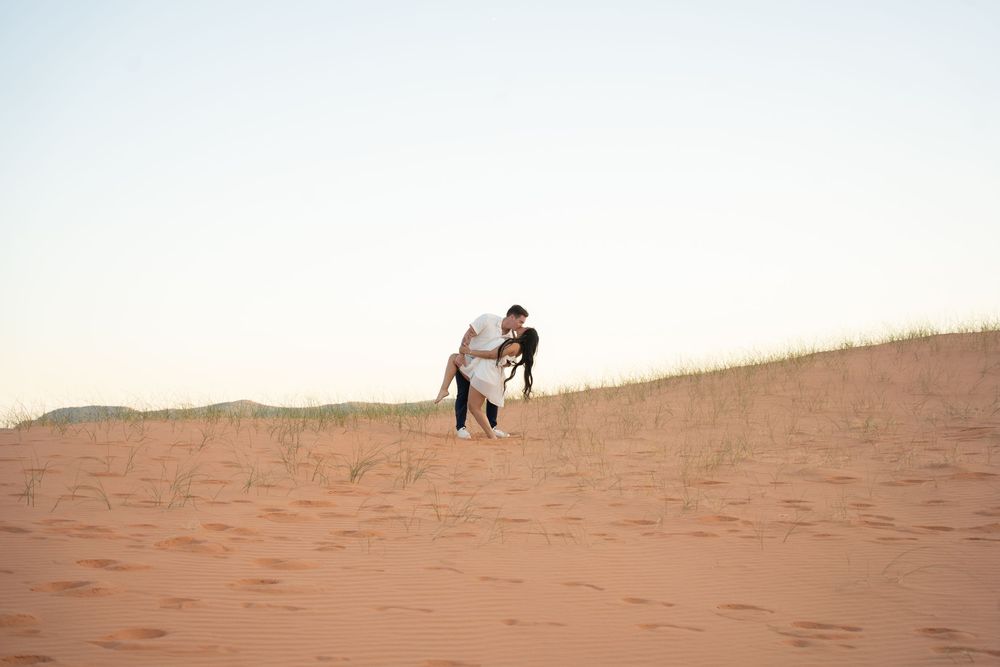
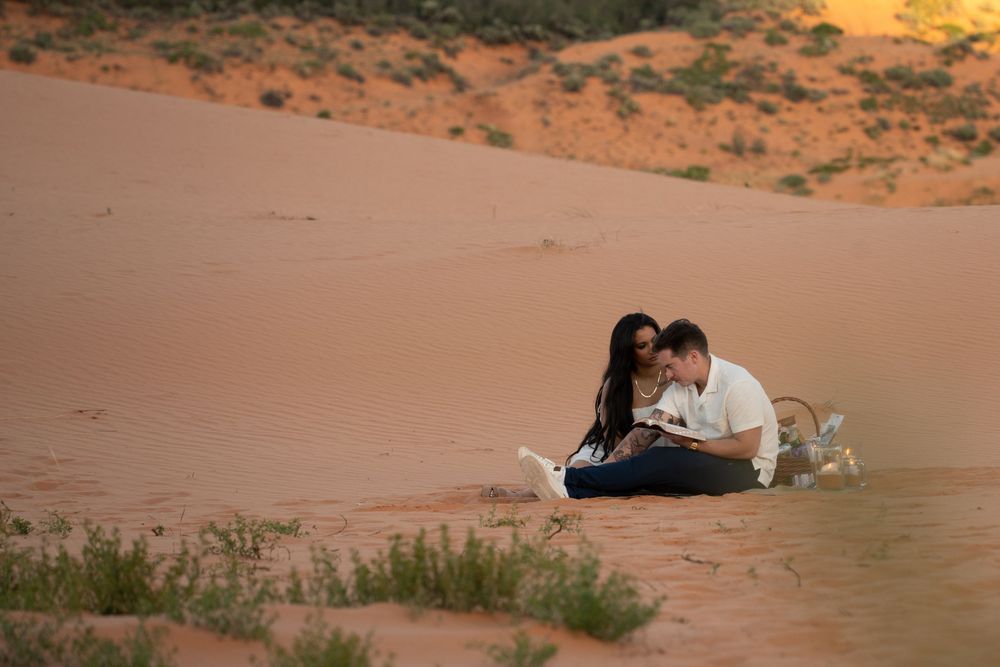
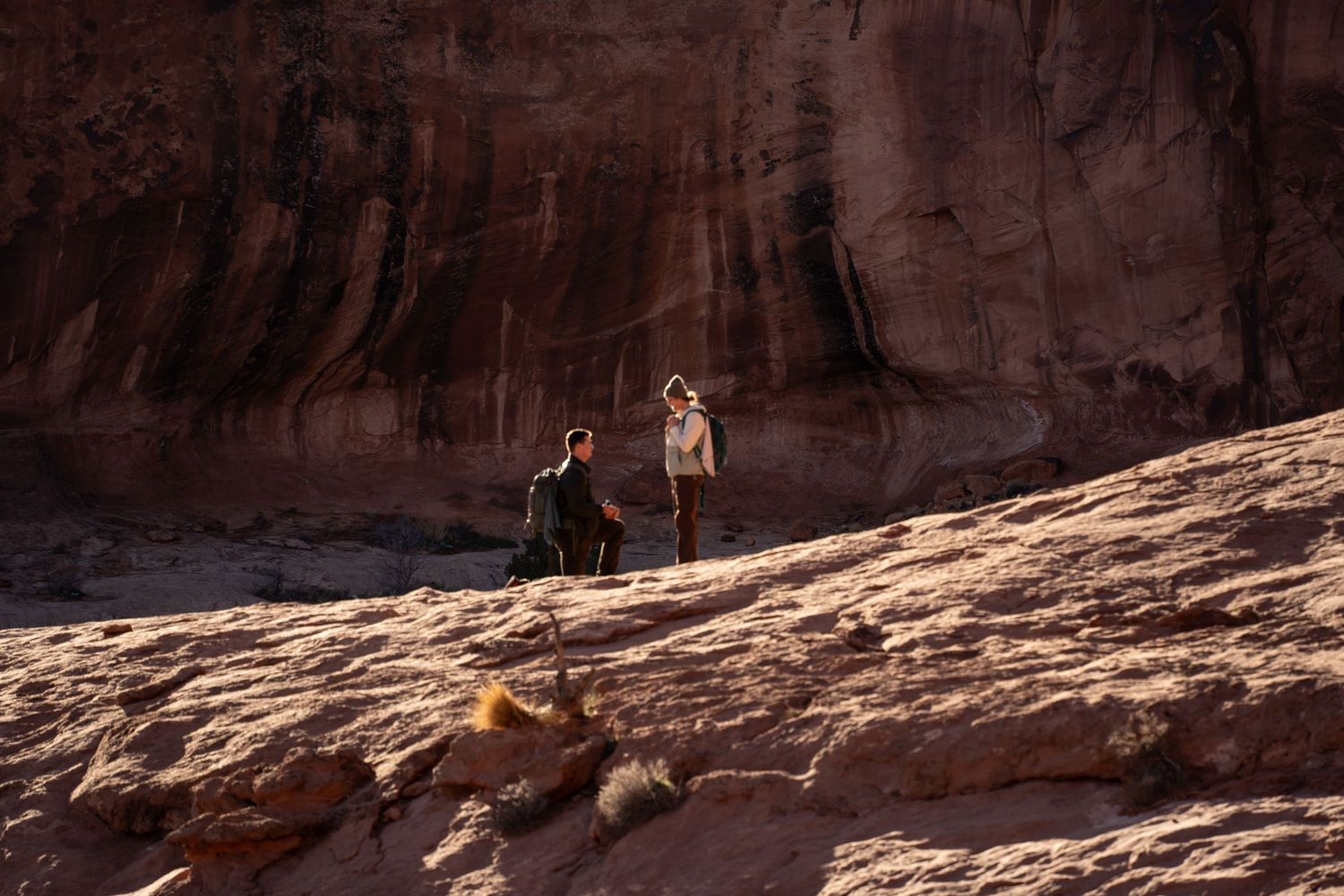
A quick, upfront note: I don't have a dedicated Capitol Reef proposal session to show you yet, so you won't find a gallery of Capitol Reef proposal photos on this page. What you will find is everything I've researched about permits, timing, fees, and eight distinct spots inside the park, useful whether you book me or someone else. The image above is from a Coral Pink Sand Dunes shoot near Kanab, a different southern Utah location with a similar red-desert look, labeled that way rather than passed off as Capitol Reef.
TL;DR
A standard proposal at Capitol Reef needs no permit at all. Only an actual wedding ceremony requires the park's $100 Special Use Permit.
Entrance costs $20/vehicle for 7 days, $15/motorcycle, or $10/person on foot or bike, well under Zion's or Arches' fee.
Eight spots covered here: Fruita Historic District, Panorama Point, Sunset Point & Goosenecks, Capitol Gorge, Cassidy Arch, Hickman Bridge, Chimney Rock, and Cathedral Valley's Temples of the Sun and Moon.
Drones are banned park-wide, and much of the ground is covered in fragile biological soil crust, so we'll stick to trail, wash, or slickrock.
Capitol Reef is a certified Gold-Tier International Dark Sky Park, one of the earliest in the National Park System.
The historic Fruita orchards run a pick-your-own fruit program roughly June through October.
Proposal photography starts at $845, with travel to Capitol Reef built into your quote, and you'll have your photos within 24 hours.
Why Capitol Reef Is Worth Proposing At
Capitol Reef solves a problem the more famous parks don't: it gives you the same scale of red-rock drama without the parking-lot version of it.
The park sits in south-central Utah, folded around the Waterpocket Fold, a 100-mile wrinkle in the earth's crust that gives Capitol Reef its name and its shape. It gets a fraction of the visitors Zion, Arches, or Bryce Canyon see in a given year, so trailhead parking rarely means circling for twenty minutes, and getting down on one knee rarely means doing it in front of a crowd. The entrance fee reflects that lower profile too: $20 a vehicle here, versus $35 at Zion or $30 at Arches, which is a small detail but not nothing when you're already covering flights, a rental car, and a hotel.
The Fruita Historic District is what sets this park apart from every other red-rock option on my list. Pioneer-planted fruit trees still grow along the Fremont River, alongside a working homestead, a one-room schoolhouse, and petroglyphs left by the Fremont culture centuries earlier. Getting down on one knee under a canopy of cherry or apple trees, sandstone cliffs rising behind you, is a backdrop you won't find anywhere else in this state, arch or no arch.
Propose here at dusk and the night doesn't just fade to dark, it turns into one of the clearest star fields in Utah. Add in eight strikingly different spots inside one park boundary, from a flat orchard stroll to a strenuous slickrock climb to a remote high-clearance drive into Cathedral Valley, and Capitol Reef gives you the same range of options Moab does, just with a smaller crowd standing between you and the moment.
Tell Me Your Travel Dates
Give me your dates and what you’re picturing, orchard or overlook, easy stroll or committed climb, and I’ll send back the spots that fit before you spend another weekend scrolling geotags.
The Challenge With Planning a Capitol Reef Proposal From Out of State
Here’s what stresses couples out about planning this from far away: you’re trying to make a once-in-a-lifetime decision about a park most people have never heard of, based on a handful of photos other people took in different light, at a different time of year, with no way to check yourself before you land.
Add up what that costs you. Hours trying to figure out whether Cassidy Arch or Chimney Rock is the “good one,” without knowing either trail is a demanding climb, not a stroll. More hours guessing whether the orchards will have fruit on the trees during your specific travel week, since harvest timing shifts every year with the weather. A nagging worry that you’ll drive the extra hour and a half into Cathedral Valley only to find the road impassable in a standard rental car. That’s easily a full weekend of research for a location most Utah proposal guides barely mention.
I’ve researched every spot on this page directly against primary sources, current entrance fees, exact trail distances and elevation gain, and the park’s own permit and photography rules, rather than repeating whatever a decade-old blog post says. When you tell me your travel dates and what you’re picturing, orchard backdrop, big overlook, serious hike, total isolation, I can tell you in one conversation which spot fits, and what to expect from the trail, the crowd, and the light.
You don’t need to become a Capitol Reef expert before your trip. You need one conversation with someone who’s already done that homework.
Best Spots to Propose at Capitol Reef National Park: 8 Options
Eight spots, eight different experiences, from a flat orchard walk to a remote high-clearance drive. Here’s the full depth on each one: distance, elevation gain, difficulty, and the plain tradeoffs, not just a highlight reel. None of these require a permit for a proposal, only an actual wedding ceremony does, so pick based on the setting and effort level you want, not the paperwork.
Fruita Historic District: The One I’d Send Most Couples To
If Capitol Reef has a signature proposal spot, this is it. The Fruita Historic District runs along the Fremont River near the visitor center: pioneer-planted orchards, a preserved homestead, a one-room schoolhouse, and Fremont-culture petroglyphs, all inside an easy, mostly flat walk. It’s the rare national park backdrop that photographs as intimate rather than epic, fruit trees and green grass against red sandstone cliffs, which is the look that sets Capitol Reef apart from every arch-and-overlook park on my list.
Timing matters more here than anywhere else in the park. The orchards run a pick-your-own program roughly June through October, with cherries first around mid-June, apricots by late June, then apples, pears, and peaches carrying the season into August, though exact dates shift year to year with the weather. If fruit on the trees is part of your vision, call the park’s fruit hotline at (435) 425-3791 as your date gets close to confirm what’s ready.
The district is also where most park services cluster: the visitor center, the campground, and the easiest parking in the park, which makes it the lowest-friction spot on this list logistically, even if it’s not the most dramatic.
Distance: Easy, mostly flat walking paths through the historic district.
Land & permit: National Park Service; $20 vehicle entrance fee; no permit for a proposal.
Best time: June through October if orchard fruit matters; the schoolhouse and homestead are worth seeing any season.
Photos on this page: None yet; I haven’t documented a proposal here, and I won’t pass off a stand-in as if it were taken here.
Panorama Point: Maximum View, Minimum Walking
Panorama Point lives up to its name outright: a sweeping overlook across the park’s red-and-white sandstone reachable from a short walk from the parking area, no significant hike required. It’s the pick if your partner wants the big Capitol Reef view without a climb, or if you’re working around a tight schedule between other stops.
Because it sits right off the Scenic Drive, it’s also one of the easiest spots on this page to combine with other stops in a single loop, Fruita in the morning, Panorama Point at midday, Capitol Gorge or Grand Wash in the afternoon.
Distance: Short walk from the parking area; effectively no hike.
Land & permit: National Park Service; $20 vehicle entrance fee; no permit for a proposal.
Best time: Any season; especially strong at sunset when the sandstone colors deepen.
Good for: A partner who doesn’t want a hike, or a tight timeline.
Sunset Point & Goosenecks Overlook: Compact and Private
Sunset Point and Goosenecks Overlook sit close together off the same short access road, and both give you a view-driven proposal spot without much company. Goosenecks looks down into a winding canyon carved by Sulphur Creek; Sunset Point, true to its name, is one of the park’s better sunset vantage points, close enough to Goosenecks that a couple can easily see both on the same short outing.
Neither spot draws the volume of visitors that Fruita or the Cassidy Arch trailhead does, which makes this pairing a strong pick if privacy matters more to you than a widely recognized landmark.
Distance: Short, easy walks from a shared parking area.
Land & permit: National Park Service; $20 vehicle entrance fee; no permit for a proposal.
Best time: Sunset, for the namesake light on the canyon.
Good for: Couples who want privacy without a serious hike.
Capitol Gorge: History Underfoot
Capitol Gorge is an easy, mostly flat 1-mile one-way walk into a narrow canyon, just 80 feet of elevation gain over the whole distance, which makes it one of the most approachable trails in the park for a couple who wants a full canyon experience without serious difficulty.
What makes it worth the trip isn’t just the canyon walls: pioneer travelers carved their names and dates into the rock along the route, some dating back over a century, a kind of unintentional guestbook that gives the hike a rare sense of history most red-rock trails don’t have. A short scramble off the main path leads to natural water-catching pockets the park calls “tanks,” a nice detour if your partner’s up for a few extra minutes of climbing.
Distance: 1.0 mile one-way, easy, 80 ft elevation gain.
Land & permit: National Park Service; $20 vehicle entrance fee; no permit for a proposal.
Notable feature: Pioneer-era names and dates carved into the canyon walls.
Good for: An easy hike with a rich sense of history built in.
Cassidy Arch: The Serious Climb With the Payoff Arch
If Corona Arch is the spot I send most couples to in Moab, Cassidy Arch is Capitol Reef’s answer to it: a steep climb that ends at a freestanding sandstone arch, named for outlaw Butch Cassidy, who reportedly used this rugged country to hide out.
The trail runs 1.7 miles one-way with 670 feet of elevation gain, rated strenuous by the National Park Service, climbing through a deep canyon and across open slickrock before reaching the arch itself. It’s a legitimate half-morning commitment, not a quick stop, and it’s the most physically demanding option on this list alongside Chimney Rock. The payoff: you can walk out onto the arch itself in places, a vantage point most arches in this state don’t offer.
I haven’t documented a proposal at Cassidy Arch yet. I know the trail from research and general trail-guide detail, not from a scouting trip of my own, so I’m upfront about that if this is the spot you’re set on.
Distance: 1.7 miles one-way, strenuous, 670 ft elevation gain.
Land & permit: National Park Service; $20 vehicle entrance fee; no permit for a proposal.
Best time: Morning, both for cooler temperatures and softer light on the arch.
Good for: An active couple who wants a proper hike and a payoff arch at the end of it.
Hickman Bridge: The Moderate Middle Ground
Hickman Bridge sits between Capitol Gorge’s easy stroll and Cassidy Arch’s serious climb: a 0.9-mile one-way trail with 400 feet of elevation gain, rated moderate, ending at a 133-foot natural stone bridge with canyon views the whole way up.
It’s one of the most popular hikes in the park for good reason, an approachable distance with an impressive payoff, which also means it draws more company than some of the quieter spots on this list. An early start beats both the heat and the crowd here, especially during the park’s busier spring and fall stretch.
Distance: 0.9 miles one-way, moderate, 400 ft elevation gain.
Land & permit: National Park Service; $20 vehicle entrance fee; no permit for a proposal.
Notable feature: A 133-foot natural stone bridge, one of the park’s most recognizable formations.
Best time: Early morning, both for light and for beating the crowd.
Chimney Rock Loop: The Park’s Own Sunset Recommendation
Chimney Rock Loop is Capitol Reef’s toughest named trail on this list: a 3.6-mile round-trip loop with 590 feet of elevation gain, rated strenuous, climbing to panoramic views across the Waterpocket Fold that the National Park Service itself recommends for sunset.
Because it’s a loop rather than an out-and-back, it also offers more varied scenery over its full distance than a straight climb-and-return trail, red-and-white banded cliffs, the chimney-shaped spire the trail is named for, and a wide sweep of the fold’s wrinkled terrain. This is the pick for a couple who wants the single most dramatic sunset view in the park and doesn’t mind earning it.
Distance: 3.6 miles round trip, strenuous, 590 ft elevation gain.
Land & permit: National Park Service; $20 vehicle entrance fee; no permit for a proposal.
Best time: Sunset, per the National Park Service’s own recommendation for this trail.
Good for: A couple who wants the most dramatic panoramic view in the park and is up for a strenuous climb.
Cathedral Valley & the Temples of the Sun and Moon: Total Isolation
If nothing else on this page feels remote enough, Cathedral Valley is the answer. Tucked in the park’s northern district, this is where you’ll find the Temples of the Sun and Moon, two towering sandstone monoliths rising alone out of an open desert valley, a landscape that looks more like Monument Valley than the canyon country closer to the visitor center.
Getting there is the tradeoff: a rough, high-clearance-vehicle-only loop road, roughly 1.5 hours each way from the visitor center, with no cell service and minimal facilities along the way. A standard rental sedan won’t make it. This is the spot for a couple who wants a private moment with almost zero chance of another visitor nearby, and who’s traveling with, or willing to rent, the right vehicle for it.
I haven’t documented a proposal at Cathedral Valley. Given the remoteness and the vehicle requirement, I’d plan this one with extra lead time to make sure logistics, mine and yours, line up before your date.
Distance: Roughly 1.5 hours each way from the visitor center via a rough loop road.
Vehicle: High-clearance required; not passable in a standard rental sedan.
Land & permit: National Park Service; $20 vehicle entrance fee; no permit for a proposal.
Good for: Total isolation and a landscape unlike anywhere else in the park.
Found Your Spot? Let’s Lock In the Timing
Once you know which of these eight fits you, the next call is timing: fruit season, sunrise or sunset, and whether your rental car can get there. I’ll help you work all three out.
Best Time of Year to Propose at Capitol Reef, Month by Month
Capitol Reef doesn’t have a hard wrong season the way Cedar Breaks does, there’s no road closure locking you out for half the year, but fruit timing, heat, and crowd levels still shift the experience a lot month to month.
January: Cold and quiet, with occasional snow dusting the red rock. The orchards are dormant and the campground empties out. If total privacy matters more than comfort, this is one of the emptiest stretches of the year here.
February: Similar to January, still cold, still quiet, with days slowly lengthening. A solid month for a couple who wants the park closer to themselves and doesn’t mind bundling up.
March: Temperatures start climbing and the park enters its busiest stretch, per the National Park Service’s own visitor data, which runs March through June. Trailhead parking for popular hikes can fill by 9 or 10am, so an early start matters more starting this month.
April: One of the most comfortable hiking months, mild days, cool nights, and still within the park’s busy season. Cassidy Arch and Hickman Bridge draw noticeable crowds midday; sunrise or the last two hours before sunset both work better.
May: Warm and still comfortable for most of the day, with heat starting to build by the end of the month. Cherry blossoms and early orchard growth are visible in Fruita, though fruit itself isn’t ready yet. Still inside the park’s official busy season.
June: The start of harvest season. Cherries ripen first, generally around mid-June, and afternoon heat starts pushing hikers toward morning starts. The busy season technically runs through this month, though crowds thin slightly compared to April.
July: Peak summer heat, and apricots typically ripen by late June into July, with apples, pears, and peaches following through August. This is a sunrise-or-dusk month for any hike with meaningful elevation gain, Cassidy Arch and Chimney Rock especially.
August: Still hot, with orchard harvest in full swing across multiple fruit varieties. Afternoon monsoon storms become more common here as in the rest of southern Utah, which can make for dramatic sky photos over the Waterpocket Fold if timed safely.
September: Temperatures ease and the park enters its second busy stretch, September through October, though still noticeably calmer than spring. Late-season orchard fruit and cooling temperatures make this one of the better all-around months.
October: Comfortable temperatures, the tail end of harvest season, and still inside the park’s busier fall window. One of the most balanced months on the calendar here: good light, good weather, manageable crowds.
November: Crowds drop off fast after the busy season ends, and temperatures cool toward winter. A quiet month for a couple who wants the orchards and canyons without much company, even though the trees themselves are done for the season.
December: Cold and quiet, similar to January, with the darkest, clearest skies of the year for a dusk or after-dark proposal under Capitol Reef’s Dark Sky Park certification.
How to Plan Your Capitol Reef Proposal: My 3-Step Process
Capitol Reef has its own quirks: fragile soil crust, a permit rule that only applies to weddings, orchard timing that shifts every year, and a remote district that needs the right vehicle. None of it has to slow your plans down.
Step 1
Share Your Dates and Vision
Tell me your travel dates and what you’re picturing, orchard backdrop, big overlook, true climb, total isolation. I’ll help you decide between Torrey and Hanksville as a home base, confirm whether the orchards will be in fruit, and flag it early if your dates land inside the park’s busiest stretch.
Step 2
We Pick the Spot and Protect the Ground
No permit office, no approval email to wait on for a proposal. We pick a spot together based on effort level and setting, then stick to trail, wash, or slickrock so the biological soil crust stays undisturbed. Keeping the moment a surprise is its own piece of the plan, covered in the FAQ below.
Step 3
If a Ceremony Is in Your Future Too
Plenty of couples come back to marry at the same park where they got engaged. That’s a separate $100 permit process from a proposal, covered in full in the Permits & Legal Requirements section below, so you know what changes if and when that day comes.
What to Expect on Proposal Day
Here’s the full timeline of a Capitol Reef proposal day, start to finish, so nothing on the actual day catches you off guard.
HOUR −1
Already in Position
I’m on site before you leave your hotel, set up somewhere with a clean sightline to your spot, camera ready, blending into the scenery like any other hiker or photographer working the park. If the plan calls for a specific angle at Cassidy Arch or a bench in the Fruita orchards, I’ve already found it and I’m waiting there.
ARRIVAL
You Show Up, Cover Story Intact
You walk up just like you would on any other hike or scenic stop, whatever cover story we built together. I stay far enough back that your partner has zero reason to suspect a photographer nearby is there for you specifically.
THE MOMENT
Down on One Knee
This is the only part I can’t script, and it shouldn’t be scripted. I shoot continuously through the moment with a longer lens from a distance, so I capture the actual reaction, not a recreated one. Once you’re both up and celebrating, I move in closer for the ring shots and the two of you together.
AFTER
Celebration Photos, Same Session
Once the shock wears off, we shoot celebratory portraits: the ring, the two of you against the view you just got engaged in front of, or the orchard behind you if that’s where we are. Whatever you want to do next, I’m still rolling.
Getting to Capitol Reef, Where to Stay & Eat, and What to Budget
Getting There
Capitol Reef has no commercial airport nearby, so nearly every out-of-state couple drives in. From I-70 westbound, exit 149 puts you about 81 miles out via Utah Route 24. From I-70 eastbound, exit 40 is roughly 74 miles away via a combination of SR-120, SR-118, SR-119, and SR-24. Coming up from the south on I-15, exit 95 northbound is about 131 miles via SR-20, US-89, SR-62, and SR-24, while exit 188 southbound runs about 103 miles via US-50 and SR-24. If you’re coming from Bryce Canyon, Highway 12 covers the roughly 123-mile route in about 3 hours, though it can turn hazardous in winter weather.
Build in buffer time regardless of your route. This isn’t a park you fly into and propose at that same afternoon; plan at least one full night nearby before your proposal day so you’re not road-weary for the moment itself.
Where to Stay
Torrey, right at the park’s west entrance on Highway 24 and roughly 10 miles from the visitor center, is the more convenient base: more restaurants, more lodging options, and the shortest drive into the park for Fruita, Panorama Point, or any of the main trails. Hanksville sits well east of the park along the same highway, a quieter, far smaller town with fewer services, better suited to a couple who wants maximum seclusion and doesn’t mind a longer drive or a more limited dinner selection.
If you want to stay inside the park itself, Fruita Campground sits right in the historic district, though it’s often fully booked from mid-March through the end of October, so reserve early if you want that option during the busier months.
Where to Eat
Torrey has grown a small but thriving food scene for a town its size, with a handful of sit-down restaurants that lean into local, seasonal ingredients, a nice pairing with a day spent around Capitol Reef’s own orchards. Hanksville’s options are more limited, mostly casual, roadside-stop fare, which is part of the tradeoff for its quieter setting. If a celebration dinner is part of your plan right after the proposal, book ahead in Torrey during peak season, small-town restaurants fill up fast on a Friday or Saturday night.
Budget Considerations
Beyond the photography itself, plan for: the park entrance fee ($20/vehicle for 7 days, covering everyone with you, or the park’s own $35 annual pass if you expect to return); lodging, which swings by season and by whether you pick Torrey or Hanksville; gas for the drive in, which is substantial from any direction; and a celebration meal afterward if you’re building that into the day. None of the park’s trails or overlooks add any fee beyond the entrance pass. Your biggest actual line item beyond the trip itself is the photography, and that’s the one piece I can give you an exact number on before you book anything.
Your Trip Window Is the Only Deadline That Matters Here
No permit office, no application to wait on, for a standard proposal anywhere in the park. The only limiting factor is my calendar, especially during the park’s March-through-June and September-through-October busy stretch. Reach out as soon as your dates are set.
Sturdy footwear. If Cassidy Arch, Chimney Rock, or Capitol Gorge is part of your plan, a sturdy shoe beats a heel or a flat sandal on uneven sandstone every time.
Layers. High desert temperatures swing more than the daytime high suggests, especially if you’re proposing at sunrise, at dusk, or under the stars.
Cash or a card for the orchard stand. The Fruita fruit stand is self-pay, scales and price list included, so bring a way to pay if your timing lines up with harvest.
Water and sun protection. Most of the park’s trails and overlooks have little to no shade, and Cassidy Arch or Chimney Rock in particular will take more water than you think.
The right vehicle, if Cathedral Valley is your spot. A standard rental sedan won’t make the loop road; confirm your vehicle can handle it before you build your day around it.
Nothing that gets left behind. Skip confetti and rice entirely. Whatever you bring for the moment leaves with you.
Which Capitol Reef Proposal Spot Fits You?
Eight options is a lot to compare from your couch. Here’s the short version: match your priority in the left column to the spot that delivers it.
If you want…
Best spot
Effort
Fee/Permit
An intimate orchard backdrop, easy walking
Fruita Historic District
Easy
$20 entrance
A big view with almost no hike
Panorama Point
Minimal
$20 entrance
A private canyon overlook, sunset light
Sunset Point & Goosenecks
Easy
$20 entrance
An easy hike with layered history built in
Capitol Gorge
Easy, 1.0 mi
$20 entrance
A steep climb and a payoff arch
Cassidy Arch
Strenuous, 1.7 mi
$20 entrance
A moderate hike to a natural stone bridge
Hickman Bridge
Moderate, 0.9 mi
$20 entrance
The single best sunset view in the park
Chimney Rock Loop
Strenuous, 3.6 mi
$20 entrance
Total isolation, a landscape unlike anywhere else
Cathedral Valley
High-clearance drive
$20 entrance
Still not sure? A few patterns worth knowing: the couple who wants a photo that looks unmistakably like Capitol Reef, not interchangeable with Arches or Zion, usually lands on Fruita or Cassidy Arch. The couple traveling with limited time or an injury goes for Panorama Point or Sunset Point. The couple chasing meaningful privacy over convenience, even if it means an extra hour and a half of driving and the right vehicle, ends up in Cathedral Valley. And more couples than you’d expect choose Capitol Gorge specifically for the pioneer inscriptions, a detail almost nobody else’s Pinterest board has.
Permits & Legal Requirements for a Capitol Reef Proposal
Here’s the section most guides bury in fine print halfway down the page. I’m putting it up front and making it simple. The short version: nothing on this page requires a permit for a proposal. Permits only enter the picture for a formal wedding ceremony.
Good news for anyone proposing (not marrying) at Capitol Reef: a standard proposal, no officiant, no ceremony, just the two of you and a ring, doesn’t require any special permit. That requirement only kicks in for an actual wedding ceremony inside the park, which trips up more couples than you’d think.
If you already know you’ll want to come back and marry here, Capitol Reef’s ceremony permit runs $100 and has to be secured with the park’s commercial services office at least 7 days before your date, though you can apply as far out as a year in advance. Ceremonies are capped at roughly 20 minutes, and the park enforces strict Leave No Trace rules: no confetti, flowers, or decorations left behind, and music has to stay non-amplified. Photography outside the ceremony itself doesn’t need that same permit, which is useful to know either way.
Two rules apply no matter what you’re planning. Drones are banned across every unit of the National Park System, Capitol Reef included, so an aerial shot isn’t on the table here. And since much of the park’s ground is covered in biological soil crust, a living layer that takes decades to recover if it’s trampled, we’ll keep any off-trail shots to wash bottoms or slickrock instead.
Entrance itself is a separate cost from any permit: $20 per vehicle for 7 days, $15 for a motorcycle, or $10 per person on foot or bike for anyone 16 or older. If Capitol Reef is the only park on your Utah itinerary this year, the park’s own $35 annual pass beats the $80 America the Beautiful pass on price; if Arches, Canyonlands, or Zion are also on your list, the broader pass covers all of them and pays for itself fast.
If a ceremony is on your future calendar, a Utah marriage license comes from any county clerk in the state, with no waiting period, so where you pick it up doesn’t have to match where you say your vows.
Why Book Someone Who Already Knows Capitol Reef
No permit office to wait on. A standard proposal needs zero paperwork, so your booking timeline runs on my calendar and your travel dates, not a government turnaround time.
Primary-source research, not a recycled blog post. Every fee, trail distance, and elevation figure on this page comes directly from the National Park Service, not a guess or a years-old number that’s since changed.
A cover story, built together. I help you construct a reason to be at the right spot at the right time that your partner will believe, then I disappear into the trail until you’re ready.
Upfront about what I have and haven’t shot. I’ll tell you plainly which spots I’ve documented and which I haven’t, rather than passing off a stand-in image as something it isn’t.
One quote, no surprises. Travel to Capitol Reef is factored into your number upfront, on a planning call before you book anything, not added as a surprise line item afterward.
Capitol Reef Proposal Photos
I don’t yet have a dedicated Capitol Reef proposal session to show you. The image on this page is from a Coral Pink Sand Dunes shoot near Kanab, a different southern Utah location with a similar red-desert look, and it’s labeled that way rather than presented as Capitol Reef. If a quiet, dramatic desert proposal in this style is what you’re picturing, that’s what I can plan for you here.
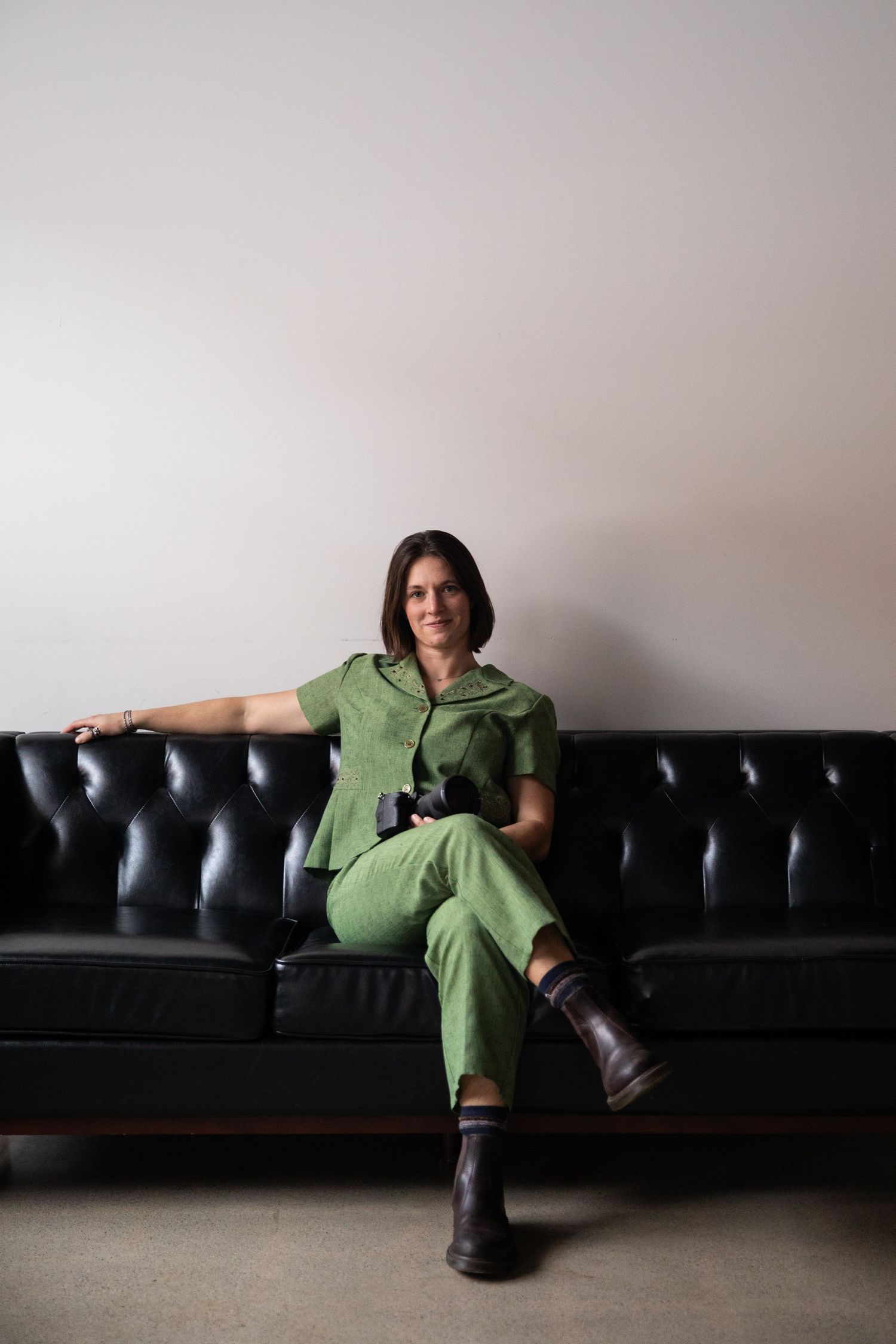
I’m Jade, a Utah-based proposal photographer, and Capitol Reef is one of the quietest parks on my list to shoot. I haven’t documented a proposal here yet, so instead of a gallery, this page is built from research pulled directly from the National Park Service: current fees, exact trail distances and elevation gain for all eight spots, permit rules, and the details that change your plans, like fruit-season timing and the vehicle you’ll need for Cathedral Valley.
Proposal photography starts at $845, with travel added since Capitol Reef sits well outside the standard hour-of-Wasatch-Front radius. You’ll have 40+ edited images and video within 24 hours. Tell me what you’re picturing and we’ll work it into your quote.
Ready to Plan Your Capitol Reef Proposal?
Tell me your travel dates and what you’re picturing, and I’ll send back the exact spot, whether Torrey or Hanksville fits your trip better, and a plan that keeps her in the dark until you’re already on one knee.
Frequently Asked Questions About Capitol Reef Proposals
Do you need a permit to propose at Capitol Reef National Park?
No. That requirement is only for an actual wedding ceremony inside the park, not a standard proposal. It works the same way for photography: hiring me to photograph your proposal doesn’t trigger any extra paperwork either, since we’re not holding a ceremony or reserving a site.
Do we need a special photography permit if we hire a professional photographer?
Not for a proposal. The National Park Service only requires a separate still-photography permit when a shoot happens somewhere the public can’t normally access, uses a “model” posing to promote a product or service, or needs added monitoring from park staff. Wedding and proposal photography are explicitly carved out of that “model” definition, so hiring me doesn’t trigger it on its own.
What's the entrance fee at Capitol Reef, and is there an annual pass just for this park?
$20 per vehicle, valid 7 days and covering everyone inside, $15 for a motorcycle, or $10 per person on foot or bike for anyone 16 or older. If you know you’re coming back, Capitol Reef sells its own $35 annual pass, cheaper than the $80 America the Beautiful pass if this is the only park on your list this year. If Arches or Canyonlands are also on your itinerary, the America the Beautiful pass covers all three and pays for itself fast.
Which Capitol Reef trail is the right call if my partner isn't an experienced hiker?
Capitol Gorge and Grand Wash are both easy, mostly flat walks through a canyon floor, 80 and 200 feet of elevation gain respectively, so neither should intimidate someone who doesn’t hike regularly. Save Cassidy Arch (670 feet of gain over a 1.7-mile climb) and Chimney Rock (590 feet over a 3.6-mile loop) for a couple who’s already comfortable on a proper trail.
How much does it cost to hire a proposal photographer for Capitol Reef?
Utah proposal photography starts at $845 for a proposal within about an hour of the Wasatch Front, and Capitol Reef is well outside that range, so travel is built into your quote. That’s separate from the park’s own ceremony permit fee, which only applies if you’re planning an actual wedding rather than a proposal. I’ll work out your exact photography number with you on the planning call before you book anything.
How much does a wedding ceremony permit cost at Capitol Reef, in case we want to marry here later?
That $100 permit goes through the park’s commercial services office and needs to be submitted at least 7 days ahead, though I’d treat that as a floor rather than a plan since anything more complex takes longer to process. It’s separate from another detail worth knowing about timing: Capitol Reef’s historic Fruita orchards run a pick-your-own program roughly June through October, where you can pick and pay by the pound at a self-serve station right in the historic district, worth building into your day whether or not you’re the one getting married here.
Is Capitol Reef a good place to propose?
Yes, and the dark sky claim isn’t just marketing. Capitol Reef is a certified Gold-Tier International Dark Sky Park, one of the earliest national parks to earn that status back in 2015, so a proposal timed for dusk can end with a sky full of stars over the canyon walls, not just a nice sunset.
Can you keep a Capitol Reef proposal a surprise?
Yes, the same approach I use everywhere else. I scout the location ahead of time, blend in like just another hiker or photographer, and shoot from a distance so she has no idea until you’re already down on one knee.
Where's the nearest place to stay for a Capitol Reef proposal?
Torrey, right at the park’s west entrance on Highway 24, is the more convenient option (roughly 10 miles from the visitor center) with more restaurants and lodging choices. Hanksville sits well east of the park along the same highway and runs quieter, with far fewer services, so it fits a couple who wants minimal distraction more than short drive times. Both work; it depends on whether convenience (Torrey) or seclusion (Hanksville) matters more to your trip.
Can we visit Cathedral Valley and the main part of the park in one trip?
Not comfortably in a single day if you also want time at Fruita or the main trails. Cathedral Valley sits in a remote district reached by a rough, high-clearance-vehicle-only loop road, roughly 1.5 hours each way from the visitor center, so most couples treat it as its own dedicated half-day rather than an add-on to a Fruita or Capitol Gorge morning.
Is Capitol Reef crowded?
Less than you’d expect for a national park with this much scenery, but not empty either. The National Park Service marks March through June and September through October as the busiest stretch, when trailhead parking for popular hikes like Cassidy Arch and Hickman Bridge can fill by 9 or 10am. An early start beats both the crowd and the harsh midday desert light.
How fast will we get our Capitol Reef proposal photos?
Within 24 hours. You’ll have 40+ edited images and video of the moment the very next day.
Written by
Jade Jarvis
Utah-based wedding, elopement, and proposal photographer since 2025. I've researched Capitol Reef's permit rules, fees, and every trail on this page directly against primary sources, so the advice here comes from actual planning, not guesswork.